
The short answer: Your air conditioner pulls gallons of moisture out of Chandler air every day it runs, and all of that water has to leave through a narrow condensate drain line. When that line clogs with algae and sediment, water backs up into the drain pan, overflows, and soaks the ceiling, insulation, and drywall below. The first visible sign is often a brown ceiling stain, and by the time you see it, water has usually been collecting out of sight for days or weeks. If you spot a stain under an attic or ceiling mounted air handler, turn the system off if it is safe to do so, call an HVAC technician to fix the drain, and call RestoreNov at (480) 701-8249 to check how far the moisture traveled before it becomes a mold problem.
How Your AC Makes Water in the First Place
Every air conditioner in Chandler is also a dehumidifier, whether you asked it to be or not. Warm indoor air blows across the cold evaporator coil inside your air handler. Moisture in that air condenses on the cold metal, exactly like water beading on a cold drink on a July afternoon. Those droplets fall into a drain pan under the coil and flow out through the condensate drain line, usually to a drain outside the home or into a plumbing drain.
In a desert climate, people are often surprised by how much water this produces. On a humid monsoon day, a residential system can produce several gallons of condensate in a single day. Over a full Chandler cooling season, which runs roughly from April through October with near daily operation, that is hundreds of gallons of water moving through a pipe about as wide as your thumb. The system works silently and invisibly, which is exactly why a failure goes unnoticed until the ceiling shows it.
Most Chandler homes have the air handler in the attic or in a ceiling mounted closet. That placement puts the drain pan directly above finished living space. There is no floor drain under it, no basement to catch a spill, and no easy way to see a slow drip. A clog in that line does not flood the attic floor where you would notice it. It soaks insulation, then drywall, then shows up as a stain on the ceiling of the room below. Understanding that layout is the key to understanding why AC condensate leaks cause so much ceiling damage in this part of Arizona.
The Condensate Drain System, Part by Part
To find the problem, you need to know the parts. The system has five pieces, and any one of them can fail.
The evaporator coil. The cold coil where moisture condenses. A dirty coil, restricted airflow from a clogged filter, or low refrigerant can cause the coil to freeze. When the ice melts, it releases a sudden rush of water that overwhelms the drain pan and line. Frozen coil problems are an HVAC repair issue first, but the water damage they cause is a restoration issue.
The primary drain pan. A shallow metal or plastic pan built into the air handler, sitting directly under the coil. It catches condensate and routes it to the drain line. Over years of service, a metal pan can rust through, and a plastic pan can crack. A rusted or cracked primary pan leaks even when the drain line is clear.
The condensate drain line. Usually white PVC pipe, three quarters of an inch in diameter, running from the pan to the outside of the home or to an approved drain. This is the most common failure point. Algae, mold, dust, and sediment grow inside the dark, damp pipe and narrow it until water can no longer pass. The line can also be installed with the wrong slope, sag in the middle, or get disconnected at a joint.
The secondary or auxiliary drain pan. In many Chandler homes, the air handler sits inside a larger secondary pan, especially when the unit is above finished space. This backup pan has its own drain line, often routed to a conspicuous spot such as above a window or over a doorway, so that water dripping from it is visible. If you ever see water dripping from a pipe stub above a window, that is usually the secondary pan telling you the primary drain has failed. It is an alarm, not a minor drip.
The float switch or overflow safety switch. A small device in the drain pan or secondary pan that shuts the air conditioner off when water rises too high. It is designed to stop the leak by stopping the system. Homeowners sometimes experience this as the AC suddenly quitting on a hot day with no explanation. If your AC shuts off and a technician finds a tripped float switch, the drain system needs attention before the system goes back into service. Never bypass a float switch to get the cooling back on. It is the only thing standing between a clogged drain and a soaked ceiling.
Why Condensate Lines Clog in Chandler
Algae and biofilm love the inside of a condensate drain. The pipe is dark, wet, and warm for most of the year, and Chandler systems run long hours. Dust from the desert blows through the system and settles in the pan and line. That combination builds a slimy layer on the pipe walls that gradually narrows the opening. The process is slow enough that the line can drain partially for months while standing water sits in the pan, feeding more growth.
Hard water adds a second problem. Chandler area water carries high levels of calcium and magnesium. Mineral scale builds up on the coil, in the pan, and inside the drain line, giving algae something to grip and further narrowing the pipe. Homes without a water softener tend to see heavier scale. Our companion article on hard water pipe corrosion in Arizona homes explains how mineral heavy water attacks plumbing throughout the house, and the condensate line is one more place it does damage.
Monsoon season makes everything worse. Humidity spikes from July through September, so the system produces more condensate exactly when the drain line is most likely to be carrying a season of buildup. Dust storms push extra dust into the system. A line that handled spring loads fine can fail in August under peak condensate volume. That is why so many Chandler ceiling stains appear in late summer: the clog was forming all year, and monsoon humidity finally pushed the volume past what the narrowed line could carry.
Infrequent maintenance is the underlying cause in most cases. A condensate line that is flushed and checked during a spring tune up rarely clogs badly enough to overflow. A line that goes three or four years without attention almost always has significant buildup. The fix is cheap and the damage from ignoring it is not.
What Ceiling Damage From a Condensate Leak Actually Looks Like
Ceiling damage from an AC leak follows a pattern, and recognizing the pattern early saves you a much bigger repair.
Stage one: the faint stain. A yellow or light brown ring appears on the ceiling below the air handler. It may be the size of a dinner plate. The drywall still feels firm. At this stage, the leak is usually active but small, and the ceiling may still be salvageable with drying alone if the source is fixed promptly.
Stage two: the spreading stain with softening. The stain darkens and grows. The drywall feels soft or spongy when pressed gently. Paint may bubble or peel. The paper facing on the drywall is absorbing water, and the gypsum core is weakening. At this stage, part of the ceiling will likely need to be cut out and replaced.
Stage three: sagging and dripping. The ceiling sags visibly under the weight of waterlogged drywall and insulation. You may hear dripping inside the ceiling, or see water dripping from a light fixture or vent. This is an emergency. Waterlogged drywall is heavy, and a saturated ceiling section can collapse. Stay out of the room, do not poke the ceiling to drain it, and keep people away from the area below it. Call for emergency water extraction help, because standing water and saturated materials need professional handling.
Hidden damage you cannot see. Above the ceiling, wet insulation loses its insulating value and holds moisture against framing and the back of the drywall. Wood framing can stay wet for weeks after the visible stain dries. Mold can begin growing within 24 to 48 hours on wet drywall paper and insulation. That is why a stain that looks small from below can hide a much larger problem above. Moisture meters and thermal imaging are the only reliable way to map the full extent. Our article on the mold 24 to 48 hour window after water damage explains the timeline in detail.
AC Leak vs. Roof Leak vs. Plumbing Leak: How to Tell
A ceiling stain has three common sources in Chandler, and the fix is completely different for each. Before you spend money, narrow it down.
Timing is the first clue. An AC condensate stain appears or grows when the air conditioner runs hard, especially on humid days, and may shrink or stop growing when the system is off. A roof leak stain appears or grows after rain, especially monsoon storms, and is often near a roof penetration, vent, or valley. A plumbing leak stain is steady regardless of weather or AC use, and may grow after a fixture above is used.
Location is the second clue. An AC stain sits directly below the air handler or below the path of the condensate drain line. If your air handler is in the attic above the hallway, the stain will be in that hallway ceiling. A roof leak stain is usually near the roofline, a skylight, or a vent stack. A plumbing leak stain is below a bathroom, kitchen, or laundry room.
The water itself is the third clue. Condensate is clean water. It has no odor and no color when it first leaks, though it picks up dust and insulation staining on the way down. Plumbing water from a supply line is also clean, but drain or sewer water carries odor. Roof leak water often carries a dusty or attic smell and may bring bits of insulation with it.
The definitive test. An HVAC technician can inspect the drain pan, check the float switch, and test the drain line flow in a single visit. If the primary pan is full or the line is blocked, you have your answer. If the drain system is clear and dry, the source is elsewhere, and a plumber or roofer is the next call. Do not guess and do not repair the ceiling before the source is confirmed. A repaired ceiling over an active leak fails again within weeks.
What To Do When You Find the Stain
Follow these steps in order. The sequence matters, because each step protects the next one.
- Turn off the air conditioner if it is safe to do so. Stopping the system stops new condensate from forming. If water is dripping near electrical fixtures, turn off the breaker for the affected room as well. Do not touch wet switches or fixtures with wet hands.
- Protect the room. Move furniture, electronics, and anything that would be damaged by a drip or a ceiling collapse out of the area. Lay a plastic sheet or tarp over anything too large to move. Place a bucket under an active drip.
- Do not poke or drain the ceiling yourself. Puncturing a sagging ceiling can release a sudden rush of water, spread contamination from insulation, and turn a contained problem into a room wide mess. It can also be dangerous if the ceiling is ready to collapse.
- Call an HVAC technician to repair the condensate drain, clear the line, replace a rusted pan, or fix a frozen coil. The restoration crew cannot finish the job until the source is fixed, because any drying done over an active leak is wasted.
- Call a water damage restoration team to assess the moisture. This is the step most homeowners skip, and it is the one that prevents the mold problem three weeks later. A professional assessment maps moisture in the ceiling, insulation, and framing with meters and thermal imaging, then sets up drying equipment sized to the actual wet area.
- Document everything with photos and dates. Photograph the stain, the air handler, the drain pan if accessible, and any damaged belongings. Keep the HVAC repair invoice. If you file an insurance claim, this documentation is what your adjuster needs. Our guide to water damage insurance claims in Arizona walks through what is typically covered and how to document a claim.
- Do not paint over the stain. Paint seals moisture inside the ceiling and hides the problem while mold grows behind it. The stain will bleed back through within weeks, and the ceiling will be worse than before.
How Professional Drying Works for a Condensate Ceiling Leak
Professional drying for a ceiling leak is different from running a household fan at the stain. The goal is to dry the entire wet assembly, not just the visible surface.
First, the technician maps moisture with pin and pinless meters and a thermal camera, finding how far water traveled in the ceiling, insulation, and wall tops. Condensate leaks often wet a larger area than the stain suggests, because water spreads across the top of the drywall before it shows below.
Next, standing water is extracted, and any drywall that is soft, sagging, or contaminated is cut out in clean lines. Wet insulation is removed, because soaked insulation cannot be dried effectively in place and holds moisture against framing. This is the step homeowners resist, but leaving wet insulation above a repaired ceiling is one of the most common causes of a mold problem that appears months later.
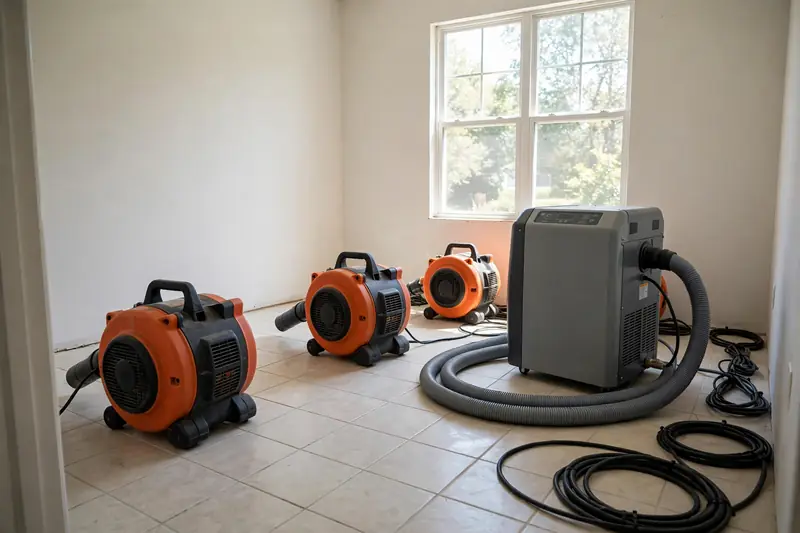
Then, air movers and dehumidifiers dry the remaining structure. Air movers push dry air across wet surfaces to speed evaporation, and dehumidifiers pull that moisture out of the air so it does not recondense elsewhere. In a ceiling cavity, technicians may use directed airflow or small access openings to get air moving inside the cavity. Drying typically takes 3 to 5 days for a ceiling assembly, and it is verified with daily meter readings, not by how the surface feels. Our article on how long structural drying takes explains the full timeline by material and severity.
Finally, once readings confirm the structure is dry, repairs begin: new drywall, taping and mudding, texture matching, and paint. The repair is a separate phase from the drying, and it should never start before drying goals are met. Closing a ceiling over damp framing traps moisture and guarantees a return visit.
Prevention: Keeping the Drain Line Clear
The good news is that condensate ceiling damage is one of the most preventable water damage problems in a Chandler home. The entire prevention program fits on a short list.
Flush the line every spring. Before cooling season, have the condensate drain line flushed and checked as part of a spring AC tune up. A technician can clear algae and sediment, verify the slope, and confirm the line drains freely. This single step prevents most overflows.
Change the air filter on schedule. A clogged filter restricts airflow, which can freeze the evaporator coil. A frozen coil that thaws dumps a surge of water into the pan. A clean filter protects the drain system indirectly but reliably.
Check the secondary pan drain. If your system has a secondary pan with a drain routed to a visible spot, glance at it during cooling season. Any water coming from that line is a warning that the primary drain has failed. Call for service before the secondary pan overflows too.
Install and maintain a float switch. If your system does not have an overflow safety switch, ask your HVAC technician about adding one. It is a small device that shuts the system down before an overflow, and it turns a potential ceiling collapse into an inconvenient service call. Test it annually.
Keep the area around the air handler clear. In an attic, boxes and stored items can block access to the unit, hide a slow drip, and soak up a leak before you notice it. Clear access also lets a technician service the drain line without moving a season of storage first.
Know where your system drains. Walk outside and find the condensate drain termination. It should drip steadily when the AC runs on a humid day. If it never drips during peak summer, the line may be clogged or disconnected. That two minute check, done once a month in summer, catches clogs early.
Chandler Specific Factors Worth Knowing
Chandler homes have a few local characteristics that make condensate leaks more likely and more damaging than in many other markets.
First, the cooling season is long. A system that runs eight or nine months a year accumulates biofilm and scale faster than a system that runs three months. The maintenance interval that works in a mild climate is not enough here.
Second, many Chandler homes have the air handler in a hot attic. Attic temperatures above 130 degrees in summer accelerate algae growth in a standing pan and make attic work miserable, which means homeowners inspect their units less often. The hotter and less accessible the attic, the more important professional maintenance becomes.
Third, monsoon humidity arrives suddenly. A system that handled dry May heat without trouble can be overwhelmed by humid August air. The condensate volume jump between a dry heat day and a monsoon day is large, and it is exactly when a partially clogged line fails.
Fourth, many homes in neighborhoods across Chandler, from older homes in downtown Chandler to newer builds in the southeast, have tile roofs and attic ductwork that make leak diagnosis harder. A stain below an attic unit could be condensate, a roof leak at a vent flashing, or a duct condensation problem. That is why diagnosis by a technician, not guessing, matters so much here.
Frequently Asked Questions
The most common cause is a clogged condensate drain line. Algae, sediment, and mineral scale narrow the line until condensate backs up into the drain pan and overflows. A rusted drain pan, a frozen evaporator coil, or a disconnected drain line can cause the same result. An HVAC technician can identify the exact cause in one visit.
Yes. A slow drip that runs for weeks soaks insulation, softens drywall, and creates mold conditions long before you see a stain. By the time the stain appears, the wet area above the ceiling is usually larger than the stain below it. Small drips cause big repairs precisely because they go unnoticed for so long.
Yes, if it is safe to do so. Turning off the system stops new condensate from forming and prevents the leak from growing while you arrange repairs. If water is near electrical fixtures, turn off the breaker for the room as well. Then call an HVAC technician for the drain and a restoration team for the moisture.
Often, yes, when the leak is sudden and accidental, but coverage depends on your policy and the cause. A sudden drain line failure is treated differently from a leak that went unrepaired for months. Document the damage with photos, keep repair invoices, and contact your insurer promptly. See our guide to water damage insurance claims in Arizona for the details.
A typical ceiling assembly takes 3 to 5 days of professional drying, verified with moisture meters. Timelines depend on how much insulation and framing got wet and how quickly drying started. Surface dryness is not the test. The structure is dry when meter readings match the dry standard for each material. See our article on how long structural drying takes for the full breakdown.
No. Paint over a moisture stain traps water in the ceiling, hides ongoing damage, and lets mold grow behind the paint. The stain will bleed back through. The ceiling must be dried, the damaged material repaired or replaced, and the surface sealed with a stain blocking primer before paint.
Schedule a spring tune up that includes flushing the drain line, change filters on schedule, check the secondary pan drain monthly in summer, and make sure your system has a working float switch. If your system has no overflow safety switch, ask your HVAC technician about adding one.
It could be. A tripped float switch shuts the system down when water rises in the drain pan, which usually means the condensate line is clogged. Do not bypass the switch. Call an HVAC technician to clear the drain and check the pan, then have the ceiling below checked for moisture if the system was off for an extended period.
---
Need Help With Water Damage in Chandler?
If you are dealing with this problem in your Chandler home, call RestoreNov at (480) 701-8249 for an assessment. See our AC Leak Water Damage and Ceiling & Wall Repair pages for how the work is handled.
Call (480) 701-8249