
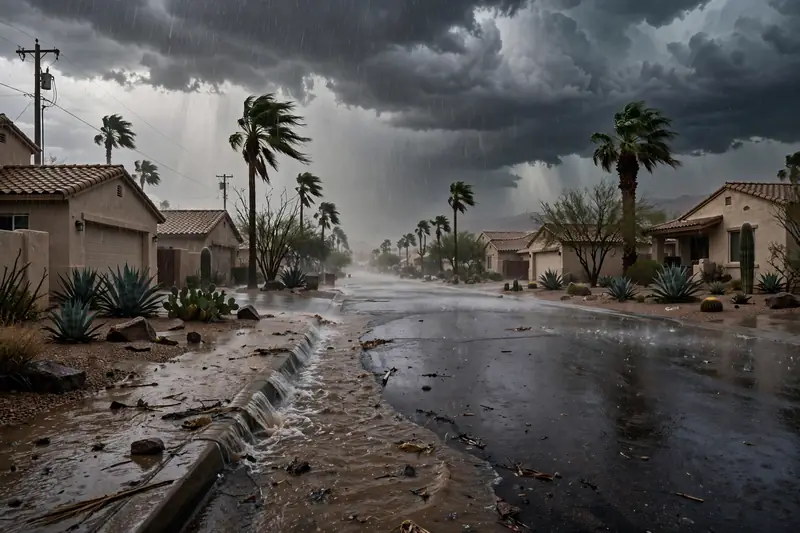
The short answer: Arizona monsoon season runs from June 15 through September 30, and it brings intense thunderstorms, high winds, dust storms, and flash floods that can overwhelm Chandler homes in minutes. Preparation means clearing roof drains, gutters, and yard drainage before the season starts, sealing roof and window weak points, knowing your flood risk, protecting valuables and documents, preparing an emergency kit, and having a plan for the first hour after water enters the home. Because desert soil absorbs water slowly, even a short downpour can send water into garages, patios, and ground floor rooms. If monsoon water gets in, call RestoreNov at (480) 701-8249 once it is safe, because the drying clock starts the moment water enters.
What Monsoon Season Really Means in Chandler
Monsoon is not a single storm. It is a seasonal wind shift that brings moist air from the south into Arizona, and with it a pattern of afternoon and evening thunderstorms from mid June through the end of September. Some days bring only wind and dust. Other days bring a microburst that drops an inch of rain in twenty minutes onto a neighborhood that has had no rain for months.
Three features make monsoon storms dangerous for homes. First, the rainfall is intense and brief. A storm can drop more water in half an hour than the ground can absorb in a day. Second, the storms are local. One neighborhood can flood while the next stays dry, which makes it hard to judge risk from a citywide forecast. Third, the storms bring multiple hazards at once: wind that damages roofs and knocks down trees, lightning, dust that reduces visibility to near zero, and flash flooding that arrives with little warning.
The National Weather Service designates a Monsoon Awareness Week each June to remind Arizona residents to prepare. The message is simple: have a plan before the season starts, because the time to prepare is not when the sky turns dark.
Why Desert Homes Flood So Easily
Chandler's flood risk confuses newcomers, because the desert looks dry. The dryness is the problem. Desert soil, especially soil that has been baked hard by months of sun, absorbs water slowly. When a monsoon downpour hits, much of the rain runs off the surface instead of soaking in. That runoff collects in washes, streets, low lying yards, and any depression around a home.
Hard surfaces make it worse. Roofs, driveways, patios, sidewalks, and streets are all impermeable. A typical Chandler lot sends most of its rainfall to the street or the nearest low point. If the grading around your home slopes toward the house instead of away from it, that runoff heads for your doors, your garage, and your foundation.
Washes and retention basins fill quickly. Chandler neighborhoods are designed with washes, channels, and retention areas that manage stormwater, but an intense storm can fill them faster than they drain. Streets can flood to curb depth in minutes. A few years ago, a stretch of I-10 became impassable during a monsoon event. If a freeway can flood, a ground floor room certainly can.
The other factor is that many Chandler homes have flat or low slope roofs, slab foundations, and ground level living space. There is no basement to buffer a flood, and a flat roof that ponds water can leak through a weak seam or a clogged scupper. Water that enters at the roof travels down through insulation and drywall and shows up far from the entry point.
Know Your Flood Risk Before the Season Starts
Preparation starts with understanding your specific risk, not the city's general risk.
Check your flood zone. Flood maps show whether your property is in a mapped flood hazard area. Even if your home is outside a high risk zone, that does not mean it cannot flood. Monsoon flooding is often localized and driven by drainage, grading, and storm intensity, not by mapped floodplains. A home outside a flood zone can still take water through a low patio door or a poorly graded side yard.
Walk your property after a rain. The most useful flood risk assessment is a walk around your home during or immediately after a heavy rain. Where does water pool? Which way does it flow? Does it collect against the house, in the side yard, or at the garage door? Does your patio drain keep up, or does water back up toward the sliding door? Note the low spots. They are your flood entry points.
Check your grading. The ground around your home should slope away from the foundation. Soil settles over time, planters get built up, and landscaping changes can reverse the slope. If you see water pooling against the house, the grading needs correction before monsoon season, not during it.
Know your roof. Flat and low slope roofs need clear scuppers and drains. Tile roofs need intact flashing at vents, chimneys, and valleys. A roof that handled last year's storms may not handle this year's, because flashing, sealant, and tiles degrade every year in Arizona sun.
Ask about your neighborhood. Longtime neighbors know which streets flood, which washes rise, and which homes have taken water before. That local knowledge is often more accurate than any map.
The Pre Season Checklist: Outside the Home
Do this work in May or early June, before the first monsoon storm. Once the season starts, you will be reacting instead of preparing.
Clear roof drains, scuppers, and gutters. Leaves, dust, and debris collect in roof drains and gutters all year. A clogged scupper on a flat roof turns the roof into a pond, and ponded water finds every weak seam. Clear all drains, test them with a hose, and confirm water flows away freely.
Clean yard drains and area drains. Yard drains, patio drains, and pool deck drains clog with leaves, gravel, and sediment. A clogged patio drain is one of the most common reasons monsoon water enters a Chandler home through a sliding door. Clean every drain, remove the grate, clear the trap, and test with a hose.
Check downspouts and drainage paths. Confirm that downspouts discharge away from the foundation and that drainage swales and channels are clear. If a downspout dumps water next to the foundation, add an extension that carries it to the yard or street.
Trim trees and secure loose objects. Monsoon winds can snap weak branches and turn patio furniture, umbrellas, and unsecured items into projectiles. Trim dead or weak branches, especially over the roof. Secure or store lightweight outdoor items before storms. A branch through a window during a storm is a water entry point.
Seal gaps and check weatherstripping. Inspect door thresholds, garage door seals, window seals, and any pipe or cable penetrations through exterior walls. A garage door with a worn bottom seal can admit inches of water during a heavy storm. Replacing a seal is a small job that prevents a large cleanup.
Protect the AC and pool equipment. Outdoor condenser units, pool equipment, and electrical panels should be clear of debris and, where appropriate, elevated or protected from standing water. Never touch electrical equipment in standing water.
Prepare sandbags if you are in a low spot. If your property has flooded before, or if your walk after rain showed water collecting against the house, keep sandbags on hand before the season starts. Sandbags are nearly impossible to buy during a storm. Place them at door thresholds, garage doors, and any low entry point before water arrives, not after.
The Pre Season Checklist: Inside the Home
Know your shutoffs. Every adult in the household should know where the main water shutoff valve is and how to turn it off. If a storm damages a pipe or a water heater, shutting off the water in seconds prevents hours of flooding. Label the valve. Do the same for the main electrical breaker panel, and know which breaker controls each area.
Elevate and protect valuables. Move irreplaceable items, documents, photos, and electronics off the floor, especially in ground floor rooms, garages, and storage areas. Use plastic bins with lids instead of cardboard boxes on the garage floor. Keep important documents in a waterproof container or a safe deposit box, not in a box on the floor.
Check your sump pump if you have one. Most Chandler homes do not have basements or sump pumps, but some have low lying areas, sunken patios, or drainage pits with pumps. If you have one, test it before the season and confirm the discharge line is clear. A pump that fails during a storm is worse than no pump, because it creates false confidence.
Prepare an emergency kit. The National Weather Service and Arizona emergency agencies recommend a kit with flashlights, batteries, bottled water, nonperishable food, a first aid kit, medications, phone chargers, and copies of important documents. Add a battery powered weather radio or a phone with weather alerts enabled. Power outages during monsoon storms are common and can last for hours.
Set up weather alerts. Enable Wireless Emergency Alerts on your phone, and sign up for local weather notifications. Flash Flood Warnings mean flooding is happening or imminent. Do not wait for a warning to act if water is rising near your home.
Review your insurance. Standard homeowners insurance does not cover flood damage from rising water outside the home. Separate flood insurance through the National Flood Insurance Program or a private insurer is a different policy with its own waiting period. If you are considering flood insurance, buy it well before monsoon season, because waiting periods mean a policy purchased during a storm will not cover that storm. Review your homeowners policy too, so you know what is covered for storm related interior water damage, such as rain entering through a wind damaged roof. Our guide to water damage insurance claims in Arizona explains the covered and excluded categories in plain language.
During the Storm: Safety First
When a monsoon storm hits, the priority is safety, not property.
Stay indoors. The safest place during a significant storm is indoors, away from windows. Avoid plumbing and electrical equipment during lightning. Wait at least 30 minutes after the last thunder before going outside.
Never drive through flooded roads. This is the most important monsoon safety rule. As little as 6 inches of moving water can sweep a person off their feet, and 12 to 24 inches can carry a vehicle away. Water depth is impossible to judge from a car, and road damage may be hidden beneath the surface. The rule is absolute: turn around, do not drown. Arizona's "Stupid Motorist Law" allows agencies to charge drivers for the cost of rescue if they ignore posted warnings and drive into flooded areas.
If you are caught in a dust storm while driving, slow down, pull off the road as far right as possible, turn off your lights, take your foot off the brake pedal, and wait. Other drivers may follow your lights and rear end you if you stop in the roadway with lights on.
If water enters your home during the storm, do not wade into it if there is any risk of electrical contact. Turn off power to the affected area from a dry location if it is safe to do so. Move to higher ground within the home. Call 911 if anyone is in danger. Do not try to stop a flood during lightning or high winds. Property can be repaired. People cannot.
The First Hour After Water Enters: What To Do
Once the storm passes and it is safe to act, the first hour matters enormously. Every hour of delay makes drying harder and mold growth more likely.
1. Make sure it is safe. Check for electrical hazards, structural damage, gas odors, and contaminated water. If water came from outside, treat it as contaminated. Monsoon floodwater can carry soil, chemicals, debris, and sewage. Do not let children or pets into flooded areas. If you smell gas, leave the home and call the gas utility from outside.
2. Stop the water if you can do it safely. If the water is coming from a broken pipe or a failed water heater rather than from outside, shut off the main water valve. If it is coming through a door or window, sandbags or towels can slow it, but do not risk your safety to save carpet.
3. Document before you clean. Photograph and video everything: the water line on walls, the affected rooms, damaged belongings, the entry point, and the outside conditions. Keep the timestamps. This documentation is what your insurance adjuster needs, and it is much harder to reconstruct after cleanup starts.
4. Remove standing water. For clean water from a pipe or a roof leak, a wet vacuum, mop, and buckets can handle shallow water. For floodwater from outside, do not attempt full cleanup yourself without protective gear and knowledge of contamination. Floodwater is Category 3 black water in restoration terms, which means porous materials it touches generally must be removed, not dried. Our article on clean, gray, and black water explains why the category changes the entire response.
5. Call a restoration team early. Professional extraction, moisture mapping, and drying should start as soon as possible. The emergency water extraction response removes standing water, maps hidden moisture, and sets up drying equipment. The structural drying and dehumidification phase dries the structure to verified dry standards. Both phases are time sensitive, because mold can begin growing within 24 to 48 hours on wet materials. Our article on the mold 24 to 48 hour window explains the timeline.
6. Contact your insurer promptly. Report the loss, describe the source, and ask what documentation they need. Do not wait for the adjuster to start emergency drying. Insurers expect homeowners to mitigate further damage, and delay can complicate a claim.
Frequently Asked Questions
When is monsoon season in Chandler, AZ?
Monsoon season is observed from June 15 through September 30. It is characterized by increased thunderstorm activity, high winds, dust storms, and flash floods. The most intense storms typically occur in July and August, when humidity is highest.
Does homeowners insurance cover monsoon flood damage?
It depends on the source. Rain entering through a wind damaged roof is often covered by a standard homeowners policy. Rising water from outside, such as floodwater that flows into your home from the street or a wash, is generally not covered by a standard policy and requires separate flood insurance. Sewer backup during a storm may require a separate endorsement. Review your policy before the season and see our guide to water damage insurance claims in Arizona for the details.
How much rain does it take to flood a Chandler home?
Less than most people expect. Because desert soil absorbs water slowly and hard surfaces shed it, a short, intense downpour can flood a low lying yard, a garage, or a ground floor room in under an hour. It is not the total rainfall that matters most. It is the intensity, the grading, and the drainage. A single microburst can do more damage than a full day of steady rain.
What should I do if water is coming in through my garage door?
If it is safe, place sandbags or rolled towels at the threshold to slow the entry, move valuables off the garage floor, and shut off power to the garage if water is near outlets. Do not stand in water near electrical equipment. Once the storm passes, document the water line and the damage, then arrange for extraction and drying. Check the drywall on the shared wall with the living space, because water wicks into it from the garage side.
Can I prevent monsoon water from entering my home?
You can reduce the risk substantially, but you cannot eliminate it. Clearing drains and scuppers, correcting grading, sealing thresholds and garage door seals, trimming trees, and keeping sandbags on hand all lower the odds. The most important preparation is knowing your property's low points and having a plan for the first hour after water enters.
Is monsoon floodwater dangerous to clean up myself?
Yes, it can be. Floodwater from outside is treated as Category 3 black water, because it can carry soil, chemicals, debris, and sewage. Porous materials it touches generally must be removed, not cleaned and dried. If floodwater entered your home, use protective gear, keep children and pets away, and call a professional restoration team. See our article on clean, gray, and black water for why the water category matters.
How fast does mold grow after monsoon flooding?
Mold can begin growing within 24 to 48 hours on wet drywall, insulation, and other organic materials. That is why drying must start quickly and be verified with meters. A home that looks dry on the surface can still be wet inside wall cavities. See our article on the mold 24 to 48 hour window for the full timeline.
What is the most overlooked monsoon preparation step?
Knowing where your main water shutoff is and keeping it accessible. Many homeowners know in theory where it is, but cannot find it or turn it in the dark during a storm. Walk to it, test it, and label it before the season. The second most overlooked step is cleaning patio and yard drains, which clog silently all year and fail exactly when you need them.
---
Need Help With Water Damage in Chandler?
If you are dealing with this problem in your Chandler home, call RestoreNov at (480) 701-8249 for an assessment. See our Storm & Monsoon Damage and Flood Damage Restoration pages for how the work is handled.
Call (480) 701-8249