Commercial Water Damage Restoration in Chandler, AZ
For a business, water damage is not just a building problem. It is a closed-doors problem.
For a business, water damage is not just a building problem. It is a closed-doors problem. Every hour a space is unusable is an hour of lost revenue, displaced employees, frustrated tenants, and customers going somewhere else. Commercial water damage restoration moves on a different logic from residential work: the building is bigger, the systems are more complex, more people are affected, and the schedule has to protect business continuity while the structure dries. RestoreNov provides commercial water damage restoration across Chandler, AZ. Call (480) 701-8249 for emergency help.
Direct answer: Commercial water damage restoration is the process of extracting water, drying the structure, cleaning and sanitizing affected areas, documenting the loss for commercial insurance, and repairing the space, organized around minimizing downtime. Work is phased so that critical areas, such as customer-facing space, revenue equipment, IT infrastructure, and essential utilities, are restored first, while secondary areas follow. After-hours scheduling, containment in occupied buildings, larger-scale drying equipment, and detailed documentation for carriers and property managers are all part of a commercial job.
This page covers the property types we serve, the most common commercial water sources in Chandler, how commercial restoration is phased to protect operations, how larger-scale drying works, what documentation commercial insurance requires, and how to prepare a business before a loss happens.
What Happens When You Call
When you call about commercial water damage, here is the sequence that follows. It runs from the first phone conversation through the final check that the space is dry and ready to return to use.
- Step 1: Call and assessment You describe the property type, the affected areas, and which operations are disrupted. We ask about tenant spaces, customer areas, and any areas that must stay open, so the work can be phased around the business.
- Step 2: Extract and dry the space The crew removes standing water, sets up large-scale drying, and contains work areas so unaffected parts of the building can keep operating where that is practical.
- Step 3: Repair and verify Once moisture readings confirm the structure is dry, damaged materials are replaced, finishes are restored, and a final check confirms the space is dry and ready to return to use.
Why Commercial Water Damage Is Different From Residential
A home water loss affects one household. A commercial water loss affects employees, customers, tenants, vendors, and sometimes the public. That difference changes every part of the job.
Scale. Commercial spaces are larger, with more square footage, longer runs of plumbing, bigger HVAC systems, and more rooms affected by a single failure. A burst line on an upper floor of a multi-tenant building can soak several suites before anyone arrives. A rooftop unit failure can affect an entire floor. Equipment and crews must scale to the loss, with multiple trucks, multiple crews, and a project manager coordinating the work.
Occupancy. Commercial buildings are often occupied during restoration, or they need to reopen in phases while work continues. Containment, dust control, noise control, and safe pathways matter more when employees, customers, or patients are nearby. Work must be sequenced so that safe areas stay usable while wet areas are dried and repaired.
Systems. Commercial buildings have more complex systems: rooftop HVAC units, fire sprinkler systems, commercial water heaters, multi-tenant plumbing stacks, elevator shafts, server rooms, and commercial kitchens. Each system has its own failure modes, its own shutoffs, and its own repair trade. Restoration teams coordinate with building engineers, HVAC contractors, plumbers, and electricians rather than working alone.
Documentation. Commercial insurance claims require more detailed documentation than residential claims: photos, moisture readings, drying logs, scope of work, contents and inventory records, and business interruption records. Property managers, owners, tenants, and carriers all need consistent information, and the restoration team is often the source of that record.
Downtime economics. In a home, delay costs comfort and repair expense. In a business, delay costs revenue, payroll for idle staff, missed orders, broken lease obligations, and customer trust. The restoration plan is built around the question that matters most to a business owner: what has to be dry and safe first so we can operate again?
Property Types Served
Commercial water damage restoration covers a wide range of property types, and each one has its own priorities and constraints.
Offices
Office losses often start with a plumbing failure, a rooftop HVAC leak, a sprinkler discharge, or a leak from a suite above. Priorities are protecting IT equipment, documents, and workstations, restoring restrooms and break areas, and getting workstations back in use. Phased drying lets a business reopen one zone while another zone is still drying. After-hours work is common in offices, because drying equipment can run overnight while employees are away, and noisy demolition can be scheduled when the space is empty.
Retail stores and shopping centers
Retail losses put inventory at risk immediately. Water on a sales floor damages product, fixtures, flooring, and displays, and a closed store loses sales every day. Priorities are protecting and documenting inventory, restoring the sales floor and entrance, and reopening customer access safely. Work is often scheduled around store hours, with extraction and noisy work done before opening or after closing, and drying equipment placed so it does not block customer flow.
Restaurants and food service
Restaurants face the strictest constraints after water damage, because food safety and health regulations govern whether a kitchen can operate. A water event in a kitchen or dining room may require health department guidance before reopening, and food-contact surfaces, storage, and equipment need thorough cleaning and sanitizing. Priorities are stopping the source, protecting food inventory, cleaning and sanitizing the kitchen, and restoring dining areas. Water categories matter more here, because gray water and black water contamination in a food space require more extensive cleaning and removal.
HOAs and multi-family properties
Homeowners associations and multi-family properties add a layer of coordination: the association, the property manager, individual unit owners, and tenants may all be involved in one loss. A leak in one unit can damage the unit below and common areas, and responsibility for each area depends on the governing documents and the lease. Priorities are clear communication, documentation by unit and common area, and a scope that separates association responsibility from unit-owner responsibility. Restoration teams document each area separately so the claim and the billing follow the right party.
Medical and healthcare facilities
Medical offices, dental offices, clinics, and other healthcare facilities have sensitive environments where infection control, air quality, and patient safety govern the work. Containment, negative air, and careful sequencing matter more than speed alone. Equipment, records, and sterile areas need protection, and drying equipment must be placed so it does not compromise clean areas. Work is coordinated with facility staff and scheduled around patient hours where possible.
Educational facilities
Schools, daycare centers, and training facilities face schedule pressure around classes, exams, and terms. Priorities are safety, air quality, and restoring classrooms and common areas so the schedule can resume. Work is often scheduled during breaks, evenings, and weekends to avoid disrupting classes, and communication with administrators, staff, and parents matters as much as the drying itself.
Warehouses and industrial spaces
Warehouses and industrial spaces are large, with high ceilings, concrete floors, racking, and stored goods. A water event can affect a large area quickly, and the contents at risk may be worth far more than the building finishes. Priorities are protecting inventory and equipment, extracting water across a large footprint, and drying the structure without shutting down the whole facility. Large-loss equipment, including desiccant dehumidifiers and high-capacity air movers, is often required.
Hotels and hospitality
Hotels face a room-by-room problem: a single leak can take multiple guest rooms and a corridor out of service, and each room-night lost is revenue lost. Priorities are restoring guest rooms in order, protecting corridors and public areas, and keeping the property presentable for guests who are still on site. Phased work that returns rooms to service one block at a time protects revenue while the rest of the loss is still being dried.
Common Commercial Water Sources in Chandler
Commercial buildings in Chandler face the same desert-climate risks as homes, plus the risks that come with larger systems and more tenants.
- Rooftop HVAC and condensate failures. Rooftop units and attic air handlers produce condensate, and a clogged drain or failed pan can send water down through ceilings across a large area. Rooftop units are also exposed to monsoon wind and rain, which can drive water into curbs, ducts, and roof penetrations.
- Multi-tenant plumbing. In multi-tenant buildings, one tenant's leak becomes the tenant below's flood. Supply lines, drain lines, and fixtures in upper suites can affect several suites before anyone notices, especially after hours or over a weekend.
- Fire sprinkler discharges. A sprinkler head that activates, whether from fire, damage, or malfunction, releases a large volume of water quickly. Sprinkler water can affect multiple floors and requires fast extraction and drying.
- Water heater and boiler failures. Commercial water heaters hold more water than residential units, and a tank failure can release a large volume into a mechanical room and adjacent spaces.
- Monsoon storm entry. Wind-driven rain through roof penetrations, flashing, and door thresholds can affect large commercial roofs and ground-floor entries. Flat commercial roofs with clogged drains can pond water and leak at seams and penetrations.
- Slab and foundation leaks. Commercial buildings on slab foundations face the same slab leak risks as homes, with the added complication that a slab leak under a large floor can be harder to locate and may affect multiple tenant spaces.
- Appliance and equipment leaks. Commercial kitchens, laundries, and ice machines have water connections that can fail. A dishwasher, ice maker, or commercial laundry leak can run overnight and affect a large area by morning.
- Sewage and drain backups. A main drain backup in a commercial building can affect restrooms, kitchens, and ground-floor spaces, and it requires contamination handling, not just drying.
After-hours failures deserve special attention. Many commercial losses are discovered on Monday morning after running all weekend, or overnight after the last employee leaves. That is why shutoff locations, alarm contacts, and after-hours access information matter. A business that can shut off water quickly and get a crew on site fast limits the loss dramatically.
Minimizing Downtime: Phased Restoration and Business Continuity
Minimizing downtime is the organizing principle of commercial restoration. The work is phased so that the business can operate as soon as it is safe to do so, even if the full restoration is not yet complete.
Phase 1: Critical areas first
The first priority is the areas the business cannot operate without: customer-facing space such as lobbies, retail floors, and dining rooms, revenue-generating equipment such as point-of-sale systems, kitchen equipment, and production lines, IT infrastructure such as server rooms and network closets, essential utilities such as restrooms and break areas, and building access points such as entrances, corridors, and elevators. These areas are extracted, dried, and cleaned first, and they are returned to service as soon as moisture readings and safety checks allow.
Phase 2: Secondary operations
Once critical areas are back in service, work moves to secondary areas: private offices, administrative space, storage rooms, and mechanical rooms that were not initially affected. These areas are dried and repaired while the business operates in the restored critical areas.
Phase 3: Non-essential and finish work
Cosmetic repairs, painting, trim work, and final finishes come last, because they do not block operations. Scheduling finish work after the business is operating again reduces the revenue impact and lets the finish work proceed without disrupting customers or employees.
After-hours and overnight scheduling
Much commercial drying work can run overnight. Dehumidifiers and air movers run continuously, and technicians can check readings, move equipment, and perform noisy demolition during off-hours so the business day is not disrupted. After-hours scheduling is arranged in advance with the property manager or owner, with clear access, security, and alarm instructions.
Temporary workspace and relocation
For larger losses, part of the operation may need a temporary workspace: a conference room becomes a temporary office, a storage area becomes a temporary staging zone, or staff work remotely while their area dries. The restoration team coordinates with the business on which areas are safe to use, which are under containment, and when each area will return to service. Clear signage and safe pathways keep employees and customers out of active work zones.
Communication plan
A commercial loss involves many people who need the same information: the owner, the property manager, tenants, employees, customers, and the insurance carrier. A simple communication plan prevents confusion: one point of contact at the restoration company, daily updates on drying progress and next steps, and a written schedule for each phase. Tenants in a multi-tenant building need to know when their suite will be dried, when they can re-enter, and what they should and should not move.
Larger-Scale Drying: Equipment and Method
Commercial drying uses the same principles as residential drying, extraction, airflow, dehumidification, and moisture verification, but at a larger scale and with more zones.
High-capacity extraction. Truck-mounted extractors and portable extractors remove standing water across large floor areas. For very large losses, multiple extractors work in parallel across zones.
Air movers at scale. Commercial jobs use more air movers, placed to create airflow across large open areas and into wall cavities, ceiling assemblies, and under-floor spaces. Airflow is balanced so that wet areas dry evenly and moisture is not pushed into dry areas.
Dehumidification. Low-grain refrigerant (LGR) dehumidifiers and, for very large or sealed spaces, desiccant dehumidifiers pull moisture out of the air so it does not reabsorb into materials. Desiccant units are useful in large warehouses, in spaces with high ceilings, and in conditions where refrigerant dehumidifiers are less effective.
Zoning and containment. Large commercial spaces are divided into drying zones, each with its own equipment and moisture targets. Containment with plastic sheeting and negative air keeps dust, debris, and contaminants in the work zone and out of occupied areas. Zoning also lets the team dry one area to completion and return it to service while another zone is still being dried.
Moisture mapping and daily readings. Technicians map the wet area across the whole floor plate, not just the visibly wet rooms, and take daily moisture readings in walls, floors, and ceilings. Drying logs document progress zone by zone. No zone is released for repair until its readings reach the dry standard. That verification matters more in commercial buildings, because a large floor plate can hide moisture in areas that look dry.
Contents and inventory handling. Commercial contents include furniture, equipment, inventory, documents, and IT hardware. Contents are inventoried, photographed, moved out of the wet area, dried or cleaned, and returned. Inventory that is damaged is documented separately for the insurance claim. IT equipment that got wet should not be powered on until it is inspected, and servers and network hardware need special handling.
Documentation for Commercial Insurance
Commercial insurance claims require a thorough, organized record. The restoration team is often the source of that record, and the quality of the documentation affects how smoothly the claim proceeds.
A commercial documentation package typically includes:
- Photos and video. Before, during, and after photos of each affected area, the water source, damaged materials, and damaged contents. Wide shots show the extent, and close shots show the detail.
- Moisture readings and drying logs. Initial moisture mapping, daily readings, and final readings that confirm each zone is dry. Drying logs show the timeline and the equipment used.
- Written scope of work. A line-item scope that lists what was extracted, dried, removed, cleaned, and repaired, zone by zone. The scope is the basis for the repair estimate and the claim.
- Contents and inventory records. A list of affected contents and inventory, with condition, disposition (saved, cleaned, or removed), and photos. Inventory records support the contents portion of the claim.
- Business interruption records. Records of closure days, partial closure, temporary workspace costs, and lost revenue, as applicable. Business interruption coverage is a separate part of many commercial policies, and the carrier will ask for records that support the claim.
- Invoices and receipts. Invoices for emergency services, drying, cleaning, and repairs, plus receipts for emergency measures such as temporary barriers, tarps, and equipment rental.
Keep copies of everything. Property managers and owners should keep a claim file with the policy number, the adjuster contact, the restoration scope, and every invoice. Do not discard damaged materials or contents until the adjuster has inspected them, because discarded items cannot be verified.
For a full discussion of how water damage claims work in general, including the sudden versus gradual distinction and the flood insurance distinction, see our insurance claim help page. That page is general information only, not legal or financial advice, and commercial policies have their own terms that should be reviewed with the carrier or agent.
Safety, Compliance, and Occupied Buildings
Commercial restoration in an occupied building carries safety obligations that go beyond the drying itself.
- Electrical safety. Standing water and wet electrical systems are a hazard. Power to affected areas is shut off until an electrician confirms it is safe. Do not let employees or customers enter a wet area with live electrical equipment.
- Slip and trip hazards. Wet floors, hoses, cables, and drying equipment create slip and trip hazards. Mark wet areas, route foot traffic around work zones, and keep pathways clear.
- Containment and air quality. Containment keeps dust and debris out of occupied areas. In healthcare, food service, and educational facilities, containment and air quality controls are especially important, and the facility's own safety staff should be involved in the plan.
- Water categories. Gray water and black water contamination require protective equipment, proper cleaning, and removal of porous materials. Employees and customers should not enter areas affected by sewage or floodwater until they are cleaned and cleared.
- Building codes and permits. Repair and reconstruction work may require permits and inspections, depending on the scope and the jurisdiction. The restoration team should confirm permit requirements with the City of Chandler or the relevant authority before walls close.
- Asbestos and lead. Older commercial buildings may contain asbestos or lead-based paint in flooring, ceiling tiles, insulation, or paint. If those materials are suspected, testing is needed before demolition. Do not disturb suspect materials without testing.
Preparing a Business Before a Loss
A business that prepares before a loss recovers faster than one that improvises during a loss. A short preparedness plan pays for itself many times over.
- Know your shutoffs. Document the locations of the main water shutoff, the fire sprinkler shutoff, the electrical panel, and the HVAC shutoffs. Post the locations where managers and facilities staff can find them, and make sure after-hours contacts know them too.
- Keep an after-hours contact list. Keep a list of the property manager, the building engineer, the alarm company, the plumber, the electrician, the HVAC contractor, the insurance agent, and the restoration team, with phone numbers that work after hours.
- Maintain the building envelope. Inspect the roof, flashing, gutters, and grading before monsoon season. Clear roof drains and gutters after haboob dust storms. Check door thresholds and seals.
- Maintain plumbing and HVAC. Inspect supply lines, water heaters, condensate drains, and sprinkler systems on a schedule. Replace aging hoses and valves before they fail.
- Protect IT and records. Keep servers and network equipment off the floor and away from water sources where possible. Back up data off-site. Store critical paper records above floor level and away from plumbing walls.
- Review insurance coverage. Review commercial property and business interruption coverage with the carrier or agent before a loss, not after. Understand what is covered, what the deductible is, and what documentation the carrier will require.
- Plan for temporary operations. Identify which areas are critical, where temporary workspace could go, and how employees and customers would be notified if the space had to close. A one-page continuity plan is enough to start.
Areas We Serve in Chandler and the East Valley
We provide commercial water damage across Chandler and the surrounding East Valley. Our address is 1651-1683 E Germann Rd, Chandler, AZ 85286, and our crews come to you.
We also serve businesses in Andersen Springs, Pecos Ranch, Clemente Ranch, Fox Crossing, Cooper Commons, and Dobson Place.
Serving Chandler and the East Valley: Downtown Chandler, Ocotillo, Fulton Ranch, Sun Groves, Tumbleweed Park, Gilbert, Mesa, Tempe, Queen Creek, Sun Lakes, Ahwatukee, Higley.
Tools & Technology We Use
Commercial losses cover more floor area and more rooms than a house, so the tools on this job are sized for larger spaces, mapped across zones, and paired with containment and documentation.
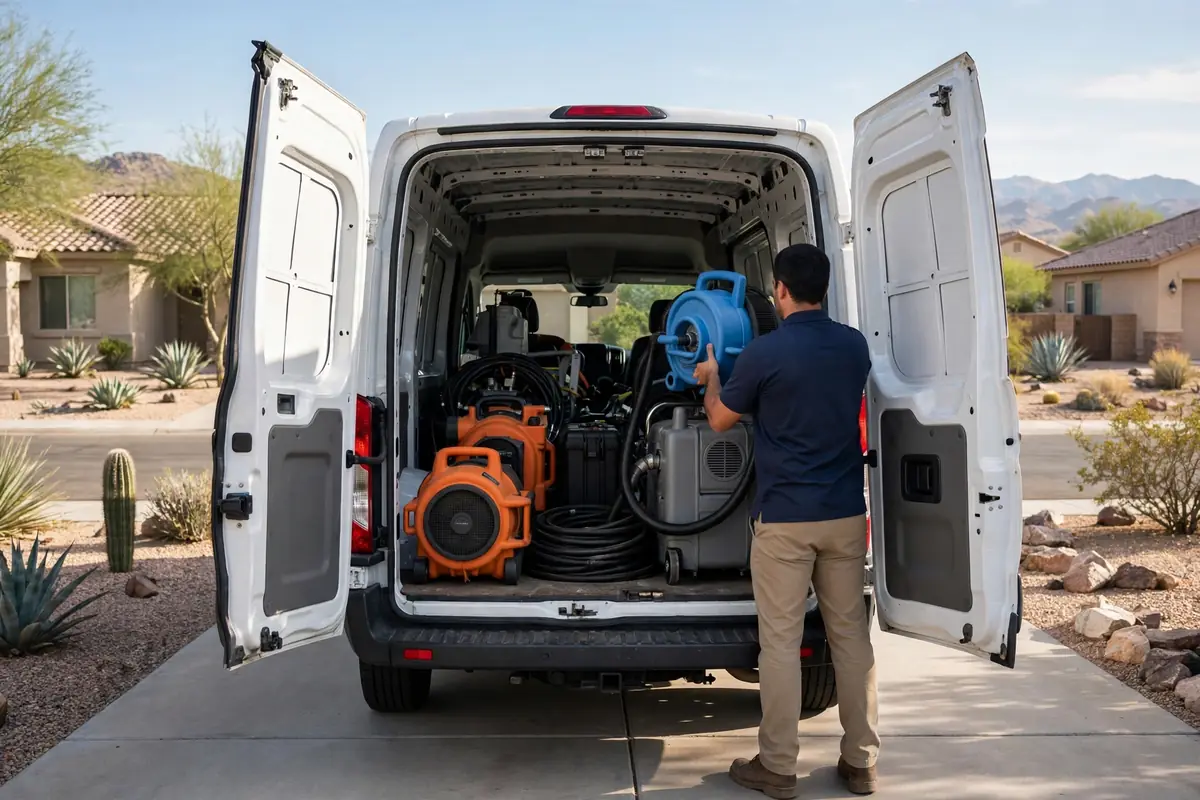
- Truck-mounted extractors. High-capacity extractors pull large volumes of water from wide floor areas, which suits warehouses, retail floors, and multi-room losses.
- Large-capacity dehumidifiers. Larger dehumidifiers handle the air volume of open commercial spaces and long hallways, keeping drying moving across a bigger footprint.
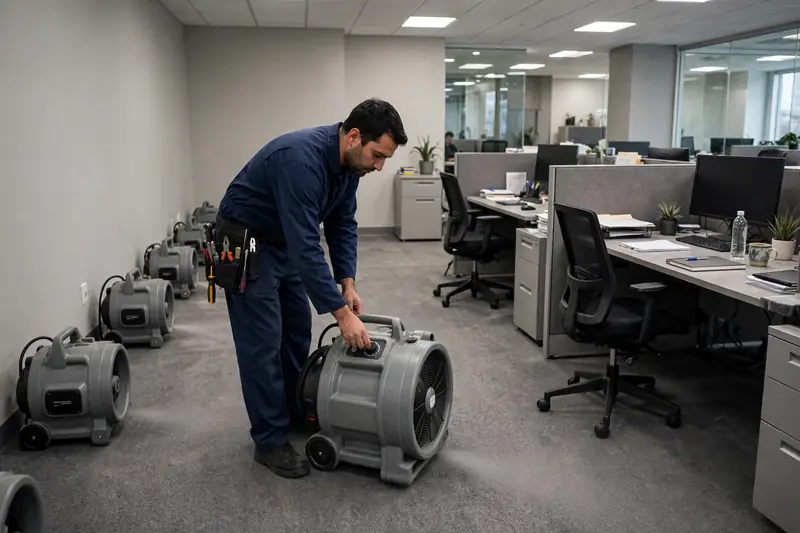
- Air movers. Rows of air movers push air across wet floors, walls, and under-cabinet spaces so evaporation keeps pace across the whole affected area.
- Moisture mapping. Meters and thermal imaging map moisture across large floor plates and shared walls, so drying zones are set from readings rather than from visible water alone.
- Documentation. Photos, moisture logs, and a written scope record the loss by area, which property managers and carriers use to track the work and the claim.
- Containment. Plastic sheeting and barriers separate wet work zones from operating areas, which limits dust and moisture spread into spaces that stay open.
Frequently Asked Questions
It depends on the size of the loss, the water category, and which areas are affected. A small, contained loss may allow partial reopening in days, while a large loss affecting multiple zones may take weeks. Phased restoration returns critical areas first so the business can operate while secondary areas are still being restored. No reputable company can promise a reopening date before the loss is assessed and drying begins.
Often, yes, with containment, zoning, and after-hours scheduling. Noisy demolition and heavy extraction are usually scheduled during off-hours, while drying equipment runs continuously. The restoration team will explain which areas are safe to use and which are under containment.
It depends on the policy, the cause, and the coverage purchased. Many commercial property policies cover sudden and accidental water damage from internal sources, while gradual leaks, maintenance failures, and flood damage from rising water may be excluded or covered only by separate endorsements or flood insurance. Review the policy with the carrier or agent, and see our insurance claim help page for general information.
Ensure safety, shut off the water source if it is safe to do so, shut off power to affected areas, notify the owner and the carrier, document the damage with photos, and call for professional extraction and drying. Notify tenants whose suites are affected, and keep a written record of every step.
Each affected suite and common area is documented and dried separately, and the scope separates association or landlord responsibility from tenant responsibility according to the governing documents and leases. Communication with all parties, and a single point of contact at the restoration company, keeps a multi-tenant loss organized.
Inventory is inventoried, photographed, and documented separately. Salvageable inventory is dried or cleaned. Damaged inventory is documented for the contents portion of the claim. Do not discard damaged inventory until the adjuster has inspected it.
Restoration teams document the loss thoroughly and provide the photos, readings, scope, and invoices that carriers require. Direct billing arrangements depend on the carrier and the policy. Ask the restoration team and the carrier what billing options are available for the specific loss.
Maintain the roof, gutters, plumbing, water heaters, and HVAC condensate drains. Know the shutoff locations. Keep IT equipment and records above floor level. Review insurance coverage before a loss. A preparedness plan that fits on one page is enough to make a real difference.
Call Now for Commercial Water Damage in Chandler
Water damage gets worse every hour it sits. Call RestoreNov now at (480) 701-8249 for live 24/7 commercial water damage across Chandler and the East Valley. Fast response, moisture-verified drying, and insurance-ready documentation, all handled as one job. If you are standing in water right now, shut off the water source if it is safe, stay clear of electrical hazards, and call.
Request a Call Back
Tell us what happened and where the water is. For emergencies, calling is fastest - a live person answers 24 hours a day.
Prefer to talk now?
Call (480) 701-8249 any time, day or night.
We serve Chandler and the East Valley: Downtown Chandler, Ocotillo, Fulton Ranch, Sun Groves, Tumbleweed Park, South Chandler, Gilbert, Mesa, Tempe, Queen Creek, Sun Lakes, Ahwatukee, and Higley.
Our address:
1651-1683 E Germann Rd, Chandler, AZ 85286
Send a Message
For immediate help, call (480) 701-8249. A live person answers 24 hours a day.
Online messaging is not connected yet. For immediate help, call (480) 701-8249.