
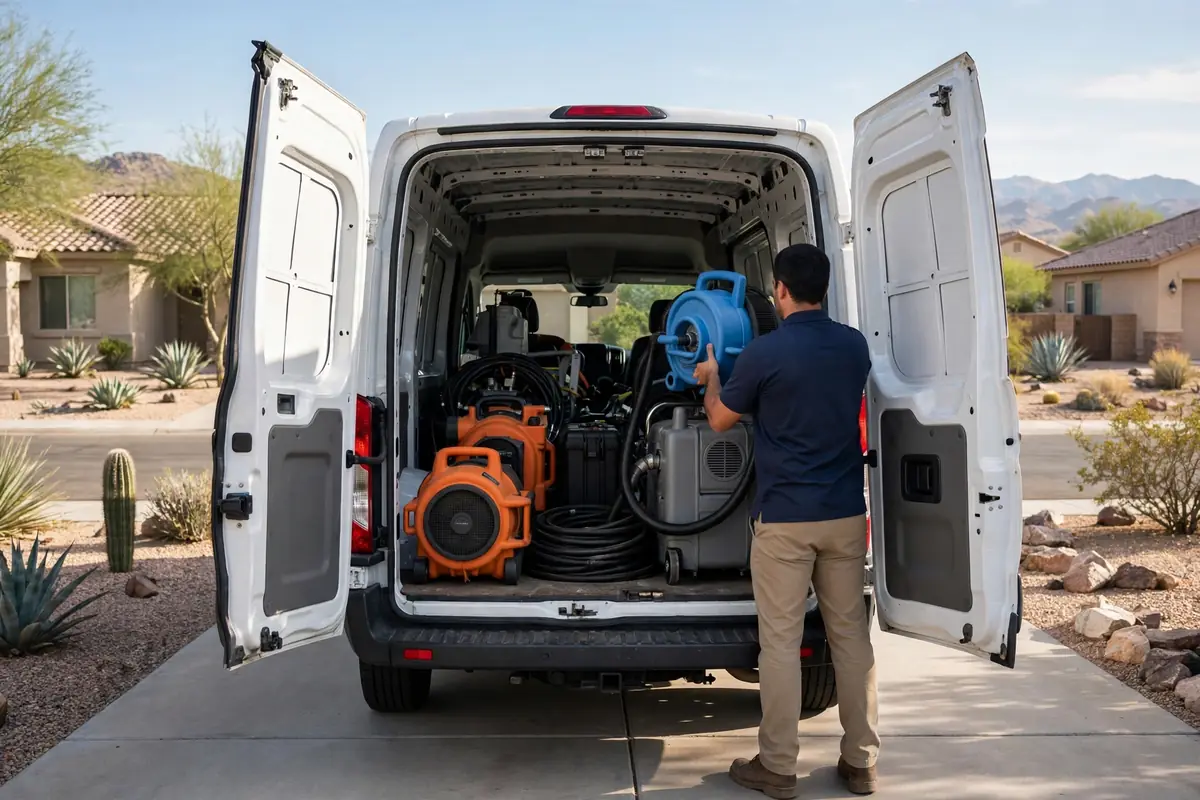
Burst Pipe and Slab Leak Water Damage in Chandler, AZ
A burst pipe floods a room in hours. A slab leak floods a foundation in silence over weeks.
A burst pipe floods a room in hours. A slab leak floods a foundation in silence over weeks. Both are plumbing failures, but they behave differently, they show different warning signs, and they need different responses. This page covers both, because Chandler homeowners face both, and because the water damage they cause is what we restore. RestoreNov provides 24/7 emergency response for burst pipe and slab leak water damage across Chandler and the East Valley. Call (480) 701-8249 now if you have standing water, a sudden bill jump, or any sign of a hidden leak.
Direct answer: A burst pipe is a sudden failure of a water supply line that releases a large volume of clean water quickly. A slab leak is a failure of a water line beneath the concrete slab foundation that releases water slowly underground, where it migrates through concrete and saturates flooring, wall bases, and soil. Both require two separate jobs: a plumber fixes the source, and a restoration crew handles extraction, drying, cleaning, and repair. Call both at the same time. Drying can begin as soon as the source is controlled.
What Happens When You Call
Here is the short version of what happens when you call (480) 701-8249.
- Step 1 - Call and assessment. Tell us what you noticed: standing water, a warm spot on the floor, a sudden bill jump, or the sound of running water. We ask whether the main shutoff is off, so the crew knows whether water is still flowing.
- Step 2 - Locate the leak and stop it. We help you confirm the water is shut off and map where moisture spread, while a plumber repairs the failed pipe. Restoration work starts as soon as the source is controlled.
- Step 3 - Repair and verify. The structure is dried with moisture checks, damaged materials are repaired, and the final readings are recorded so you have a written record of the job.
Two Failures, Two Patterns
Understanding the difference between a burst pipe and a slab leak helps you describe what is happening when you call, and it helps you act correctly in the first hour.
A burst pipe is loud, fast, and visible. A supply line, fitting, or joint fails, and clean water pours into a room, a wall cavity, or a ceiling. You see it, hear it, or discover it within hours, because the volume is large. The water is Category 1 clean water at first, which means it starts as the least contaminated category, but it can degrade into Category 2 within 24 to 48 hours if it sits and picks up contaminants. A burst pipe is an emergency extraction call, and the faster the extraction starts, the smaller the job.
A slab leak is quiet, slow, and hidden. A water line beneath the concrete slab cracks, corrodes, or fails at a joint, and water escapes under the foundation. You do not see a puddle. You see the secondary signs: a water bill that jumps, a warm spot on the floor, the sound of running water when every fixture is off, damp carpet, or a musty smell near a baseboard. By the time the signs appear, water has often been migrating through concrete for days or weeks, saturating a wide area. A slab leak is a detection call first, then a plumbing repair, then a restoration job. The drying scope is often wide, because the water spread through concrete rather than across a floor.
Both failures end in the same place: water inside building materials that must be extracted, dried, verified, and repaired. The rest of this page covers each failure in turn, then the shared restoration sequence that follows both.
What This Service Covers
Burst pipe and slab leak service covers the water damage side of the loss: finding how far the water spread, removing it, drying the structure, and documenting the job. The pipe repair itself is a plumber's job.
- Moisture mapping after a burst pipe or slab leak, including hidden spread under flooring
- Extraction of standing water from a burst pipe release
- Drying of walls, floors, ceilings, and wall cavities
- Drying of the concrete slab and subfloor after a slab leak
- Removal of materials that cannot be dried and salvaged
- Daily moisture readings until materials reach their dry standard
- Photos, moisture readings, and a written scope for your records
- A written scope that separates the plumber's pipe repair from the restoration work
Burst Pipes in Chandler Homes
What Causes a Burst Pipe
Burst pipes in Chandler are rarely caused by freezing. Desert nights can get cold enough to threaten exposed lines in garages and patios, but the dominant causes here are corrosion, pressure, aging, and installation wear.
Corrosion. Chandler water is hard, commonly measured in the high teens to low twenties in grains per gallon (18 to 22 GPG). Hard water accelerates corrosion inside metal pipes, especially galvanized steel and copper. Over years, corrosion thins pipe walls from the inside, creating weak points that eventually fail under normal pressure. Corrosion is invisible from the outside. A pipe that looks fine can be paper-thin inside.
High water pressure. Municipal water pressure in parts of the East Valley can run high, and pressure spikes from the supply system stress fittings, joints, and weak pipe sections. A pressure regulator that has failed, or a home without one, exposes plumbing to sustained high pressure. High pressure does not cause a healthy pipe to burst, but it accelerates failure at every weak point.
Aging materials. Galvanized steel pipes, common in older Chandler homes, corrode from the inside over decades. Copper pipes develop pinhole leaks from water chemistry and erosion. PEX and CPVC, common in newer homes, resist corrosion but can fail at fittings, from installation defects, or from chemical and UV exposure. Every material has a failure mode. Age makes every failure mode more likely.
Installation wear and physical stress. Pipes that rub against framing, concrete, or other pipes wear through over years of vibration and thermal expansion. A pipe that was nicked during construction, kinked during installation, or supported incorrectly carries a weak point from day one. Remodeling work, slab settlement, and soil movement add stress to rigid piping.
Freezing, in limited cases. Exposed lines in garages, patios, and exterior walls can freeze on cold desert nights. A frozen section expands, and the pipe bursts at the weakest point, often not at the frozen section itself. If you have exposed lines, insulation and shutoff discipline on cold nights reduce this risk.
Burst Pipe Warning Signs
A burst pipe announces itself. The signs are:
- Sudden standing water in a room, under a sink, in a garage, or on a ceiling, with no storm and no appliance running.
- A hissing or rushing sound inside a wall or ceiling when no fixture is in use.
- A sudden drop in water pressure at multiple fixtures, because water is escaping before it reaches the tap.
- A water stain spreading quickly across a ceiling or wall, or paint bubbling and peeling within hours.
- A water meter spinning fast with all fixtures off, indicating a large-volume leak.
- A sudden large water bill that arrives after the event, confirming what you already found.
If you see any of these, act immediately. Shut off the main water valve, or the valve on the leaking fixture. In most Chandler homes the main shutoff is at the street meter box, the front hose bib, or the garage. Then call a plumber and a restoration crew at the same time.
What a Burst Pipe Damages
A burst supply line can release hundreds of gallons into a home in hours. The damage pattern depends on where the pipe failed.
A pipe that fails inside a wall saturates drywall, insulation, and framing in that wall, then spreads to adjacent rooms through wall cavities and under flooring. The visible stain on one wall often understates the real scope, because the water inside the cavity has spread further than the stain. Moisture mapping with meters and thermal imaging finds the full extent.
A pipe that fails above a ceiling, such as a supply line in an attic or a second-floor bathroom, saturates ceiling drywall, insulation, and framing, then drips into the room below. Ceiling drywall that is saturated can sag and collapse. If your ceiling is sagging or bulging, stay out of the room and call immediately. Do not push on it, do not poke it, and do not stand under it. The full ceiling sequence is on the ceiling and wall water damage repair page.
A pipe that fails under a sink, behind a toilet, or at an appliance connection floods the room it serves, then spreads under flooring and through walls into adjacent rooms. A washing machine hose failure is one of the highest-volume indoor floods, because the hose runs at full line pressure and the machine may be running unattended.
Slab Leaks in Chandler Homes
Why Chandler Homes Are Prone to Slab Leaks
Most Chandler homes are built on a concrete slab foundation, with water supply lines running beneath the slab. That construction method is standard in Arizona, and it creates a specific risk: a pipe failure under the slab is hidden by concrete, and the water it releases has nowhere to go except into the slab, the soil, and the structure above.
Three Chandler-specific factors make slab leaks more likely here than in many other markets.
Hard water corrosion. Chandler water hardness commonly measures 18 to 22 grains per gallon, which is very hard. Hard water accelerates corrosion inside metal pipes, especially copper and galvanized lines under the slab. Hot water lines corrode faster, because temperature cycling accelerates the chemistry. A hot water line under a slab is one of the highest-risk pipes in a Chandler home.
Expansive and shifting soils. Arizona desert soils expand and contract with moisture changes, and they shift with settlement and seasonal moisture variation. That movement stresses rigid piping under the slab. A pipe that was installed with inadequate bedding, or that bears against a sharp concrete edge, takes stress at one point for years until it cracks or a joint separates.
Age and installation era. Chandler grew rapidly, and many homes carry plumbing from eras when galvanized steel and early copper installations were standard. Older piping under a slab has had decades of corrosion and soil stress. Newer homes with PEX are less vulnerable to corrosion, but they are not immune to fitting failures and installation defects.
Slab Leak Warning Signs
Slab leaks are hard to spot because the failure is underground. No single sign proves a slab leak. Several signs together make a slab leak likely, and the combination is what should prompt a call.
A water bill that jumps without a change in usage. This is often the first sign. If your bill rises sharply and your household water use has not changed, water is escaping somewhere. Compare your bill to the same month last year, and to your recent average, before you assume it is a rate change.
The sound of running water when every fixture is off. Stand in a quiet room, especially at night, and listen. A faint hissing, rushing, or trickling sound under the floor, with all taps off and no appliance running, is a strong indicator of an under-slab leak.
A warm or damp spot on the floor. A warm spot points to a hot water line leak beneath the slab, because heat from the escaping water transfers upward through the concrete. A damp spot points to any line. Both deserve prompt attention, especially if the spot persists or grows.
Moisture or mildew under carpet. Carpet that feels damp, smells musty, or shows mildew near a baseboard, with no surface spill to explain it, may be wicking moisture up from a slab leak below. The moisture migrates through concrete and up through flooring, so the visible sign can appear far from the actual leak.
New cracks in baseboards, walls, or flooring. Water under a slab erodes and shifts the soil that supports the foundation. That movement shows up as cracks in baseboards, new cracks in walls, or cracks in tile grout and flooring. A single hairline crack is not proof. New cracks appearing alongside other signs are a serious warning.
Low water pressure. A leak diverts water before it reaches fixtures, so pressure drops at multiple taps. Low pressure at one tap is usually a fixture issue. Low pressure across the home, alongside other signs, points to a supply line leak.
A water meter that keeps moving with all fixtures off. This is the most reliable homeowner test, and it is covered in detail below.
The Water Meter Test
The water meter test is a simple, non-invasive check any homeowner can perform. It does not locate the leak, but it confirms whether a leak exists.
- Turn off all water in the home: every tap, every appliance, the ice maker, the irrigation system, and any water-using equipment.
- Find your water meter, usually at the street meter box.
- Record the meter reading, or note the position of the leak indicator dial, usually a small triangle or star on the meter face.
- Wait 30 to 60 minutes without using any water.
- Check the meter again. If the reading has moved, or if the leak indicator dial is spinning, water is leaving your system somewhere. You have a leak.
If the meter test confirms a leak, call a plumber for professional detection. Do not tear into walls or flooring yourself. Random demolition makes the repair scope bigger, exposes you to mold inside cavities, and does not locate an under-slab leak.
How Plumbers Detect a Slab Leak
Slab leak detection is a plumber's job, and it uses specialized tools. The common methods are acoustic listening devices, which amplify the sound of escaping water through the slab, thermal imaging, which reveals the warm pattern of a hot water leak under concrete, electronic line tracing, which maps the pipe route under the slab, and pressure testing, which isolates sections of the line to identify which run is leaking. The plumber's goal is to locate the leak precisely enough to choose the least destructive repair, not to open the slab at random.
Detection matters because the leak location determines the repair method and the restoration scope. A leak under a bathroom may be repaired through a small slab opening. A leak under a living room may call for rerouting the line through the attic or walls instead of opening the slab. That decision belongs to the plumber, and the restoration crew coordinates timing so drying starts as soon as the repair is complete.
Slab Leak Repair Options: A Plumber's Decision
Slab leak repair is plumbing work, not restoration work, and the options below are general information about what plumbers commonly do. The plumber who locates your leak will recommend the right option for your home.
Spot repair. The plumber opens a small section of slab at the leak location, repairs or replaces the failed pipe section, and closes the slab. Spot repair is the least disruptive option when the leak is accessible and the rest of the line is in good condition.
Rerouting. The plumber abandons the failed under-slab line and runs a new line through walls or the attic, bypassing the slab entirely. Rerouting avoids opening the slab and avoids future leaks in the abandoned run. It is commonly chosen when the line is old, when the leak is under a difficult location, or when the homeowner wants to eliminate the under-slab risk for that run.
Repiping. The plumber replaces a full run, or the whole home's supply lines, when the piping is old enough that spot repairs will keep failing. Repiping is the largest-scope option, and it is chosen when the system, not a single joint, is the problem.
Whichever option the plumber chooses, restoration follows the same sequence: extraction of any standing water, removal of unsalvageable materials, drying with moisture verification, sanitization, and repair. Drying should not start until the source repair is complete, or the structure will simply get wet again. Call both vendors at the same time, and let them coordinate timing.
The Restoration Sequence After a Burst Pipe or Slab Leak
Whether the source was a burst pipe or a slab leak, the restoration sequence is the same, and it follows a fixed order.
- 1. Emergency call and source control. Your call is answered live, 24 hours a day. The crew confirms the source is stopped or helps you stop it. If the source is not yet repaired, the crew can begin extraction and protection work while the plumber is on the way, and drying begins once the repair is complete.
- 2. Inspection and moisture mapping. The crew inspects every affected area and the rooms next to it. Moisture meters measure saturation in drywall, flooring, and framing. Thermal imaging cameras reveal hidden moisture behind walls and under floors. For slab leaks, the crew maps the full migration path through concrete, because slab leak moisture often appears far from the leak. The crew writes a scope of work before drying equipment goes in.
- 3. Water extraction. Standing water is removed with submersible pumps and truck-mounted or portable extractors. The full extraction sequence is on the emergency water extraction page. Burst pipe jobs often need heavy extraction. Slab leak jobs often need moderate extraction over a wide area.
- 4. Removal of unsalvageable materials. Carpet pad soaked with contaminated water is removed. Soaked insulation is removed. Drywall that has lost structural integrity is cut out, often with a flood cut. Slab leak jobs often involve removing baseboards and opening wall bases so the cavity and the slab edge can be dried.
- 5. Structural drying and dehumidification. Commercial air movers and LGR dehumidifiers run until moisture readings confirm the structure is dry. Technicians return daily to take moisture readings, reposition equipment, and record progress. The full drying science is on the structural drying and dehumidification page.
- 6. Cleaning and sanitizing. Affected surfaces are cleaned and treated with antimicrobial products. After a slab leak that ran for weeks, sanitization and odor treatment matter more than after a burst pipe that was caught in hours, because prolonged moisture supports more microbial growth.
- 7. Mold prevention and monitoring. Fast, verified drying is the core of mold prevention. Published industry guidance says mold growth can begin in wet materials within 24 to 48 hours, and a slab leak that ran undetected for days or weeks carries elevated mold risk. Where mold growth is found, containment and remediation steps are added. The full mold sequence is on the mold remediation after water damage page.
- 8. Repair and rebuild. Once the structure is verified dry, damaged drywall, baseboards, flooring, paint, and trim are repaired or replaced. For slab leak jobs, flooring over the leak path and baseboards along the migration path are commonly part of the repair scope.
- 9. Final walkthrough and moisture verification. Before the job is closed, the crew walks the space with you, reviews the final moisture readings, and confirms the scope is complete. You receive the documentation package for your records and your insurance carrier.
Insurance: Burst Pipes, Slab Leaks, and What Is Usually Covered
This section is general information, not insurance advice. Your policy wording controls your coverage, and your insurance agent or adjuster is the authority on your specific claim.
Most standard homeowners policies cover sudden and accidental water damage, such as a burst pipe, including the resulting water damage and the mitigation that follows it. They generally do not cover the cost of repairing the failed pipe itself, because the pipe failure is a maintenance and wear issue. The distinction matters: the plumber's pipe repair is usually the homeowner's cost, while the water damage restoration that follows the sudden failure is commonly part of the claim.
Slab leaks are more complicated. Coverage depends on the policy, the cause, and the timing. A sudden slab leak that is discovered promptly is more likely to be treated as sudden and accidental than a leak that ran for months and was ignored. A leak caused by long-term corrosion may be treated differently from a leak caused by a sudden failure. Gradual leaks that were ignored, and damage that resulted from deferred maintenance, are commonly excluded. The earlier you discover and report a slab leak, the stronger your position, which is one more reason to act on the warning signs promptly instead of waiting.
Document everything. Photograph the damage, the water meter readings, and every affected room before anything is moved or removed. Keep a written log of every call, including the time and who you spoke with. Keep every receipt. We document the loss with photos, moisture readings, drying logs, and a written scope, so your adjuster has what is needed.
Prevention: Reducing Burst Pipe and Slab Leak Risk
You cannot eliminate plumbing failures, but you can reduce the risk and catch failures early.
- Know your water pressure. Have your pressure checked, and make sure your pressure regulator is working. Sustained high pressure accelerates failure at every weak point.
- Know your main shutoff. Every adult in the home should know where the main water valve is and how to shut it off. In most Chandler homes it is at the street meter box, the front hose bib, or the garage. Practice shutting it off before an emergency.
- Watch your water bill. A bill that jumps without a change in usage is the earliest warning of a hidden leak. Compare each bill to your recent average, and investigate a jump promptly instead of assuming it is a rate change.
- Run the meter test periodically. The meter test takes an hour and costs nothing. Run it once or twice a year, or any time you suspect a leak.
- Insulate exposed lines. Lines in garages, patios, and exterior walls deserve insulation, both for cold nights and for protection from physical damage.
- Replace washing machine hoses. Washing machine supply hoses are a leading source of sudden indoor flooding. Replace rubber hoses with braided stainless steel hoses, and replace them on a schedule, not after they fail.
- Consider a water softener. Hard water accelerates corrosion inside metal pipes. A water softener reduces hardness and slows corrosion. Discuss options with a plumber, because softener choice depends on your home's piping and water chemistry.
- Schedule plumbing inspections for older homes. If your home has galvanized steel or aging copper piping, a periodic plumbing inspection can identify thinning, corrosion, and weak fittings before they fail.
Areas We Serve in Chandler and the East Valley
We provide burst pipe & slab leak across Chandler and the surrounding East Valley. Our address is 1651-1683 E Germann Rd, Chandler, AZ 85286, and our crews come to you.
Serving Chandler and the East Valley: Downtown Chandler, Ocotillo, Fulton Ranch, Sun Groves, Tumbleweed Park, Gilbert, Mesa, Tempe, Queen Creek, Sun Lakes, Ahwatukee, Higley.
We also serve Chandler neighborhoods including Andersen Springs, Pecos Ranch, Clemente Ranch, Fox Crossing, Cooper Commons, and Dobson Place.
Tools & Technology We Use
Burst pipe and slab leak jobs start with finding the water, including the water you cannot see. Each tool below helps with one part of that job.
- Leak detection, acoustic listening sensitive listening equipment placed on pipes and floors picks up the sound of water escaping under pressure, narrowing the search area before any opening is made.
- Thermal imaging an infrared camera shows warm or cool patterns on floors and walls that point to the path of a hot-water or cold-water leak.
- Moisture meters pin and pinless meters measure saturation in flooring, wall bases, and slab-adjacent materials, showing how far the leak spread.
- Extractors remove standing water after a burst pipe release, pulling water from floors, carpet, and hard surfaces.
- Air movers push dry air across wet surfaces to speed evaporation once extraction is done.
- Dehumidifiers pull moisture out of the air so evaporated water leaves the building instead of settling back into materials, with readings tracked until materials reach their dry standard.
Frequently Asked Questions
A slab leak is an emergency in slow motion. It will not flood your living room tonight, but it is damaging your foundation, your flooring, and your wall bases every day it runs, and it is wasting water. Call a plumber for detection now, and call a restoration crew for moisture mapping. Waiting turns a drying job into a demolition and rebuild job.
Your plumber fixes the source. We handle extraction, drying, cleaning, and repair of the water damage. The two jobs are separate, and we coordinate timing so drying starts as soon as the source repair is complete. Call both at the same time.
Run the water meter test: turn off all water, wait 30 to 60 minutes, and check whether the meter moved. If it moved, you have a leak. Combine the meter test with the other signs: warm floor spots, running-water sounds, damp carpet, new cracks, and low pressure. Several signs together point strongly to a slab leak.
Water under a slab erodes and shifts the soil that supports the foundation, and prolonged saturation can cause settlement, heaving, and cracking. The longer a slab leak runs, the greater the foundation risk. Prompt detection, repair, and drying limit that risk.
Yes. Published industry guidance says mold growth can begin in wet materials within 24 to 48 hours. A burst pipe that is extracted and dried promptly carries low mold risk. A burst pipe that sits for days, or a slab leak that ran undetected for weeks, carries elevated mold risk. Fast extraction and moisture-verified drying are the primary mold prevention tools.
It depends on your policy, the cause, and the timing. Sudden and accidental failures are commonly covered for the resulting water damage, while gradual leaks and maintenance failures are commonly excluded. The pipe repair itself is usually the homeowner's cost. This is general information, not advice about your policy. Check your policy wording and ask your agent or adjuster.
Tile hides slab leak moisture well, because the tile surface looks almost normal while the subfloor and wall bases saturate. Water pushes up through grout lines and migrates under adjacent flooring. Moisture mapping with meters and thermal imaging finds the full extent, and tile may need to be lifted along the leak path so the slab can be dried.
Extraction happens on the first visit. Structural drying for most residential jobs takes 3 to 5 days of equipment run time with daily moisture checks. Slab leak jobs that ran undetected for weeks may take longer, because the moisture is deeper and the material removal scope is wider. Repairs follow once moisture readings confirm the structure is dry.
Call Now for Burst Pipe and Slab Leak Water Damage in Chandler
A burst pipe floods fast. A slab leak damages silently. Both get worse every day they wait. Call RestoreNov now at (480) 701-8249 for live 24/7 emergency response across Chandler and the East Valley. Fast extraction, moisture mapping, moisture-verified drying, mold prevention, repair, and insurance-ready documentation, all handled as one job. If you have standing water right now, shut off the water source if it is safe, stay clear of electrical hazards, and call.
Request a Call Back
Tell us what happened and where the water is. For emergencies, calling is fastest - a live person answers 24 hours a day.
Prefer to talk now?
Call (480) 701-8249 any time, day or night.
We serve Chandler and the East Valley: Downtown Chandler, Ocotillo, Fulton Ranch, Sun Groves, Tumbleweed Park, South Chandler, Gilbert, Mesa, Tempe, Queen Creek, Sun Lakes, Ahwatukee, and Higley.
Our address:
1651-1683 E Germann Rd, Chandler, AZ 85286
Send a Message
For immediate help, call (480) 701-8249. A live person answers 24 hours a day.
Online messaging is not connected yet. For immediate help, call (480) 701-8249.