Carpet and Flooring Water Damage in Chandler, AZ
When water reaches your floors in Chandler, the floor itself becomes the first decision point of the whole restoration. Carpet, hardwood, tile, laminate, and concrete each react to water differently, each dries differently, and each has a different point where saving it stops making sense and replacing it starts making sense.
When water reaches your floors in Chandler, the floor itself becomes the first decision point of the whole restoration. Carpet, hardwood, tile, laminate, and concrete each react to water differently, each dries differently, and each has a different point where saving it stops making sense and replacing it starts making sense. A fast, floor-aware response protects the finish you walk on and the structure underneath it. RestoreNov provides carpet and flooring water damage restoration across Chandler, AZ. Call (480) 701-8249 for emergency help.
Direct answer: Carpet soaked by clean water and dried within 24 to 48 hours can often be cleaned and saved, but the carpet pad underneath almost always needs replacement. Hardwood that is lightly cupped can often be dried and refinished, while buckled, crowned, or mold-affected boards usually need partial or full replacement. Tile itself usually survives, but water trapped under tile and in grout lines can damage the subfloor below. The right call depends on the water category, how long the floor stayed wet, the floor material, and moisture readings from the subfloor, not on how the surface looks.
This page covers every common flooring type in Chandler homes, how each one responds to water, how professional drying works floor by floor, how salvage versus replace decisions are made, and what to do in the first hours to protect your floors.
What Happens When You Call
Calling starts a short, plain process. The three steps below describe what happens from the first call to a finished job.
Step 1 - Call and assessment. You describe which floors got wet, what kind of water it was, and how long the floor stayed wet. The person who answers asks about the floor material, the rooms affected, and whether water reached baseboards or nearby walls. That information shapes what the crew brings and which floors get checked first.
Step 2 - Extract and dry. On arrival, the crew removes standing water, pulls up carpet and pad where needed, and checks moisture in the floor and the subfloor below it. Drying equipment is matched to the floor type, and readings are taken as drying goes on.
Step 3 - Repair and verify. Once moisture readings show the floor and subfloor are dry, salvageable floors are cleaned and finished, and floors that cannot be saved are listed for replacement. The crew walks the area with you, shows the dry readings, and notes what to watch for in the days after the job.
What to Do in the First Hours When Floors Get Wet
Speed matters more for floors than for almost any other part of a water loss, because flooring traps water against the subfloor and hides it. A floor that looks dry on top can still be wet underneath, and that hidden moisture is what causes mold, odors, warping, and adhesive failure days later.
- Stop the source if you can do so safely. Shut off the supply valve for a leaking appliance or fixture, or shut off the main water valve for a pipe failure. Do not wade into standing water where electrical outlets, cords, or appliances are submerged.
- Remove standing water from hard floors. Use towels, a mop, or a wet vacuum on tile, laminate, vinyl, and concrete. Every gallon removed now is a gallon that does not soak deeper.
- Lift rugs and move furniture off wet carpet and hardwood. Rug dyes can stain carpet and wood, and furniture legs can leave permanent marks. Place aluminum foil or plastic under furniture legs that must stay in place.
- Do not peel up flooring yourself. Pulling up hardwood, laminate, or tile without a drying plan can damage boards and planks that could have been saved, and it can release trapped water into new areas.
- Start airflow, but do not aim heat at hardwood. Open windows if the weather allows, run ceiling fans, and run your air conditioner to lower indoor humidity. Do not use space heaters or heat guns on wood floors, because fast, uneven drying can worsen cupping and cracking.
- Photograph everything before cleanup. Take wide shots of each room and close shots of the wet floor, the water source, and any warped or discolored areas. These photos support an insurance claim and document the pre-drying condition.
- Call for professional extraction and moisture mapping. A moisture meter and thermal imaging check can find water under flooring, in the subfloor, and along baseboards where eyes cannot reach.
The most common mistake is drying only the surface. Carpet can feel dry while the pad below is still saturated. Hardwood can look flat while moisture sits between boards and the subfloor. Tile can look perfect while the underlayment swells. Professional drying targets the whole floor assembly, not just the top layer.
What This Service Covers
Carpet and flooring restoration covers the full path from a wet floor to a dry floor with a clear salvage or replace call. The list below describes the work that is part of this service.
- Removal of standing water from carpet, hardwood, tile, laminate, vinyl, and concrete floors
- Moisture checks of the floor surface, the subfloor, and nearby baseboards and wall bases
- Removal of carpet pad and flooring sections that cannot be dried or cleaned
- Drying matched to each floor type, with readings taken from the floor and the subfloor
- Cleaning of salvageable carpet and hard floors after drying
- A salvage or replace call for each floor area, with the reasons written down
- Notes on subfloor repairs and new flooring steps where replacement is needed
Carpet and Carpet Pad: When the Pad Must Go
Carpet is one of the most forgiving floor coverings after clean-water damage, and one of the least forgiving after contaminated water. The difference is the water category and the clock.
How carpet responds to water
Carpet fibers themselves are usually synthetic in Chandler homes, typically nylon or polyester, and those fibers do not absorb much water. What absorbs water is the carpet backing, the carpet pad, the tack strips, and the subfloor below. A carpet that is soaked by clean water from a supply line or an appliance overflow can often be extracted, dried in place with air movers and dehumidifiers, and then deep cleaned. A carpet soaked by gray water from a dishwasher or washing machine discharge, or black water from a sewage backup, is a different situation. Contaminated carpet usually needs removal, because cleaning cannot reliably sanitize the backing, pad, and subfloor after sewage or chemical exposure.
Why the pad almost always goes
Carpet pad is typically rebond foam or fiber, and it behaves like a sponge. Once saturated, pad holds water against the subfloor, dries slowly, and becomes a prime site for mold growth and odor. Industry practice in most clean-water losses is to remove and replace wet pad even when the carpet itself is saved. Replacing pad is far less expensive than replacing carpet, and new pad restores the feel and cushion underfoot. Trying to dry saturated pad in place extends the drying time by days and raises the risk of a musty smell that never fully leaves.
Signs carpet cannot be saved
- The water was sewage, floodwater from outside, or chemically contaminated.
- The carpet stayed wet longer than about 48 hours and already smells musty or shows visible mold on the backing.
- The backing is delaminated, meaning the carpet layers are separating, bubbling, or rippling and will not lie flat after drying.
- The carpet is glued directly to concrete and the adhesive has failed, leaving loose, wrinkled sections.
- Dye has transferred from rugs or furniture onto the carpet and cannot be cleaned out.
How professional carpet drying works
Technicians extract water with truck-mounted or portable extractors, pulling as much moisture as possible from carpet and pad. If the pad is being replaced, the carpet is pulled back from the tack strips so the pad can be removed and the subfloor dried directly. Air movers push dry air across and under the carpet, and dehumidifiers pull moisture out of the air so it does not reabsorb. Moisture readings track progress in the carpet, the subfloor, and nearby baseboards until the assembly reaches its dry standard. Only then is new pad installed, the carpet re-stretched, and cleaning performed.
Carpet in Chandler homes: local notes
Chandler homes commonly have carpet in bedrooms, living rooms, and bonus rooms, often over concrete slab subfloors. Slab foundations mean there is no crawl space for water to drain into, so water stays in the floor assembly until it is extracted. In summer, when air conditioners run constantly, indoor humidity is low, which helps drying, but attic heat can also push warm air into wall cavities and complicate moisture readings. A room that feels cool and dry can still hold moisture in the slab below the carpet. Moisture meters, not touch, settle that question.
Hardwood Floors: Cupping, Crowning, Buckling, and When Wood Can Be Saved
Hardwood is the flooring type where patience pays the most. Wood moves as it absorbs and releases moisture, and many hardwood floors look worse at day two than they will at day ten. The worst response is to sand or refinish too early, before the wood has finished drying and settled.
Cupping: edges higher than the center
Cupping is the most common hardwood water symptom. Each board absorbs moisture along its edges faster than at its center, so the edges swell and rise while the center stays lower, creating a washboard profile across the floor. Mild cupping after a short, clean-water exposure often flattens as the floor dries evenly, especially if drying starts quickly and the subfloor dries at the same pace. Cupping alone is not a reason to replace a hardwood floor.
Crowning: center higher than the edges
Crowning is the opposite profile: the center of each board sits higher than the edges. Crowning often appears when a cupped floor was sanded flat before it finished drying, trapping the cupped shape, and then the floor continued to dry and the centers pushed upward. Crowning is also a sign that the floor was refinished too early. A crowned floor usually needs professional sanding and refinishing after it is fully dry, and in severe cases boards must be replaced.
Buckling: boards lifting off the subfloor
Buckling is the severe stage. Boards swell so much that they have nowhere to expand, so they lift, tent, or pull away from the subfloor, sometimes separating at the tongue and groove joints. Buckled boards usually cannot be saved in place. They need removal, subfloor drying, and replacement with matching boards, followed by sanding and refinishing to blend the repair.
Other hardwood warning signs
- Dark stains and discoloration. Water stains that turn boards gray or black, especially around joints, often mean moisture sat long enough to affect the wood fiber and the finish. Surface stains may sand out. Deep stains may not.
- Gaps and separation. Boards that shrink and gap after drying had absorbed a large amount of water. Small seasonal gaps are normal in Arizona. Wide, uneven gaps after a leak are not.
- Finish damage. Water can cloud, whiten, or peel polyurethane and other finishes even when the wood below is sound. Refinishing restores the protective layer.
- Musty odor from the floor. A smell coming from hardwood after surface drying usually means moisture remains in the subfloor or between boards, and mold may be growing in that hidden space.
How hardwood drying works
Hardwood drying uses controlled airflow and dehumidification, plus specialty equipment when needed. Mat drying systems place sealed panels over sections of floor and pull air across and under the boards to draw moisture out without overheating the wood. Tenting, where plastic sheeting channels airflow over a defined area, concentrates drying on the wettest sections. Technicians take moisture readings in the hardwood, the subfloor, and a dry reference area of the same floor, and they keep drying until readings stabilize. The floor is then left to acclimate, sometimes for days, before any sanding or refinishing begins. Sanding a floor that is still drying locks in the wrong shape and guarantees a second round of work.
When hardwood can be saved
Hardwood can usually be saved when the water was clean, the exposure was short, the boards are cupped but not buckled, the subfloor is not swollen or mold-affected, and moisture readings return to normal with drying. Engineered hardwood, which has a real wood veneer over plywood or composite layers, is more variable. Thin-veneer engineered floors often cannot be sanded, so deep damage means board replacement rather than refinishing. Solid hardwood is the most forgiving, because it can be sanded and refinished multiple times over its life.
When hardwood needs replacement
Replacement is usually the right call when boards are buckled or tented, when the subfloor is swollen, delaminated, or mold-affected, when mold has grown into the wood fiber, when the water was contaminated, or when the floor was wet for many days before discovery. In partial replacement, technicians remove only the damaged boards, install matching species and width, and then sand and refinish the room so the repair blends. Matching older floors can be challenging because sun exposure and age change wood color, and a full-room refinish is often the cleanest way to get a uniform look.
Tile, Grout, and Natural Stone
Tile has a reputation for being waterproof, and the tile itself mostly is. The weak points are the grout lines, the underlayment, the adhesive, and the subfloor.
Ceramic and porcelain tile
Ceramic and porcelain tiles do not absorb much water, and they usually survive a water event without visible damage. The risk is water seeping through grout lines and cracks into the thinset and subfloor below. Over days, that trapped moisture can loosen tiles, cause hollow sounds underfoot, stain grout, and grow mold in the underlayment. A tile floor that sounds hollow or feels spongy after a leak needs moisture testing, even if the tiles look fine. In some cases, a few tiles must be removed to dry the assembly and then reset.
Grout and sealant
Grout is porous unless it has been sealed, and even sealed grout can absorb water over a long exposure. Wet grout can darken, crack, crumble, or grow mold and mildew in the joints. After drying, grout may need deep cleaning, re-sealing, or partial re-grouting. Silicone sealant around tubs, showers, and thresholds can also trap water behind it, and it may need removal and replacement after a leak.
Natural stone
Natural stone floors, such as travertine, slate, and flagstone, are more absorbent than ceramic tile, and they can stain, darken, or develop efflorescence, a white mineral deposit left behind as water evaporates. Stone floors need gentle drying and professional cleaning to avoid etching or further staining. Sealing after restoration helps protect the stone against the next exposure.
Tile over slab versus tile over wood subfloor
In Chandler, most tile sits over a concrete slab, which is the more forgiving assembly, because concrete can be dried with airflow and dehumidification even though it dries slowly. Tile over a wood subfloor, common in second stories and additions, is higher risk, because the wood subfloor can swell, rot, and grow mold while the tile above looks unchanged. Moisture readings through grout lines and from below, where accessible, are essential for tile over wood.
Laminate, Luxury Vinyl, and Other Manufactured Floors
Manufactured floors are common in Chandler homes because they are affordable and attractive, but they vary widely in how they handle water, and the product name does not always tell the truth about water resistance.
Laminate flooring
Laminate is the least water-tolerant common flooring. Its core is typically high-density fiberboard, which swells when it absorbs water, and swollen laminate does not shrink back. Signs of laminate water damage include swollen, peaked seams, warped planks, bubbling, and a spongy feel. Even a short exposure can ruin laminate if water reaches the seams and core. Laminate that has swollen, buckled, or separated almost always needs replacement. If the exposure was brief and only surface water, quick extraction and drying may save it, but the seams must be checked closely.
Luxury vinyl plank and tile (LVP and LVT)
LVP and LVT are more water resistant than laminate because the planks themselves are vinyl, not fiberboard. Surface water usually does not damage the planks. The problem is water getting underneath through seams and edges, where it can sit on the subfloor, grow mold, and cause odors. Click-lock vinyl can often be disassembled, dried, and reinstalled if the subfloor is sound and the planks are undamaged. Glue-down vinyl is harder to salvage, because the adhesive may fail and the planks may stretch or tear during removal. A vinyl floor that smells musty after surface drying almost always has water trapped underneath.
Sheet vinyl and linoleum
Sheet vinyl and linoleum can trap water underneath because they form a continuous sheet with few seams for water to escape. The flooring may bubble, loosen, or develop mold underneath while the surface looks intact. Small, brief exposures may dry in place with airflow. Larger or longer exposures usually require lifting or replacing the sheet so the subfloor can dry.
Engineered wood and bamboo
Engineered wood floors have a real wood top layer over a layered core. They handle humidity better than solid hardwood, but standing water can still damage the core and the finish. Thin veneers cannot be sanded, so deep damage means board replacement. Bamboo floors behave similarly to hardwood, with cupping and discoloration as the main symptoms, and they can be sensitive to rapid drying, which can cause cracking if heat is applied too aggressively.
Concrete and Subfloors: The Layer That Decides Everything
Every floor type sits on something, and that something is usually concrete slab or wood subfloor in Chandler homes. The subfloor is where restoration succeeds or fails, because a dry surface over a wet subfloor is a mold problem waiting to happen.
Concrete slab subfloors
Concrete looks solid, but it is porous and can hold a surprising amount of water. After a leak, concrete wicks moisture outward and downward, and it releases that moisture slowly over days. Drying concrete requires sustained airflow and dehumidification, not a single day of fans. Moisture readings in concrete are taken with pin meters or relative humidity probes, and technicians compare wet areas to dry reference areas of the same slab. Flooring should not be reinstalled over concrete until readings show the slab is dry, because trapped moisture will damage new flooring, loosen adhesives, and feed mold under the new floor.
Wood subfloors
Wood subfloors, usually plywood or oriented strand board (OSB), are more vulnerable than concrete. Plywood can delaminate when saturated, and OSB can swell and lose strength. A wood subfloor that has swollen, softened, or grown mold usually needs partial replacement. Drying a wood subfloor requires airflow from above and, where possible, from below, plus careful moisture monitoring. In second-story rooms, the ceiling below may need to be opened to dry the subfloor assembly from underneath.
Underlayment and vapor barriers
Many floors have underlayment layers, foam, cork, or felt, plus vapor barriers. Wet underlayment usually needs removal, because it holds water against the subfloor and dries slowly. Vapor barriers that trapped water can also trap moisture after drying, so they are often removed and replaced as part of the restoration. These hidden layers are a common reason floors smell musty weeks after a leak that seemed to dry quickly.
Drying by Floor Type: How Professionals Match Equipment to Material
There is no single drying setup that fits every floor. The drying plan follows the material, the water category, and the moisture map.
- Carpet: extraction, pad removal, carpet pulled back, air movers and dehumidifiers, carpet re-stretched after drying.
- Hardwood: controlled airflow, dehumidification, mat or tent drying for concentrated sections, long acclimation before sanding.
- Tile: airflow across the surface, dehumidification, moisture testing through grout lines, selective tile removal if the underlayment is wet.
- Laminate: fast extraction and airflow, but replacement is likely if seams have swollen. Drying rarely reverses fiberboard swelling.
- LVP and LVT: plank removal where water is trapped underneath, subfloor drying, reinstallation or replacement of damaged planks.
- Concrete: sustained airflow and dehumidification over multiple days, with relative humidity readings to confirm the slab is dry.
In every case, technicians take daily moisture readings and keep written drying logs. Those logs matter for two reasons. They prove the floor is dry before repairs begin, and they document the loss for an insurance claim. Rebuilding over a floor that has not been verified dry is one of the most expensive mistakes in restoration, because new flooring installed over moisture will fail, and the work must be done twice.
Salvage Versus Replace: How the Decision Is Made
Homeowners often ask for a simple rule for salvage versus replace. There is no single rule, because the decision weighs five factors together: water category, duration, material, subfloor condition, and cost.
Water category. Clean water from a supply line gives the most salvage options. Gray water from appliances narrows them. Black water from sewage or outside flooding usually means removal of porous materials, including carpet, pad, and laminate, because sanitizing them reliably is not practical.
Duration. A floor dried within 24 hours has a far better salvage outlook than the same floor discovered after a week. The 24 to 48 hour window is widely cited in published industry guidance as the period after which mold growth becomes a growing risk in wet materials. Floors that sat wet for days are more likely to need replacement, even if they look salvageable.
Material. Tile and concrete are the most salvageable. Solid hardwood is salvageable in many cases. Carpet is often salvageable with new pad. Laminate, fiberboard-core products, and swollen OSB subfloors are the least salvageable.
Subfloor condition. A sound, dry subfloor supports salvage. A swollen, delaminated, or mold-affected subfloor usually forces replacement of the flooring above it, because the floor cannot be reinstalled on a damaged base.
Cost and matching. Sometimes a floor is technically salvageable but replacement is more practical, for example when only a few boxes of a discontinued laminate remain, or when partial hardwood replacement plus a full refinish costs nearly as much as new flooring. A written scope that lists what will be saved, what will be replaced, and what the finish work includes helps homeowners make that call with clear numbers.
A reputable restoration team explains the decision in these terms and does not push replacement when drying will do, or push drying when replacement is the honest answer. Ask for the moisture readings and the reasoning behind the recommendation, and get the scope in writing before work begins.
Contents and Furniture Handling During Floor Restoration
Floor restoration is not only about the floor. Furniture, rugs, and contents in the wet area affect drying and can be damaged by water, by humidity, and by the drying process itself.
- Furniture legs and bases. Wood furniture legs wick water and can stain floors. Upholstered furniture absorbs water and can grow mold. Move furniture out of the wet area where possible, or block it up on foil or plastic so air can circulate underneath.
- Area rugs. Rugs trap moisture against the floor and can bleed dye onto carpet and hardwood. Roll rugs up and move them to a dry area, and do not lay them back down until the floor is verified dry.
- Electronics and documents. Move electronics, papers, photos, and important documents out of the wet area immediately. Water and humidity damage electronics and paper quickly, and they are difficult to restore once soaked.
- Appliances. Appliances sitting in standing water should not be operated until they are inspected. Water under a refrigerator, dishwasher, or washing machine can also hide a leak source that needs repair before the floor is dried.
- Pack-out. For large losses, contents may be packed out to a clean, dry area or an off-site location while the structure dries. Inventory and photo documentation protects both the homeowner and the restoration team.
When furniture is moved, note where it came from. Returning furniture to the right room after restoration is a small detail that matters when a whole house has been disrupted.
What Flooring Water Damage Restoration Costs
Cost depends on the floor type, the affected area, the water category, how much material must be removed, and how much finish work is needed. Nationally published cost guides commonly list water damage restoration in broad ranges, and flooring work sits inside those ranges. As labeled nationally published data, small clean-water drying jobs are often listed in the low hundreds to low thousands of dollars, while large losses involving demolition, subfloor replacement, and new flooring can run into the thousands or tens of thousands. Hardwood refinishing, tile reset, and carpet replacement add finish costs on top of drying.
The most useful way to think about cost is in phases: extraction and drying, removal of unsalvageable materials, and repair and replacement of finishes. A written estimate should separate those phases so you can see what each step costs and what insurance may cover. Ask whether the estimate includes pad replacement, baseboard work, furniture moving, and final cleaning, because those items are sometimes left out of a low initial quote and added later. For a full discussion of how claims work, see our page on water damage insurance claim help in Chandler.
Preventing the Next Floor Loss
Once floors are restored, a few habits reduce the chance of a repeat loss, especially in Chandler homes where AC condensate lines, supply lines, and monsoon storms are the usual sources.
- Check appliance supply lines. Replace rubber washing machine hoses with braided steel lines, and check dishwasher, refrigerator, and ice maker lines for kinks, cracks, and slow drips.
- Maintain the AC condensate drain. A clogged condensate line is one of the most common causes of ceiling and floor damage in Chandler homes. Regular HVAC maintenance and a clear drain line protect floors below attic units.
- Watch for slow leaks. A water bill that climbs without explanation, a warm spot on a slab floor, or a faint sound of running water can signal a slab leak. Early detection protects floors and foundations.
- Seal grout and stone. Sealed grout and stone resist water absorption and make cleanup easier after a spill or leak.
- Keep rugs and furniture off wet floors. After any spill or leak, lift rugs and block furniture until the floor is fully dry.
- Know your main water shutoff. Everyone in the household should know where the main shutoff is and how to use it. Shutting off water in the first minutes of a pipe failure can save floors across multiple rooms.
Areas We Serve in Chandler and the East Valley
We provide carpet & flooring drying across Chandler and the surrounding East Valley. Our address is 1651-1683 E Germann Rd, Chandler, AZ 85286, and our crews come to you.
Serving Chandler and the East Valley: Downtown Chandler, Ocotillo, Fulton Ranch, Sun Groves, Tumbleweed Park, Gilbert, Mesa, Tempe, Queen Creek, Sun Lakes, Ahwatukee, Higley.
We also serve homeowners in Andersen Springs, Pecos Ranch, Clemente Ranch, Fox Crossing, Cooper Commons, and Dobson Place.
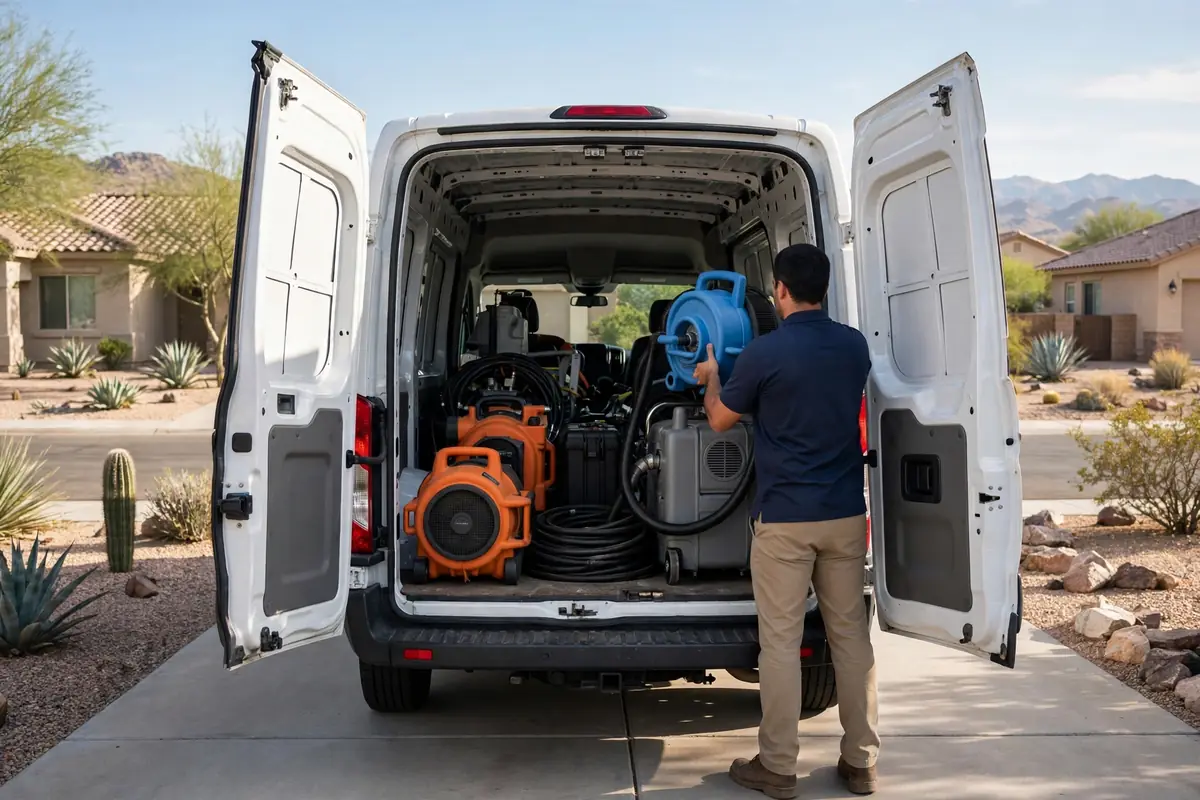
Tools & Technology We Use
Floors need different tools for different materials. Carpet, hardwood, tile, and concrete each hold water differently, so the crew matches the tool to the floor instead of treating every floor the same way.
Extractors. Extractors pull standing water and deep moisture out of carpet fibers and off hard floors so drying can start from a lower moisture level.
Weighted extraction tools. Weighted tools press down on carpet while extracting, squeezing water out of the carpet and the pad below it that a surface pass leaves behind.
Air movers. Air movers push dry air across floor surfaces and under lifted carpet edges so moisture releases from the floor and the subfloor.
Dehumidifiers. Dehumidifiers pull moisture out of the air in the drying area so floors dry through, not just on the surface.
Moisture meters. Pin and pinless meters read moisture in carpet, wood, concrete, and subfloors so the crew can tell when each layer is dry, not just the top.
Floor-specific tools. Hardwood drying mats, grout and tile cleaning tools, and subfloor probes handle the details that differ by floor type, from pulling moisture through wood boards to reading moisture under tile.
Frequently Asked Questions
Carpet soaked by clean water and dried within 24 to 48 hours can often be cleaned and saved, usually with new pad. Carpet soaked by sewage, floodwater, or contaminated water usually needs replacement, as does carpet that stayed wet for days or already shows mold on the backing.
In most cases, yes. Wet pad holds water against the subfloor, dries slowly, and becomes a site for mold and odor. Replacing pad is far less expensive than replacing carpet, and it gives the drying process a clean, dry base to work from.
Mild cupping often flattens as the floor dries evenly, especially when drying starts quickly. Do not sand a cupped floor before it is fully dry and acclimated, because sanding too early can cause crowning and a second round of refinishing.
Drying time depends on the floor type, the depth of saturation, and the subfloor. Surface drying may take a day or two, but full drying of hardwood, concrete, or subfloors often takes 3 to 5 days or longer. Moisture readings, not the calendar, determine when drying is complete.
The tile itself usually survives, but water can seep through grout lines into the underlayment and subfloor, loosening tiles and growing mold underneath. A tile floor that sounds hollow or feels spongy after a leak needs moisture testing.
Laminate with swollen seams, warped planks, or bubbling almost always needs replacement, because fiberboard cores do not shrink back after swelling. Laminate exposed only briefly to surface water may survive if it is dried quickly and the seams are intact.
Do not install new flooring until moisture readings confirm the subfloor is dry. Installing over hidden moisture traps water, damages adhesives and new flooring, and creates mold risk. Ask for the drying log and the final moisture readings before approving finish work.
It depends on the cause. Sudden and accidental events, such as a burst supply line, are often covered under a standard homeowners policy, while gradual leaks and flood damage usually are not. See our insurance claim help page for the full breakdown, and remember that page is general information only, not legal or financial advice.
Call Now for Carpet & Flooring Drying in Chandler
Water damage gets worse every hour it sits. Call RestoreNov now at (480) 701-8249 for live 24/7 carpet & flooring drying across Chandler and the East Valley. Fast response, moisture-verified drying, and insurance-ready documentation, all handled as one job. If you are standing in water right now, shut off the water source if it is safe, stay clear of electrical hazards, and call.
Request a Call Back
Tell us what happened and where the water is. For emergencies, calling is fastest - a live person answers 24 hours a day.
Prefer to talk now?
Call (480) 701-8249 any time, day or night.
We serve Chandler and the East Valley: Downtown Chandler, Ocotillo, Fulton Ranch, Sun Groves, Tumbleweed Park, South Chandler, Gilbert, Mesa, Tempe, Queen Creek, Sun Lakes, Ahwatukee, and Higley.
Our address:
1651-1683 E Germann Rd, Chandler, AZ 85286
Send a Message
For immediate help, call (480) 701-8249. A live person answers 24 hours a day.
Online messaging is not connected yet. For immediate help, call (480) 701-8249.