Sewage Cleanup in Chandler, AZ
A sewage backup is the most dangerous water damage emergency a Chandler homeowner can face. It is not a cleanup job.
A sewage backup is the most dangerous water damage emergency a Chandler homeowner can face. It is not a cleanup job. It is a health hazard that requires professional extraction, containment, removal of contaminated materials, sanitization, and drying, performed with protective equipment and a controlled process. Do not attempt to clean sewage yourself. Stay out of the water, keep children and pets out of the area, and call RestoreNov now at (480) 701-8249 for live 24/7 emergency sewage cleanup across Chandler and the East Valley.
Direct answer: Sewage cleanup is the professional process of removing Category 3 black water from a home, removing contaminated porous materials, cleaning and sanitizing all affected surfaces, drying the structure with moisture verification, and repairing damaged materials. Sewage water is grossly contaminated with bacteria, viruses, and parasites, and it must be treated as a health hazard. Professional cleanup uses protective equipment, containment, specialized extraction, EPA-registered disinfectants, and HEPA filtration. Do not use household tools, fans, or vacuums on sewage water.
What Happens When You Call
Calling starts a short, plain process. The three steps below describe what happens from the first call to a finished job.
Step 1 - Call and assessment. You describe what backed up, where the water is, and whether anyone has touched it. The person who answers asks about the rooms affected, the water source if you know it, and whether anyone in the home needs to stay clear of the area. That information shapes what the crew brings and which rooms get sealed off first.
Step 2 - Contain and remove. On arrival, the crew sets up containment around the affected rooms, removes standing contaminated water with extraction equipment, and takes out porous materials that cannot be cleaned, such as soaked carpet pad and saturated drywall sections. Affected hard surfaces are cleaned and treated, and the area is set up for drying.
Step 3 - Repair and verify. Once moisture readings show the structure is dry, damaged materials are rebuilt and finished. The crew walks the area with you, shows the dry readings, and notes what to watch for in the days after the job.

What Sewage Water Is, and Why It Is Dangerous
Restoration professionals classify water by contamination level. Category 1 is clean water, from a supply line break or a tub overflow without contaminants. Category 2 is gray water, with significant contamination, from a washing machine, dishwasher, or toilet overflow with urine but no feces. Category 3 is black water: grossly contaminated water, including sewage, floodwater from outside the structure, and water that has traveled through soil or waste lines. Sewage water is Category 3 by definition, and it is the most dangerous category.
Sewage water carries a concentrated load of biological hazards. It contains bacteria that cause gastrointestinal illness, skin infections, and respiratory infections. It contains viruses, including stomach viruses that spread easily through contact and aerosolized droplets. It contains parasites, including protozoa and helminths, that cause serious illness. It contains chemicals from household drains, cleaning products, and whatever else entered the waste system. It carries a heavy organic load that feeds mold growth once the water is removed, which is why sewage jobs carry elevated mold risk even after sanitization.
Exposure does not require drinking the water. Skin contact with sewage water, or with surfaces it touched, can cause infection through cuts, scrapes, or mucous membranes. Splashes can reach the eyes, nose, and mouth. Aerosolized droplets, created by walking through sewage water, by running a fan across it, or by flushing a toilet into a backed-up line, can be inhaled. That is why the first instruction on every sewage call is the same: stay out of the water, and do not run fans, vacuums, or household equipment in it.
Some people are more vulnerable than others. Children, older adults, pregnant people, and people with weakened immune systems, asthma, allergies, or chronic respiratory conditions face higher risk from sewage exposure. If anyone in your home falls into one of these groups, keep them completely away from the affected area, and tell the crew when you call so they can prioritize isolation of the area.
What This Service Covers
A sewage cleanup job covers the full path from contaminated water to a dry, rebuilt room. The list below describes the work that is part of this service.
- Removal of standing sewage water and solid waste from affected rooms
- Removal of contaminated porous materials that cannot be cleaned, such as carpet pad, soaked insulation, and saturated drywall
- Cleaning and treating of hard surfaces, floors, and fixtures in the affected area
- Drying of the structure with moisture readings taken before rebuild
- Rebuilding of removed drywall, trim, and flooring finishes
- Documentation of the work, including photos and moisture readings, for your records and your insurer
Why DIY Sewage Cleanup Is Unsafe
The temptation to clean up a small sewage backup yourself is understandable, and it is dangerous. Household cleaning products, rubber gloves, and a mop are not protection against Category 3 contamination, and do-it-yourself cleanup usually makes the problem worse in three ways.
First, household tools cannot remove contamination from porous materials. Carpet, carpet pad, drywall, insulation, particle board, and upholstered items absorb sewage water along with the bacteria, viruses, and parasites it carries. There is no reliable way to disinfect a carpet pad or a drywall core once sewage has soaked through. Bleach on the surface does not reach the contamination inside the material. Wiping the surface leaves the interior contaminated. Professional cleanup removes contaminated porous materials rather than trying to clean them in place, because removal is the only reliable way to eliminate the hazard.
Second, do-it-yourself cleanup spreads contamination. Walking through sewage water carries it on shoes into clean rooms. Mopping pushes it into grout lines, under baseboards, and into wall cavities. Running a household fan across sewage water aerosolizes pathogens and pushes them through the home. Flushing a toilet or running a faucet into a backed-up line adds more water to the backup. A professional crew works under containment, with a dirty-zone and clean-zone protocol, so contamination stays inside the work area instead of spreading through the home.
Third, do-it-yourself cleanup gives a false sense of completion. The floor looks clean. The smell fades. But bacteria remain in the carpet backing, in the wall cavity, in the subfloor, and in the grout lines. The area looks finished while it is still contaminated. Professional cleanup verifies completion with cleaning, sanitization, drying, and moisture readings, not with appearance.
If you have already touched sewage water, wash thoroughly with soap and clean water, change and wash contaminated clothing separately, and watch for symptoms of illness. If you feel ill after sewage exposure, seek medical attention and tell the provider you were exposed to sewage water.
What Causes a Sewage Backup in Chandler
Sewage backups have several causes, and identifying the cause helps you describe the problem when you call and helps prevent a repeat.
Monsoon storms and heavy rain. This is one of the most common Chandler causes. During a heavy monsoon storm, storm water enters the sewer system through inflow and infiltration, and the municipal sewer line can surcharge, meaning it fills beyond capacity and pushes wastewater backward through the lowest drains in your home. A backup that starts during or right after a heavy storm is often a surcharge backup. Homes with floor drains, basement-level fixtures, or plumbing at the lowest elevation on the street are the first to back up when the main surcharges.
Main sewer line blockage. A blockage in the main sewer line between your home and the street prevents wastewater from leaving the property, so it backs up through the lowest fixture. Blockages form from grease buildup, flushed non-flushable items such as wipes, paper towels, and hygiene products, collapsed or bellied pipe sections, and accumulated debris. A backup that affects multiple fixtures at once, especially the lowest fixtures, often points to a main line blockage.
Root intrusion. Tree roots seek moisture, and they find it in sewer lines through small joints, cracks, and connections. A root mass inside a sewer line catches debris, slows flow, and eventually blocks the line. Chandler landscaping, including trees planted near sewer laterals, makes root intrusion a recurring cause. Root intrusion often shows warning signs before a full backup: slow drains across multiple fixtures, gurgling sounds, and recurring clogs that return after clearing.
Aging and damaged sewer lines. Older sewer lines, especially clay and cast iron lines in older Chandler homes, crack, corrode, and collapse over time. A collapsed section blocks flow. A cracked section admits roots and soil. A bellied section, where the pipe sags and holds standing wastewater, accumulates solids and blocks. Sewer line condition is a plumber's assessment, and a camera inspection of the line is the standard diagnostic.
Septic system failure. Homes on septic systems face a different set of backup causes: a full or failing drain field, a blocked outlet filter, or a tank that needs pumping. A septic backup follows the same cleanup process as a sewer backup, because the contamination category is the same.
Improper use and flushing. Flushing wipes labeled flushable, paper towels, hygiene products, grease, and food waste contributes to blockages. Wipes do not break down the way toilet paper does, and they are a leading cause of residential sewer blockages. Grease poured down a kitchen drain solidifies in the line and catches debris.
The Professional Sewage Cleanup Process
Sewage cleanup follows a fixed sequence. Each step depends on the step before it, and skipping a step leaves contamination behind.
- 1. Emergency call and dispatch. Your call is answered live, 24 hours a day. You describe the water source, the affected rooms, whether the water is still rising, and whether anyone has been exposed. A crew is dispatched with extraction equipment, protective equipment, containment materials, moisture meters, air movers, dehumidifiers, and disinfectants.
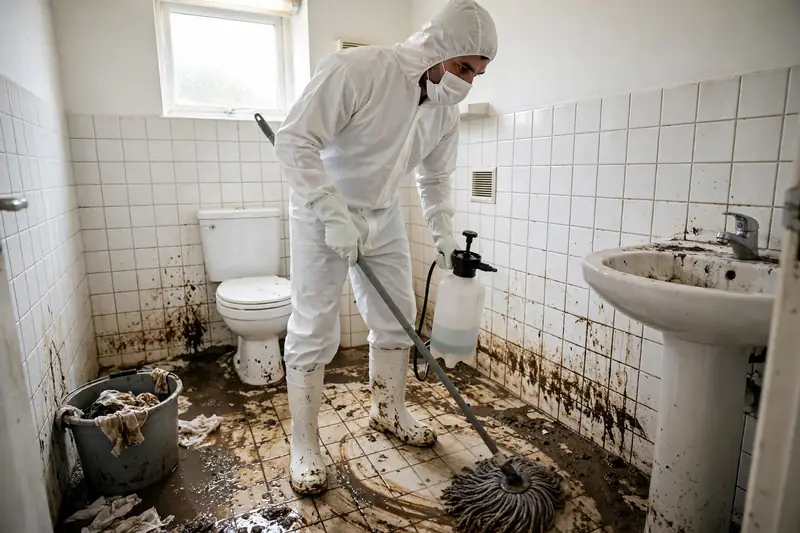
- 2. Safety and access control. On arrival, the crew restricts access to the contaminated area. Doors are closed, and containment barriers are set up. The crew puts on personal protective equipment: gloves, boots, full-body suits, eye protection, and respirators. Electrical hazards are checked, because sewage water near outlets, cords, or appliances carries the same shock risk as any standing water.
- 3. Assessment and containment. The crew assesses the extent of the contamination, including rooms the water reached under flooring and through wall cavities. Containment barriers, usually heavy plastic sheeting, seal the affected area from the rest of the home. Negative air pressure, created with HEPA-filtered air scrubbers, keeps airborne particles inside the work area instead of spreading them through the home. A dirty-zone and clean-zone protocol controls how crew members move in and out, so contamination does not travel on boots, tools, or clothing.
- 4. Extraction of sewage water and solids. Standing sewage water, solids, and debris are removed with specialized extraction equipment and pumps built for contaminated water. Recovered waste is contained and disposed of according to local regulations. The crew works from the least contaminated edge toward the most contaminated center where possible, so already-cleaned areas are not re-contaminated.
- 5. Removal of contaminated porous materials. This is the step that defines sewage cleanup. Carpet and carpet pad soaked with sewage are removed. Drywall that absorbed sewage, usually the lower portion, is cut out, often with a flood cut. Soaked insulation is removed. Upholstered furniture, mattresses, pillows, and soft items that sat in sewage are normally removed. Particle board and MDF that swelled are removed. These materials cannot be reliably sanitized in place, and leaving them in place means leaving contamination inside your home. The removed materials are bagged inside the containment area and disposed of as contaminated waste.
- 6. Deep cleaning. All remaining surfaces are cleaned thoroughly before disinfectant is applied, because disinfectants cannot work through a layer of grime and organic matter. Hard surfaces are scrubbed. Grout lines, corners, and transitions get detailed attention. Wall cavities opened by drywall removal are cleaned. Subfloors are cleaned. The cleaning step removes the organic load that disinfectants cannot penetrate.
- 7. Sanitization and disinfection. Cleaned surfaces are treated with EPA-registered disinfectants and antimicrobial products, applied at the label concentration and contact time. Contact time matters: a disinfectant must stay wet on the surface for the time specified on its label to be effective. Spraying and immediately wiping defeats the product. The crew follows label directions for every product used.
- 8. Odor treatment. Sewage odor comes from bacteria, organic matter, and gases trapped in materials. Odor treatment follows cleaning and sanitization, not the other way around. Once the source materials are removed and surfaces are sanitized, residual odor is treated with appropriate deodorizers and air scrubbing. Odor that persists after cleaning and sanitization usually means a contaminated material was missed, and the crew re-inspects rather than masking the smell.
- 9. Structural drying and dehumidification. Commercial air movers and LGR dehumidifiers dry the structure after sanitization, with daily moisture readings until materials reach their dry standard. Drying follows sanitization, not the other way around, so drying does not seal contamination inside walls. The full drying science is on the structural drying and dehumidification page.
- 10. Mold prevention and monitoring. Sewage jobs carry elevated mold risk, because the water was contaminated and the wetting often involved organic material that feeds mold. Fast, verified drying is the core of mold prevention. Where mold growth is found, containment and remediation steps are added. The full mold sequence is on the mold remediation after water damage page.
- 11. Repair and rebuild. Once the structure is verified dry and clean, damaged drywall, baseboards, flooring, paint, and trim are repaired or replaced. The goal is a room that looks and feels the way it did before the backup.
- 12. Final verification and documentation. Before the job is closed, the crew walks the space with you, reviews the final moisture readings, and confirms the scope is complete. You receive the documentation package, including photos, moisture readings, drying logs, and a written scope, for your records and your insurance carrier.
What Not To Do After a Sewage Backup
This list matters as much as the process, because the wrong action in the first hour can spread contamination through the home or make the crew's job harder.
- Do not walk through sewage water. Every step spreads contamination on shoes and splashes it onto surfaces. Stay out of the affected rooms entirely.
- Do not run household fans, air movers, or vacuums in sewage water. Fans aerosolize pathogens and push them into clean areas. Standard vacuums are not built for water and create a shock hazard.
- Do not flush toilets or run faucets. If the sewer line is blocked, every flush and every faucet adds water to the backup. Stop using all plumbing until the crew or a plumber tells you it is safe.
- Do not use household bleach as a substitute for professional sanitization. Bleach on a contaminated surface does not reach contamination inside porous materials, and it does not replace removal, cleaning, and disinfection with appropriate products at label contact times.
- Do not pull up flooring or cut drywall yourself. Controlled removal under containment is part of the professional job. Random cutting spreads contamination and opens cavities without containment.
- Do not move contaminated items through clean rooms. Carpet, furniture, and contents removed from the affected area must be bagged or contained before they pass through clean areas, or they will contaminate the path.
- Do not let children or pets into the area. Keep them completely away until the area is cleaned, sanitized, and dry.
- Do not delay calling. Every hour of delay gives contamination more time to soak into materials and spread, and gives mold more time to establish. Call immediately.
Sewage Backup and Your Plumbing: A Separate Job
Sewage cleanup and plumbing repair are separate jobs, and both are needed after a backup. The restoration crew handles extraction, removal, sanitization, drying, and repair of the water damage. A plumber handles the cause: clearing the blockage, repairing or replacing the damaged sewer line, removing root intrusion, or servicing the septic system. The restoration crew does not diagnose or repair sewer lines, and the plumber does not clean up contamination.
Call both at the same time. The plumber's camera inspection and line clearing should happen promptly, because a backup that is cleaned up without fixing the cause will simply recur. The restoration crew coordinates timing so sanitization and drying are not undone by a second backup. If the backup was caused by a municipal surcharge during a storm, report it to your local utility as well, because surcharge backups can affect multiple homes on the same line, and the utility needs to know.
A backwater valve, installed by a plumber on the main sewer line, can prevent future surcharge backups by allowing wastewater to flow out while blocking reverse flow back into the home. Ask your plumber whether a backwater valve is appropriate for your home, especially if you have backed up before or if your fixtures sit at the lowest elevation on the street.
Insurance: Sewage Backups and Coverage
This section is general information, not insurance advice. Your policy wording controls your coverage, and your insurance agent or adjuster is the authority on your specific claim.
Sewer backup coverage is usually a separate endorsement, not part of a standard homeowners policy. Many standard policies exclude sewer and drain backups under the base policy, and coverage requires a sewer backup or water backup endorsement purchased separately, often with its own sub-limit. Common sub-limits are 5,000, 10,000, or 25,000 dollars, though limits vary by carrier and policy. Check your declarations page for an entry like sewer backup or water backup of sewers and drains, and ask your agent what it covers before you need it.
Flood insurance does not necessarily cover a sewer backup, and a sewer backup endorsement does not necessarily cover flood damage. The two are separate coverages with separate triggers. A backup caused by a municipal surcharge during a storm may fall into a gray area between the two, which is why documentation and prompt reporting matter. Photograph the backup, the affected rooms, and every damaged item before anything is moved or removed. Keep a written log of every call, including the time and who you spoke with. Keep every receipt. We document the loss with photos, moisture readings, drying logs, and a written scope, so your adjuster has what is needed.
Do not wait for an adjuster before mitigating. Mitigation, meaning extraction, removal of contaminated materials, sanitization, and drying, should start immediately. Waiting for an adjuster while sewage sits in your home makes the contamination worse and can complicate the claim. Document first, then mitigate.
Sewage Cleanup by Room: What to Expect
Bathrooms. The most common backup entry point, because toilets, tubs, and floor drains are the lowest fixtures. Tile floors survive, but water seeps through grout into the subfloor and wall cavities. Vanities with particle board bases usually do not survive. Toilets and tubs that backed up need thorough cleaning and sanitization, and the plumbing cause must be fixed before they are used again.
Laundry rooms and utility rooms. Floor drains are a common backup entry point. Washers and dryers that sat in sewage need professional inspection before use. Stored items, especially soft goods and cardboard boxes, that sat in sewage are normally removed.
Kitchens. Kitchen drains and dishwashers can back up into sinks and onto floors. Cabinets with particle board or MDF bases usually do not survive sewage exposure. The area under cabinets hides contamination and needs cavity access to clean and dry fully.
Living areas and bedrooms. Sewage that backs up through a floor drain or toilet can spread across ground-floor living areas and bedrooms. Carpet and pad in the path are removed. Baseboards and lower drywall along the path are removed. Furniture with upholstered or particle board construction that sat in sewage is normally removed.
Garages. Garage floor drains can back up during a surcharge. Concrete floors are cleaned and sanitized. Stored items on the floor that sat in sewage are normally removed. The interior garage door and wall bases need attention, because sewage water wicks into drywall at the floor line.
Preventing the Next Sewage Backup
You cannot control a municipal surcharge, but you can reduce your backup risk.
- Never flush wipes, paper towels, hygiene products, or grease. Wipes labeled flushable do not break down like toilet paper and are a leading cause of residential sewer blockages. Grease poured down a kitchen drain solidifies in the line and catches debris.
- Have your sewer line inspected. If your home is older, if you have recurring slow drains or gurgling, or if you have backed up before, ask a plumber for a camera inspection of the main sewer line. A camera inspection finds root intrusion, cracks, bellies, and blockages before they cause a backup.
- Manage trees near sewer lines. If you plant trees, keep them away from the sewer lateral route. If existing trees sit over the line, a plumber can advise on root management and monitoring.
- Ask your plumber about a backwater valve. A backwater valve blocks reverse flow from a surcharging municipal line into your home. It is one of the most effective protections against storm-related backups.
- Check your sewer backup endorsement. Confirm that your policy includes a sewer backup endorsement, and that the sub-limit is enough to cover a realistic cleanup. If you do not have the endorsement, ask your agent about adding it before you need it.
- Know the warning signs. Slow drains across multiple fixtures, gurgling sounds from drains or toilets, recurring clogs that return after clearing, and a sewage smell near floor drains are early warnings. Act on them before they become a backup.
Areas We Serve in Chandler and the East Valley
We provide sewage cleanup across Chandler and the surrounding East Valley. Our address is 1651-1683 E Germann Rd, Chandler, AZ 85286, and our crews come to you.
Serving Chandler and the East Valley: Downtown Chandler, Ocotillo, Fulton Ranch, Sun Groves, Tumbleweed Park, Gilbert, Mesa, Tempe, Queen Creek, Sun Lakes, Ahwatukee, Higley.
We also serve homeowners in Andersen Springs, Pecos Ranch, Clemente Ranch, Fox Crossing, Cooper Commons, and Dobson Place.
Tools & Technology We Use
Sewage work uses a different tool set from clean-water work, because every surface and every tool that touches the water must be treated as contaminated. The tools below are the ones that shape how the job is done.
Protective gear. Gloves, boots, eye protection, and respirators keep the crew from direct contact with contaminated water and splashes while they work.
Extraction equipment for contaminated water. Pumps and wet vacuums rated for dirty water pull standing sewage out of rooms and off hard floors so cleaning can start.
Containment materials. Plastic sheeting and tape seal off affected rooms so contaminated air and debris do not spread into clean parts of the home during removal.
HEPA filtration. Air filtration units with HEPA filters capture fine particles stirred up during removal and cleaning, and help keep the work area air cleaner while the crew works.
Antimicrobial treatment. Cleaning and treating products, used according to label directions, are applied to hard surfaces after solids and water are removed.
Moisture meters. Pin and pinless meters read moisture inside drywall, framing, and subfloors so the crew can tell when the structure is dry enough to rebuild.
Disposal handling. Contaminated materials are bagged, sealed, and removed from the home for disposal, rather than carried loose through clean rooms.
Safe for Family and Pets
During sewage cleanup, keep family members and pets out of the affected rooms until the crew says the area is ready to re-enter. Containment sheeting stays in place while removal and cleaning are underway, and air filtration runs during the work to capture particles stirred up by removal. Cleaning and treating products are used according to label directions, and treated surfaces are left to dry before rooms are put back into use. If anyone in the home has asthma, allergies, a weakened immune system, or another condition that makes exposure riskier, tell the crew when you call so the affected area can be sealed off first.
Frequently Asked Questions
Yes. Any amount of sewage water is Category 3 black water, and it carries the same categories of pathogens regardless of volume. A small backup still requires professional extraction, removal of contaminated porous materials, sanitization, and drying. Volume changes the scope, not the hazard category.
It depends on the scope. A small backup confined to one bathroom may allow you to stay, with the affected area sealed off. A multi-room backup, or a job with containment and heavy equipment, may make parts of the home unusable for days. Your crew will tell you what to expect before work starts. Keep children, pets, and vulnerable household members completely away from the affected area.
Extraction and removal happen on the first visit. Cleaning and sanitization follow. Structural drying for most residential sewage jobs takes 3 to 5 days of equipment run time with daily moisture checks. Repairs follow once moisture readings confirm the structure is dry. Large or multi-room jobs take longer, and your written scope will include a timeline for your specific job.
No, in almost all cases. Carpet and carpet pad soaked with sewage are removed, not dried, because they cannot be reliably sanitized once Category 3 contamination has soaked through. Replacement carpet and pad become part of the repair scope.
No. Bleach does not reach contamination inside porous materials, and it does not replace removal, cleaning, and disinfection with appropriate products at label contact times. Do not attempt to clean sewage yourself. Call a professional crew.
Flood events commonly cause sewer backups, because storm water surcharges the municipal sewer line. Tell the crew when you call, because the combination changes the safety steps and the scope. The full flood sequence is on the flood damage restoration page.
Sewer backup coverage is usually a separate endorsement with its own sub-limit, not part of a standard homeowners policy. This is general information, not advice about your policy. Check your declarations page and ask your agent or adjuster about your specific coverage.
Wash thoroughly with soap and clean water, change and wash contaminated clothing separately, and watch for symptoms of illness. If you feel ill after sewage exposure, seek medical attention and tell the provider you were exposed to sewage water.
Call Now for Sewage Cleanup in Chandler
Sewage is a health hazard, not a cleanup job. Call RestoreNov now at (480) 701-8249 for live 24/7 emergency sewage cleanup across Chandler and the East Valley. Professional extraction, containment, removal of contaminated materials, sanitization, moisture-verified drying, and insurance-ready documentation, all handled as one job. Stay out of the water, do not run fans or vacuums in it, do not flush toilets or run faucets, and call now.
Request a Call Back
Tell us what happened and where the water is. For emergencies, calling is fastest - a live person answers 24 hours a day.
Prefer to talk now?
Call (480) 701-8249 any time, day or night.
We serve Chandler and the East Valley: Downtown Chandler, Ocotillo, Fulton Ranch, Sun Groves, Tumbleweed Park, South Chandler, Gilbert, Mesa, Tempe, Queen Creek, Sun Lakes, Ahwatukee, and Higley.
Our address:
1651-1683 E Germann Rd, Chandler, AZ 85286
Send a Message
For immediate help, call (480) 701-8249. A live person answers 24 hours a day.
Online messaging is not connected yet. For immediate help, call (480) 701-8249.