Emergency Water Extraction in Chandler, AZ
If you are standing in water right now, call (480) 701-8249. Emergency water extraction is the first and most urgent step in water damage restoration, and it is the step that decides how bad the rest of the job gets.
If you are standing in water right now, call (480) 701-8249. Emergency water extraction is the first and most urgent step in water damage restoration, and it is the step that decides how bad the rest of the job gets. RestoreNov answers live 24 hours a day and dispatches crews with truck-mounted and portable extraction equipment across Chandler and the East Valley. The goal of this page is simple: explain exactly what emergency water extraction is, what happens when the crew arrives, what you should do before they get there, and why speed matters more than any other single factor in your recovery.
Direct answer: Emergency water extraction is the professional removal of standing water and absorbed water from floors, carpet, tile, hardwood, concrete, and wall bases using truck-mounted extractors, portable extractors, and submersible pumps. It is the first step after the water source is stopped. Fast extraction removes the bulk of the water in minutes to hours, shortens drying time by days, and is the single most effective way to limit mold growth, material damage, and repair cost. Extraction is not drying. Extraction removes liquid water. Drying removes the moisture left inside materials after extraction, and both steps are required.
What Happens When You Call
Here is the short version of what happens when you call (480) 701-8249.
- Step 1 - Call and assessment. Tell us where the water is, what caused it if you know, and which rooms are affected. We ask about the water source, whether the water looks clean or dirty, and whether water is near outlets or appliances, so the crew arrives with the right equipment and safety plan.
- Step 2 - Extract and dry. The crew removes standing water with pumps and extractors, checks moisture in floors and wall bases, and places air movers and dehumidifiers to start drying on the same visit.
- Step 3 - Repair and verify. Once moisture readings show materials are dry, damaged materials are cleaned or repaired, and the readings are recorded so you have a written record of the job.
What Emergency Water Extraction Is
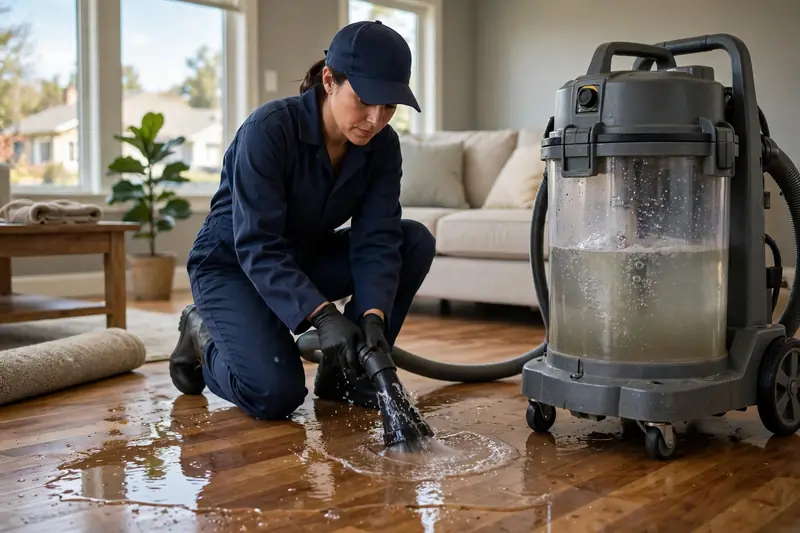
Water extraction means physically pulling liquid water out of your home. It covers standing water you can see, water trapped in carpet and carpet pad, water sitting on tile and in grout lines, water pooled on hardwood, water that has run under baseboards and into wall cavities, and water absorbed into the top layer of concrete. A professional crew does not mop. Mopping moves water around. Extraction lifts it out of materials and carries it out of the building through a hose, so the water leaves your home for good.
Extraction is measured by what it prevents. Every gallon removed by an extractor is a gallon that does not have to be evaporated out of your drywall, framing, subfloor, and insulation over the following days. Evaporation is slow. Extraction is fast. That is why extraction always comes first, before drying equipment is placed, before any demolition, and before any repair work is considered. A job that starts with thorough extraction dries faster, costs less, and leaves less moisture behind for mold to feed on.
Extraction also protects materials that are still salvageable. Carpet that is extracted within hours often survives. The same carpet left soaking for a day often does not, because the pad beneath it breaks down, the backing delaminates, and bacteria and odor set in. Hardwood that is extracted quickly and dried promptly can often be saved. Hardwood left under standing water cups, warps, and buckles, and then replacement becomes the only option. Speed at the extraction stage is what keeps a drying job from becoming a rebuild job.
What This Service Covers
Emergency water extraction covers the removal of liquid water from your home and the moisture checks that follow it. The checklist below shows what is part of this service.
- Standing water removal from floors, garages, and other low areas
- Water trapped in carpet and carpet pad
- Water on tile, hardwood, laminate, vinyl, and concrete
- Water that ran under baseboards and into wall bases
- Water in ceilings from an overhead leak
- Moisture checks in adjoining rooms the water may have reached
- Drying equipment placed to follow extraction
- Photos, moisture readings, and a written scope for your records
Repair of the water source itself, such as a burst pipe or a roof leak, is a separate trade and is not part of extraction.
Why Speed Matters More Than Anything Else
Water does not sit still, and it does not wait for a convenient time. Within minutes of a leak or flood, water spreads across the floor and starts wicking up drywall. Drywall is thirsty. It pulls water upward through capillary action, and the water line inside the wall can climb well above the level of the water on the floor. Within hours, water reaches subfloors, insulation, baseboards, and the bottoms of door frames. Within 24 to 48 hours, published industry guidance says mold growth can begin in wet materials, and in warm Arizona conditions the fast end of that window is a real risk.
Speed also controls cost in a direct way. A leak that is extracted and dried on day one is often a drying job. The same leak left for three days can become a demolition and rebuild job, because materials that could have been dried in place pass the point of recovery and must be torn out and replaced. Delay also gives water time to reach rooms you never saw get wet. Moisture travels along framing, under flooring, through concrete, and inside wall cavities, so a leak in a laundry room can show up as a damp baseboard in a bedroom two rooms away.
There is one more reason speed matters in Chandler specifically. Air conditioning runs most of the year, and many homes keep indoor temperatures in the 70s even when it is over 100 degrees outside. Warm indoor air speeds evaporation from wet surfaces, which raises indoor humidity and pushes moisture deeper into dry materials. Attic spaces run far hotter, which accelerates drying of attic insulation in one sense but also bakes moisture into ceiling drywall from above after an AC condensate overflow or a roof leak. Fast extraction breaks this cycle before it starts.
Call as soon as you find the water. If you are waiting for a plumber to fix the source, call the restoration team at the same time. Extraction and drying can begin while the plumbing repair is scheduled, and early action is the single most effective way to limit both damage and cost.
Truck-Mounted Extractors vs Portable Extractors
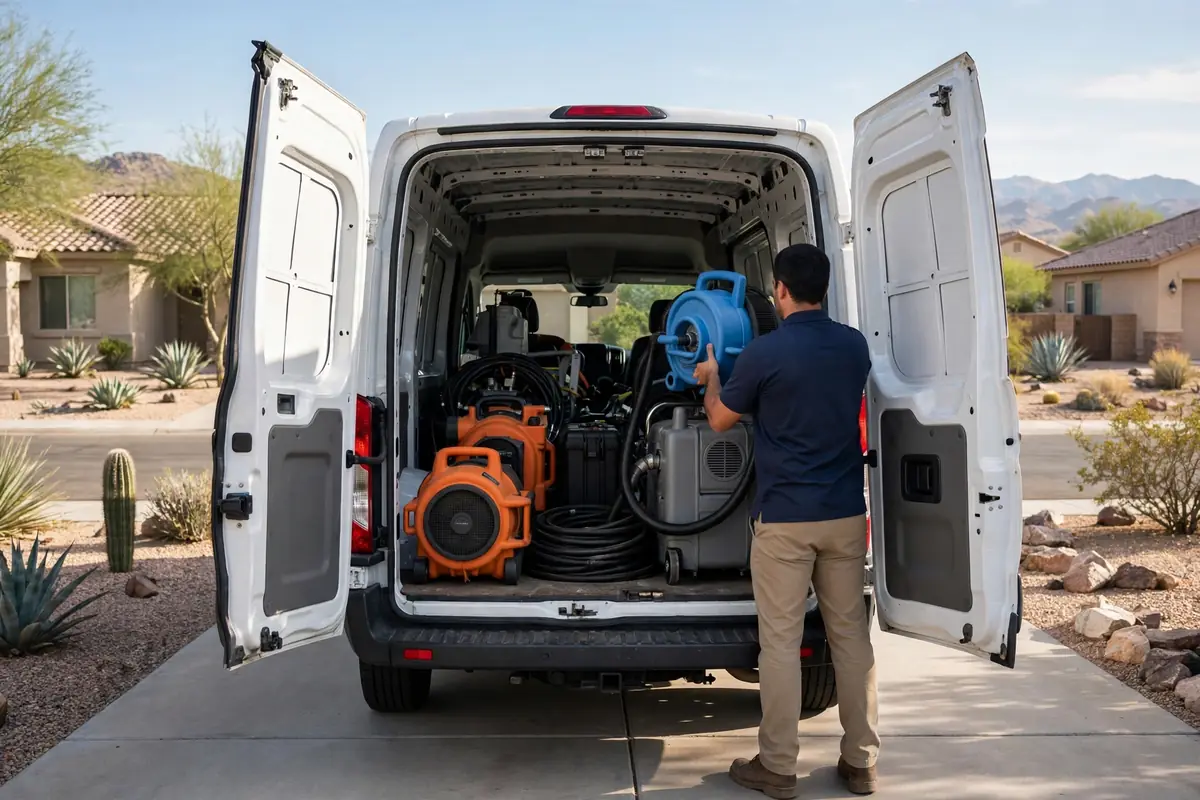
Not all extraction equipment is the same. A professional crew carries more than one type, and the choice depends on the size of the loss, the floor type, the location of the water, and how much water is present. Understanding the two main types helps you understand what is happening in your home.
Truck-Mounted Extractors
A truck-mounted extractor is a high-capacity unit mounted in the service vehicle, powered by the truck engine or a dedicated power unit. A long vacuum hose runs from the truck into your home, and a technician works the extraction wand across floors and carpet. Truck-mounted units deliver the strongest vacuum lift and the highest water removal rate of any extraction equipment. They can pull thousands of gallons in a single job without stopping, because the recovered water goes into a large holding tank on the truck rather than a small onboard tank that must be emptied every few minutes.
Truck-mounted extraction is the best choice for large losses: a flooded room or several rooms, a burst pipe that released a large volume, a monsoon intrusion that covered a ground floor, or any job where standing water is more than a thin layer. The strong vacuum also pulls more water out of carpet and pad in a single pass than a portable unit can, which matters because carpet pad holds water like a sponge and is one of the hardest materials to dry.
Truck-mounted units have one limitation. The hose has a practical length limit, and the truck must be able to park within reach of the affected rooms. In most Chandler single-family homes this is not a problem. For upper floors, long setbacks, or gated properties where the truck cannot get close, the crew switches to portable equipment.
Portable Extractors
A portable extractor is a self-contained unit on wheels that is rolled into the affected room. It has its own vacuum motor, recovery tank, and pump-out hose. Portable units are used where a truck-mounted hose cannot reach, in upper-floor rooms, in tight spaces, in homes with long driveways or restricted access, and for smaller losses where a full truck setup is more than the job needs. They are also used for detail work after the bulk of the water is gone, such as extracting water from a closet, a bathroom corner, or the edge of a room.
Portable extractors trade raw power for access. A good commercial portable unit still pulls far more water than any household wet vacuum, and it is built to run continuously with a pump-out that sends recovered water to a drain or outside. The crew empties or pumps out the recovery tank as it fills, so the work does not stop.
Submersible Pumps
When standing water is deep, usually more than about two inches, the crew starts with a submersible pump rather than an extractor. A submersible pump sits in the water and pushes it out through a discharge hose at a high flow rate. Once the water level drops to a thin layer, the crew switches to an extractor for the remaining water and the water absorbed in flooring and carpet. Using the right tool at each stage is what keeps the job fast. Pumps move bulk water. Extractors remove the water that pumps leave behind.
Weighted Extraction Tools and Carpet Wands
For carpeted areas, the crew may use a weighted extraction tool, sometimes called a ride-on or walk-behind extractor head. The weight of the tool compresses the carpet and pad against the subfloor, squeezing trapped water out of the pad where a standard wand cannot reach it. This step is one of the main differences between professional extraction and do-it-yourself cleanup. A household wet vacuum passes over the top of the carpet. A weighted tool presses into the pad and pulls the water out of the layer that holds the most moisture and causes the most odor and mold risk.
What Happens When the Crew Arrives
Knowing the sequence removes the stress of not knowing what comes next. Here is what happens, step by step, when the extraction crew reaches your Chandler home.
- 1. Safety check and source control. The crew confirms the water source is stopped or helps you stop it. They check for electrical hazards: water near outlets, cords, appliances, or the electrical panel. If water is near electrical equipment, power to the affected rooms is switched off before anyone steps into standing water. For sewage water, the crew puts on protective equipment and restricts access before any other work begins.
- 2. Inspection and moisture mapping. Before extraction starts, the crew inspects every affected area and the rooms next to it. Moisture meters measure saturation in drywall, flooring, and framing. Thermal imaging cameras reveal temperature differences that point to hidden moisture behind walls and under floors. This mapping matters because water spreads further than the visible puddle. The moisture map sets the extraction plan and the drying plan, and it becomes part of the documentation package for your insurance carrier.
- 3. Furniture and contents protection. Furniture, rugs, electronics, documents, and personal items are moved out of wet areas or blocked up off the floor. Wooden furniture legs get foil or wood blocks underneath to slow staining and moisture absorption. Contents that are already wet are set aside for drying or cleaning. This step happens before extraction in rooms where furniture is sitting in water, because furniture left in standing water absorbs moisture and adds to the drying load.
- 4. Bulk water removal. Submersible pumps remove deep standing water. Truck-mounted or portable extractors remove the remaining water. The crew works in a pattern, usually from the driest edge toward the wettest center, so already-extracted areas are not re-wetted by foot traffic. On carpet, the crew may lift the carpet at the edges to extract water from the pad and subfloor directly, because pad that stays wet under carpet is one of the most common sources of lingering odor.
- 5. Detail extraction by floor type. After bulk removal, the crew extracts water from each floor type with the right tool and technique, covered in detail in the next section. Baseboards may be removed or drilled with small holes so water trapped behind them can be extracted and the wall cavity can be dried. This is a controlled, repairable step, not damage. It is far better than leaving water sealed inside a wall.
- 6. Written scope and next steps. Before the crew leaves, you get a written scope of what was extracted, what materials were affected, what drying equipment will be placed, and what happens next. Drying equipment is usually placed the same visit, because extraction and drying are one job, not two separate appointments. If materials must be removed, the crew explains what and why before cutting anything.
Extraction by Floor Type
Water behaves differently on every floor type, and the extraction approach changes with it. This is one of the reasons generic cleanup advice fails. The right technique for tile will damage hardwood, and the right technique for carpet does nothing for concrete.
Carpet and Carpet Pad
Carpet is the most common floor covering in Chandler bedrooms and living areas, and it hides the most water. The carpet fibers themselves hold relatively little water. The pad underneath holds a great deal, and the subfloor under the pad holds more. A carpet that feels damp on top can have a pad that is fully saturated.
Extraction on carpet uses a wand or weighted tool worked slowly across the surface, with overlapping passes. Slow passes matter. A fast pass pulls surface water. A slow pass gives the vacuum time to pull water up out of the pad. Where the pad is heavily saturated or the water is contaminated, the crew lifts the carpet, removes the pad, and extracts the subfloor directly. Carpet pad is inexpensive relative to the cost of drying it, and pad soaked with gray water or black water is normally removed rather than dried, because it cannot be reliably sanitized in place.
After extraction, carpet is usually laid back down over a dry surface or left pulled back with air movers drying the subfloor beneath it. Carpet that is extracted quickly, from a clean water source, usually survives. Carpet that sat in standing water for a day or more, or that was soaked by contaminated water, usually does not, and replacement becomes part of the repair scope.
Tile and Grout
Tile itself is waterproof, which fools many homeowners into thinking a tile floor is fine after a flood. The problem is everything around the tile. Grout lines are porous. Water seeps through grout into the thinset and subfloor below. Water runs under baseboards and into the wall cavity behind the tile. Water finds the expansion joint at the edge of the room and travels under adjacent flooring.
Extraction on tile focuses on removing standing water quickly, then extracting water from grout lines, edges, and transitions. The crew checks the rooms on the other side of tile walls, because water that went under a tile floor in a bathroom often shows up in the drywall and flooring of the adjoining room. Tile floors also hide a specific risk in Chandler homes: a slab leak under a tile floor can push water up through grout lines for days before anyone notices, because the tile surface looks almost normal while the subfloor and wall bases are saturating.
Hardwood and Laminate
Hardwood is the floor type most at risk from delayed extraction. Wood absorbs water, swells, and then cups, warps, and buckles as it dries unevenly. Laminate is worse in one way: its fiberboard core swells when wet and does not return to its original shape, so laminate that has absorbed significant water usually must be replaced.
Extraction on hardwood uses a low-profile wand or a specialized hardwood extraction mat system, worked gently to avoid scratching the finish. The crew avoids standing on wet hardwood with heavy equipment, because pressure on saturated boards can cause permanent indentations. Speed is everything here. Hardwood that is extracted within hours and dried with controlled airflow and dehumidification often returns close to its original shape. Hardwood left under water for a day or more often cups beyond recovery, and sanding and refinishing cannot fix boards that have buckled.
Concrete and Slab Floors
Many Chandler homes have concrete floors in garages, utility rooms, and patios, and every Chandler home has a concrete slab under its finished flooring. Concrete looks solid, but it is porous. It absorbs water, holds it, and releases it slowly over days. Extraction on bare concrete uses a squeegee wand that pushes water ahead of the vacuum head, followed by slow extraction passes. In a garage or utility room, the crew also extracts water from stored items, the bottoms of cabinets, and the wall bases, because concrete wicks water sideways into drywall at the floor line.
The bigger issue with concrete is what sits on top of it. Carpet pad over concrete, laminate over concrete, and hardwood over concrete all trap water between the flooring and the slab. Extraction must reach that trapped layer, which is why the crew lifts flooring edges and checks moisture readings in the slab itself, not just on the surface.
Vinyl and Luxury Vinyl Plank
Vinyl plank flooring is common in Chandler homes because it handles desert living well. It is water resistant at the surface, but water gets into the seams and underneath the planks, where it sits on the subfloor and cannot evaporate. Extraction on vinyl plank includes removing water from the surface, then checking seams and edges for trapped water. Planks that have lifted or buckled are usually removed so the subfloor can be dried. Planks that are still flat and tight can often stay in place while the subfloor dries beneath them, with moisture readings confirming progress.
What To Do Before the Crew Arrives
If you can do these things safely, they help. If any step puts you in standing water near electricity, or in contaminated water, skip it and wait for the crew.
- Stay safe first. Do not walk through standing water where it may reach outlets, cords, or appliances. If water is near electrical equipment, switch off the breaker for the affected rooms, and only if you can reach it without standing in water.
- Stop the water. Shut off the main water valve, or the valve on the leaking fixture or appliance. In most Chandler homes the main shutoff is at the street meter box, the front hose bib, or the garage. For an AC leak, turn off the system at the thermostat.
- Document everything. Photograph and video every affected room, ceiling, and item before anything is moved or removed. Keep a written log of every call you make, including the time and who you spoke with. This documentation supports your insurance claim.
- Move valuables and small furniture. If you can do it safely, move documents, electronics, rugs, and small furniture out of wet rooms. Put foil or wood blocks under wooden furniture legs to slow staining.
- Do not use a household vacuum on standing water. Standard vacuums are not built for water and create a shock hazard. Do not run household fans across contaminated water, because they spread contaminants into the air.
- Do not pull up flooring or cut drywall yourself. Controlled removal is part of the professional job. Random cutting opens wall cavities to contamination and makes the repair scope bigger, not smaller.
- Call your insurance company to report the loss and get a claim number, then call the restoration crew for extraction and drying. Keep every receipt and record.
Extraction vs Drying: Why You Need Both
Extraction and drying are different jobs, and confusing them is the most common and most expensive mistake homeowners make after water damage. Extraction removes liquid water you can see and feel. Drying removes the moisture that remains inside materials after extraction: the water inside drywall, framing, subfloors, insulation, and concrete. A room can look completely dry after extraction and still hold enough hidden moisture to grow mold and rot framing over the following weeks.
Drying uses commercial air movers and low-grain refrigerant (LGR) dehumidifiers, placed in a calculated layout, running for days with daily moisture readings. Drying is complete when moisture meters confirm materials have reached their dry standard, not when surfaces feel dry to the touch. Extraction without drying leaves hidden moisture. Drying without extraction wastes days evaporating water that an extractor could have removed in minutes. The two steps work as a sequence, and both are covered in the written scope before work begins. Full detail on the drying step is on the structural drying and dehumidification page.
What Extraction Does Not Do
Honest expectations matter. Extraction does not fix the source of the water. A plumber fixes a burst pipe. An HVAC technician fixes an AC condensate drain. A roofer fixes a roof leak. Extraction removes the water the source already released. Extraction does not repair damaged materials. Drywall, baseboards, flooring, and paint that have passed the point of recovery are repaired after drying, not during extraction. Extraction does not guarantee that every material is salvageable. It gives every salvageable material its best chance, and it documents which materials cannot be saved so your insurance scope is accurate.
Extraction also does not remove contamination by itself. After gray water or black water, extraction is followed by removal of contaminated porous materials, cleaning, and sanitization. After clean water, extraction is followed by drying and monitoring. The extraction step is the same in both cases. What follows it changes with the water category.
Common Extraction Situations in Chandler Homes
Chandler homes produce a specific set of extraction calls. Each has its own pattern, and recognizing yours helps you describe it accurately when you call.
Burst pipe or supply line failure. A large volume of clean water, often discovered hours after it started because the leak was behind a wall or under a sink. Extraction is usually heavy, multi-room, and urgent, because the water has had time to spread. See the burst pipe and slab leak page for the full picture.
AC condensate overflow. Water from an attic air handler drips through insulation and ceiling drywall, often into a room that is not used every day. Extraction may involve a small amount of standing water on the floor plus a saturated ceiling cavity above. Ceiling safety matters here, and the full ceiling sequence is on the ceiling and wall water damage repair page.
Slab leak. Water migrates up through the slab and appears as damp flooring, often far from the actual leak. Extraction is usually moderate in volume but wide in area, because the water has spread through concrete. Detection and plumber coordination come first, and drying follows the repair.
Appliance leak. A washing machine hose, dishwasher connection, refrigerator ice maker line, or reverse osmosis drain can release a large volume quickly or a slow volume over days. Extraction covers the kitchen, laundry room, or garage, plus the rooms the water reached under flooring and through walls.
Monsoon intrusion and flooding. Storm water enters through roof valleys, window frames, door thresholds, and garage entries. Floodwater is Category 3 black water even if it looks clear, because it has picked up contaminants on its way into your home. Extraction follows black water protocols. See the flood damage restoration page.
Sewage backup. Contaminated water comes up through floor drains, tubs, and toilets. This is Category 3 black water and a health hazard. Stay out of the water and call immediately. Extraction follows full containment and protective equipment protocols. See the sewage cleanup page.
Areas We Serve in Chandler and the East Valley
We provide emergency water extraction across Chandler and the surrounding East Valley. Our address is 1651-1683 E Germann Rd, Chandler, AZ 85286, and our crews come to you.
Serving Chandler and the East Valley: Downtown Chandler, Ocotillo, Fulton Ranch, Sun Groves, Tumbleweed Park, Gilbert, Mesa, Tempe, Queen Creek, Sun Lakes, Ahwatukee, Higley.
We also serve Chandler neighborhoods including Andersen Springs, Pecos Ranch, Clemente Ranch, Fox Crossing, Cooper Commons, and Dobson Place.
Tools & Technology We Use
The extraction crew brings more than one kind of equipment, because no single tool fits every loss. Each tool below does a different part of the job.
- Submersible pumps move deep standing water out first, where an extractor alone would take too long. Pumps are used when water is inches deep.
- Truck-mounted extractors high-powered vacuum and water lift run from the vehicle, pulling large volumes of water from carpet and floors in long, slow passes.
- Portable extractors self-contained units carried into rooms a truck hose cannot reach easily, such as upstairs rooms and tight spaces.
- Weighted extraction tools a weighted head presses carpet and pad down as it passes, squeezing water out of the pad that a standard wand leaves behind.
- Moisture meters pin and pinless meters measure how much moisture is inside drywall, flooring, and framing, so the crew knows where water traveled beyond the visible puddle.
- Thermal imaging an infrared camera shows surface temperature patterns that point to cooler, damp areas behind walls and under floors, guiding where to check with a meter.
Frequently Asked Questions
Emergency calls are answered live 24 hours a day, and crews are dispatched right away with extraction equipment on board. Arrival time depends on your location and current call volume, and you will be given a realistic arrival window when you call.
A single-room clean water extraction often takes one to three hours on site. A multi-room flood or a large burst pipe can take half a day or more. The time depends on water volume, floor type, and how far the water spread. Extraction happens on the first visit, and drying equipment is usually placed the same visit.
A household wet vacuum removes surface water from a small spill, but it cannot match the vacuum lift, flow rate, or pad extraction of professional equipment, and it cannot reach water inside wall cavities or under flooring. For anything beyond a small spill that you caught within minutes, professional extraction plus moisture-verified drying is the safer choice. Never use a standard household vacuum on standing water.
Carpet soaked by clean water and extracted within hours usually survives, though the pad underneath often needs replacement. Carpet soaked by gray water or black water, or carpet left wet for a day or more, usually does not survive, and replacement becomes part of the repair scope. The crew will tell you which outcome applies to your carpet before work begins.
Both. Water in ceilings and wall cavities is extracted through controlled openings, and wall bases may be opened with a flood cut so trapped water can be removed and the cavity can be dried. The full wall and ceiling sequence is on the ceiling and wall water damage repair page.
Stay out of the water, do not run household fans or vacuums in it, and call immediately. Sewage water is Category 3 black water and requires professional extraction, sanitization, and removal of contaminated porous materials. Do not attempt to clean it yourself. See the sewage cleanup page.
Most standard homeowners policies cover sudden and accidental water damage, such as a burst pipe or a sudden appliance failure, and extraction is part of that covered mitigation. They generally do not cover gradual leaks that were ignored, or flood damage from outside rising water, which usually requires separate flood insurance. We document the loss with photos, moisture readings, and a written scope so your adjuster has what is needed.
Drying begins. Commercial air movers and LGR dehumidifiers are placed in a calculated layout, moisture readings are taken daily, and equipment stays in place until materials reach their dry standard. Then cleaning, sanitizing, mold prevention checks, and repair follow. Full detail is on the structural drying and dehumidification page.
Call Now for Emergency Water Extraction in Chandler
Water damage gets worse every hour it sits. Call RestoreNov now at (480) 701-8249 for live 24/7 emergency water extraction across Chandler and the East Valley. Fast truck-mounted and portable extraction, moisture mapping, moisture-verified drying, and insurance-ready documentation, all handled as one job. If you are standing in water right now, shut off the water source if it is safe, stay clear of electrical hazards, and call.
Request a Call Back
Tell us what happened and where the water is. For emergencies, calling is fastest - a live person answers 24 hours a day.
Prefer to talk now?
Call (480) 701-8249 any time, day or night.
We serve Chandler and the East Valley: Downtown Chandler, Ocotillo, Fulton Ranch, Sun Groves, Tumbleweed Park, South Chandler, Gilbert, Mesa, Tempe, Queen Creek, Sun Lakes, Ahwatukee, and Higley.
Our address:
1651-1683 E Germann Rd, Chandler, AZ 85286
Send a Message
For immediate help, call (480) 701-8249. A live person answers 24 hours a day.
Online messaging is not connected yet. For immediate help, call (480) 701-8249.