
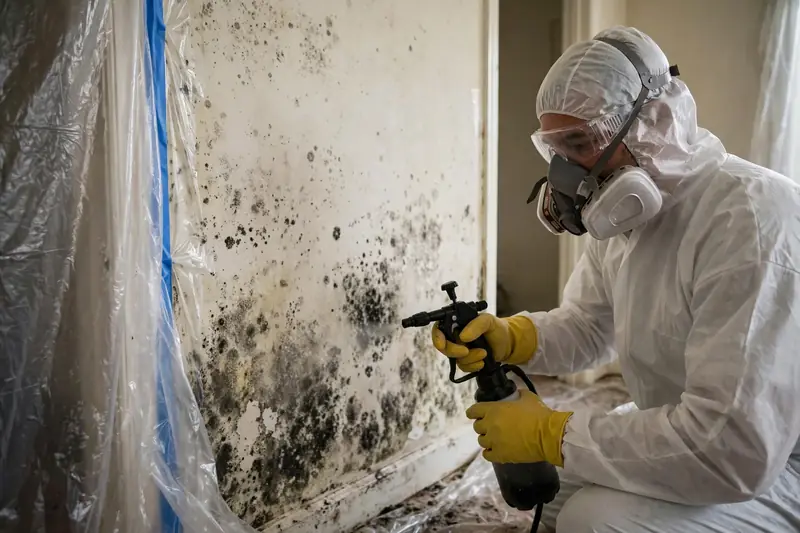
Mold Remediation After Water Damage in Chandler, AZ
Mold after water damage is not a separate problem. It is the consequence of water damage that was not dried fast enough, not dried completely, or not dried at all.
Mold after water damage is not a separate problem. It is the consequence of water damage that was not dried fast enough, not dried completely, or not dried at all. This page is about post-water-damage mold: mold that grew because water sat in building materials after a leak, a burst pipe, a flood, a sewage backup, or an AC overflow. We do not offer mold services as a standalone business, and this page does not present them that way. Mold remediation here is one step inside water damage restoration, and it exists because the water came first. If your home has had water damage and you see or smell mold, call RestoreNov at (480) 701-8249 for a moisture assessment and a written scope.
Direct answer: Mold remediation after water damage is the professional process of containing the affected area, removing mold-affected porous materials, cleaning and treating remaining surfaces, drying the structure with moisture verification, and fixing the moisture source so mold does not return. It is part of water damage restoration, not a separate service. Published industry guidance says mold growth can begin in wet materials within 24 to 48 hours, which is why fast extraction and verified drying are the primary mold prevention tools. Once mold growth is established, drying alone is not enough, and removal, containment, and HEPA filtration are added to the job.
What Happens When You Call
Calling starts a short, plain process. The three steps below describe what happens from the first call to a finished job.
Step 1 - Call and assessment. You describe where you saw or smelled mold, what water event came before it, and which rooms are affected. The person who answers asks about the water source, how long the area stayed wet, and whether the source has been fixed. That information shapes the inspection and the written scope.
Step 2 - Contain and treat. On arrival, the crew checks moisture in the affected materials, sets up containment around the work area, and removes mold-affected porous materials that cannot be cleaned. Remaining surfaces are cleaned and treated, and the area is dried with moisture readings taken along the way.
Step 3 - Repair and verify. Once the structure is dry and the moisture source is addressed, removed materials are rebuilt and finished. The crew walks the area with you, shows the dry readings, and notes what to watch for so the same spot does not stay damp again.
Mold Is a Consequence, Not a Standalone Problem
This distinction matters, and it shapes everything on this page. Mold does not appear on its own in a dry home. Mold spores are present in indoor air all the time, in every home, and they are harmless while they stay dry and dormant. Mold grows when spores land on an organic surface, find moisture, and have time. The organic surface is almost always already there: drywall paper, wood framing, carpet backing, insulation, dust, and cardboard. The moisture is the variable. Water damage supplies it. Time does the rest.
That is why mold remediation after water damage always starts with the water, not with the mold. A crew that cleans mold without fixing the moisture source, without drying the structure, and without verifying dryness will watch the mold return, because the conditions that grew it are still in place. The correct sequence is: stop the water source, extract the water, remove materials that cannot be saved, dry the structure with verification, contain and remove mold-affected materials, clean and treat remaining surfaces, and repair. Mold remediation is steps in the middle of that sequence, not a job on its own.
It is also why this page does not treat mold testing, mold inspection, or mold removal as independent services. Testing and remediation are discussed here only as they relate to a water damage event: when testing is relevant after a loss, what remediation looks like inside a restoration job, and how prevention through drying works. If you have mold with no known water event, the first step is still the same: find the moisture source, because there is always one, even if it is a slow leak inside a wall that you have not found yet.
What This Service Covers
Mold remediation after water damage covers the work between a damp, affected room and a dry, rebuilt one. The list below describes the work that is part of this service.
- Moisture inspection of the affected area to find where water reached and which materials stayed wet
- Containment of the work area so spores and debris are not spread into clean rooms during removal
- Removal of mold-affected porous materials that cannot be cleaned, such as soaked drywall and insulation
- Cleaning and treating of remaining hard surfaces in the affected area
- Drying of the structure with moisture readings taken before rebuild
- Rebuilding of removed drywall, trim, and finishes
- Notes on the moisture source and the drying steps that keep the same area from staying damp again
How Mold Grows After Water Damage
Mold growth after water damage follows a timeline, and understanding it explains why speed matters so much.
Hours 0 to 24. Materials are wet. Spores that are already present in the air and on surfaces begin to absorb moisture. Nothing is visible yet. This is the window where fast extraction and drying prevent mold entirely. Materials that are dried within this window and verified dry do not support mold growth.
Hours 24 to 48. Published industry guidance says mold growth can begin in wet materials within 24 to 48 hours. This is the window the homepage FAQ also states, and it is stated here deliberately as the second of the site's two mold-window mentions, so the message is consistent across the site. In warm Arizona conditions, with indoor temperatures in the 70s and attic spaces far hotter, the fast end of this window is a real risk. Growth in this window is microscopic at first. You will not see it. You may start to smell it: a musty, earthy odor in the affected room.
Hours 48 to 72. Colonies that formed in the earlier window become visible as small dark, green, or gray spots on drywall, wood framing, or carpet backing. The musty smell becomes distinct. At this point the job has changed from water damage to water damage with mold. The scope changes: affected materials must be cut out and replaced rather than dried in place, and containment, HEPA filtration, and protective equipment become part of the job.
Day 4 and beyond. Colonies establish and expand. They produce more spores, the spore count in indoor air rises, and colonies spread to adjacent organic material: from wet drywall to the framing behind it, to the floor below it, to the insulation above it. What was a contained problem at 48 hours can become a multi-material problem at one week. Demolition scope grows. Reconstruction grows with it. Indoor air quality becomes a concern for occupants, particularly anyone with asthma, allergies, or compromised immunity.
This timeline is why every other page on this site stresses the same point: call fast, extract fast, dry with verification. The mold timeline is the clock that water damage runs on, and the drying job is a race against it.
Where Mold Grows After Water Damage in Chandler Homes
Mold grows where moisture and organic material meet, and Chandler homes offer specific hiding places.
Inside wall cavities. The most common hidden location. Water wicks up drywall, soaks insulation, and wets framing inside the cavity. The cavity is dark, still, and warm, which are ideal growth conditions. Mold inside a wall cavity is invisible from the room, and it is often discovered only when the drywall is opened, or when a musty smell persists after the room looks dry.
Behind baseboards and under flooring. Water runs under baseboards and under flooring, where it sits on the subfloor and the wall base. Carpet backing, pad, and the bottom edge of drywall are all organic, and they sit in exactly the place where water collects. A baseboard that separates from the wall, or a carpet edge that smells musty, often points to mold in this zone.
In ceiling cavities. AC condensate overflows and roof leaks saturate ceiling insulation and the top side of ceiling drywall. Attic heat accelerates growth. Ceiling mold often shows first as a stain on the ceiling surface, but the colony above the drywall can be much larger than the visible stain. The full ceiling sequence is on the ceiling and wall water damage repair page.
Under cabinets and inside built-ins. Cabinet toe kicks, the space behind dishwashers, and the area under sinks trap moisture and block airflow. Particle board and MDF cabinet bases are organic and absorb water readily. Mold in these locations is often found only when cabinets are opened or removed.
In HVAC-adjacent areas. An AC condensate overflow wets the area around the air handler, the drain pan, and nearby ductwork and insulation. Dust on coils and in ductwork is organic material. A condensate leak that is fixed at the drain line but not dried in the surrounding cavity leaves mold in exactly the place where airflow can distribute spores through the home. HVAC components themselves are a technician's job, and the restoration crew handles the surrounding structure, drying, and remediation.
On contents and soft goods. Upholstered furniture, mattresses, rugs, cardboard boxes, books, and clothing that stayed wet after a loss support mold growth on their own surfaces. Contents that cannot be cleaned and dried are removed. Contents that can be salvaged are dried and cleaned separately from the structure.
Warning Signs of Post-Water-Damage Mold
Mold after water damage is often hidden, so the signs are indirect. Watch for these after any water event, especially if drying was delayed or never verified.
A musty or earthy smell that does not go away. This is the most reliable early sign. A musty smell in a room that had water damage, or in a room next to one that did, points to mold inside a cavity, under flooring, or behind a baseboard. If the smell persists after the room looks dry, the moisture is still there, and so is the mold.
Visible spots on drywall, grout, or wood. Small dark, green, gray, or black spots on drywall, on grout lines, on wood framing, or on carpet backing are visible colonies. Do not assume a spot is just a stain. A water stain is flat and uniform. A colony has texture, irregular edges, and often a slightly raised or fuzzy surface. Do not disturb it. Disturbing a colony releases spores into the air.
Discoloration that grows or changes. A water stain that stays the same size after drying is usually just a stain. A discoloration that grows, darkens, or develops spots is active growth.
Allergy-like symptoms that improve away from home. Sneezing, itchy eyes, congestion, coughing, or headaches that are worse at home and better elsewhere can indicate elevated indoor spore levels. This is not a diagnosis, and it is not a substitute for medical advice. If you have symptoms, see a medical professional, and tell them you have had water damage and suspect mold.
Warping, bubbling, or separating finishes. Paint that bubbles, baseboards that separate, and flooring that warps after a water event indicate moisture still inside the assembly, and moisture inside the assembly means mold risk inside the assembly, even if no colony is visible yet.
The Remediation Process Inside a Water Damage Job
Mold remediation after water damage follows a fixed sequence, inside the larger restoration job. It is not a spray-and-wipe service, and it is not a coat of paint over a stain.
- 1. Stop the water source and assess moisture. The plumber, HVAC technician, or roofer fixes the source. The crew maps moisture with meters and thermal imaging, including the full extent of wet materials and the rooms next to the loss. Remediation scope is set by the moisture map, not by the visible mold alone, because the colony is usually larger than the visible spot.
- 2. Containment. The affected area is sealed off from the rest of the home with heavy plastic sheeting. Doorways, vents, and openings are sealed. The containment area is run under negative air pressure, using HEPA-filtered air scrubbers, so air flows into the containment area rather than out of it. Negative air pressure keeps spores inside the work area instead of spreading them through the home. Containment is set before any mold-affected material is disturbed, because disturbance is what releases spores.
- 3. Protective equipment. Crew members wear respirators, gloves, eye protection, and protective suits inside the containment area. Protective equipment protects the crew, and it prevents the crew from carrying spores out of the containment area on clothing and skin.
- 4. Removal of mold-affected porous materials. This is the core of remediation. Drywall with visible mold growth, or drywall that has been wet long enough for growth inside the core, is cut out. Carpet and pad with mold growth are removed. Insulation with mold growth is removed. Particle board and MDF with mold growth are removed. Porous materials cannot be reliably cleaned once mold has grown into them, because the growth penetrates below the surface. Removal, not cleaning, is the correct treatment for porous materials. Removed materials are bagged inside the containment area and disposed of as contaminated waste, so spores do not escape during transport through the home.
- 5. Cleaning of remaining surfaces. Semi-porous and non-porous surfaces that remain, such as framing lumber, concrete, tile, and metal, are cleaned thoroughly. Cleaning means physical removal of growth and residue, not just spraying. Surfaces are HEPA-vacuumed, then damp-wiped or scrubbed with an appropriate cleaning solution. HEPA vacuuming captures fine particles, including spores, instead of blowing them into the air the way a standard vacuum would.
- 6. Antimicrobial treatment. After cleaning, remaining surfaces are treated with an antimicrobial product to discourage regrowth. Antimicrobial treatment follows cleaning, not the other way around, because antimicrobial products cannot work through a layer of growth and organic matter. Treatment is applied at label concentration and contact time.
- 7. Drying and moisture verification. The structure is dried with commercial air movers and LGR dehumidifiers, with daily moisture readings until materials reach their dry standard. Drying is verified with meters, not assumed from appearance. The full drying science is on the structural drying and dehumidification page. Remediation is not complete until the structure is dry, because moisture left behind will regrow mold on the cleaned surfaces.
- 8. HEPA air scrubbing. HEPA-filtered air scrubbers run during and after remediation to capture airborne spores released during removal and cleaning. Scrubbers run until the work is complete and the area is clean. On larger jobs, scrubbers continue running during the drying phase.
- 9. Clearance and repair. Once the area is clean and dry, containment is removed, and repair begins: new drywall, insulation, baseboards, flooring, paint, and trim. The goal is a room that looks and feels the way it did before the loss, with the moisture source fixed and the structure verified dry.
Removal vs Cleaning: Which Materials Get Which Treatment
The removal-versus-cleaning decision is the most important judgment in remediation, and it follows a simple rule: porous materials with mold growth are removed, and non-porous and semi-porous materials are cleaned.
Removed: Drywall with mold growth or prolonged saturation. Carpet and carpet pad with mold growth. Insulation with mold growth. Particle board and MDF with mold growth. Upholstered furniture, mattresses, and soft goods with mold growth that cannot be fully cleaned and dried. Cardboard, paper goods, and books with mold growth.
Cleaned: Solid wood framing and structural lumber, after HEPA vacuuming and damp wiping, where the growth is on the surface and the wood is structurally sound. Concrete and masonry, after cleaning and antimicrobial treatment. Tile, glass, metal, and plastic, after cleaning and disinfection. Solid wood furniture and cabinetry, where the growth is on the surface and the piece can be fully cleaned and dried.
This rule is why remediation scope is set by the moisture map and by inspection of each material, not by a fixed formula. A drywall panel that was wet for 12 hours and dried promptly may be cleanable. The same panel wet for five days is removed. A framing member with surface growth is cleaned. A framing member with deep growth and softening is removed. The crew explains the decision for each material before work begins, and the written scope reflects it.
When Testing Is Relevant After Water Damage
Mold testing is not required for every water damage job, and it is not the first step. In most post-water-damage jobs, the moisture map, the visible growth, and the known water event are enough to set the remediation scope. Testing is relevant in specific situations.
When the moisture source is unclear. If mold is found but the water event is unknown, testing can help establish whether the growth is active and how widespread it is, alongside moisture mapping. The priority remains finding the moisture source, because remediation without source control will fail regardless of test results.
When occupants have health concerns. If household members have asthma, allergies, compromised immunity, or persistent symptoms that improve away from home, testing can provide information that a medical professional or an indoor air quality specialist can use. Testing in this context is a health-information step, not a restoration step, and it does not replace remediation.
When a third-party clearance is required. Some insurance carriers, property managers, and commercial clients require independent clearance testing after remediation, to confirm that the area is clean before re-occupancy or before repair begins. Clearance testing is performed by an independent party, not by the remediation crew, so the verification is impartial.
What testing does not do. Testing does not locate the moisture source. Testing does not set the remediation scope by itself. A test result showing spores in the air does not tell the crew which wall cavity to open. Moisture mapping does that. Testing is a supplement to inspection and moisture mapping, not a replacement for them. If a company proposes testing before inspection, or testing instead of moisture mapping, that is a warning sign.
This page does not offer testing as a standalone service. Testing is discussed here only as it relates to a water damage event, and clearance testing is performed by an independent party where required.
What Remediation Does Not Do
Honest expectations matter. Remediation does not fix the moisture source. A plumber fixes a pipe. An HVAC technician fixes a condensate drain. A roofer fixes a roof leak. Remediation handles the mold that the source already caused. Remediation does not make a home sterile. Mold spores are present in indoor air all the time, and the goal is to return spore levels to normal background conditions and remove active growth, not to eliminate every spore. Remediation does not guarantee that mold will never return. If the moisture source returns, mold will return, because the conditions that grew it are back. The guarantee that matters is the one you can verify: the source is fixed, the structure is dry, and the readings prove it. Remediation does not replace drying. A remediated area that is not dried will regrow mold on the cleaned surfaces, and the job will have to be repeated.
Prevention Through Drying: The Only Real Mold Prevention
The most effective mold remediation is the one that never has to happen, and it is achieved through fast, verified drying after water damage. Every other page on this site points to the same conclusion, because the mold timeline is the clock that water damage runs on.
Call fast. Extraction within hours, not days, keeps materials inside the window where drying prevents growth entirely. The emergency water extraction page covers the first step.
Dry with verification. Drying is complete when moisture meters confirm materials have reached their dry standard, not when surfaces feel dry. The structural drying and dehumidification page covers the science, the equipment, and the dry standard.
Fix the source. Drying without source repair is temporary. The plumber, HVAC technician, or roofer fixes the source. The restoration crew handles the water damage. Both jobs are needed, and they should be scheduled at the same time.
Watch the warning signs after any water event. A musty smell, a growing stain, a separating baseboard, or symptoms that improve away from home all point to moisture still inside the structure. Act on them promptly instead of waiting to see if they go away. They will not go away on their own.
Maintain the systems that cause Chandler water damage. Clean AC condensate drain lines and check drain pans. Check roof drains, gutters, and scuppers before monsoon season. Watch your water bill for hidden leak signs. Replace washing machine hoses on a schedule. These maintenance steps prevent the water events that cause mold in the first place.
Mold After Specific Chandler Loss Types
Different causes of water damage produce different mold patterns, and the remediation plan changes with the cause.
Burst pipe and slab leak mold. A burst pipe that is extracted and dried promptly carries low mold risk. A slab leak that ran undetected for weeks carries elevated mold risk, because the moisture was prolonged and the migration path through concrete is wide. The full picture is on the burst pipe and slab leak page.
Flood mold. Flood jobs carry the highest mold risk, because the water was contaminated and the wetting was often prolonged and deep. Flood remediation follows removal of contaminated porous materials, sanitization, and drying, with containment and remediation added where growth is found. See the flood damage restoration page.
Sewage mold. Sewage jobs carry elevated mold risk, because the water was contaminated and carried a heavy organic load. Remediation follows removal, sanitization, and drying. See the sewage cleanup page.
AC condensate and ceiling mold. AC condensate overflows saturate ceiling cavities, where attic heat accelerates growth and the colony above the drywall can be much larger than the visible stain. See the ceiling and wall water damage repair page.
Areas We Serve in Chandler and the East Valley
We provide mold remediation across Chandler and the surrounding East Valley. Our address is 1651-1683 E Germann Rd, Chandler, AZ 85286, and our crews come to you.
Serving Chandler and the East Valley: Downtown Chandler, Ocotillo, Fulton Ranch, Sun Groves, Tumbleweed Park, Gilbert, Mesa, Tempe, Queen Creek, Sun Lakes, Ahwatukee, Higley.
We also serve homeowners in Andersen Springs, Pecos Ranch, Clemente Ranch, Fox Crossing, Cooper Commons, and Dobson Place.
Tools & Technology We Use
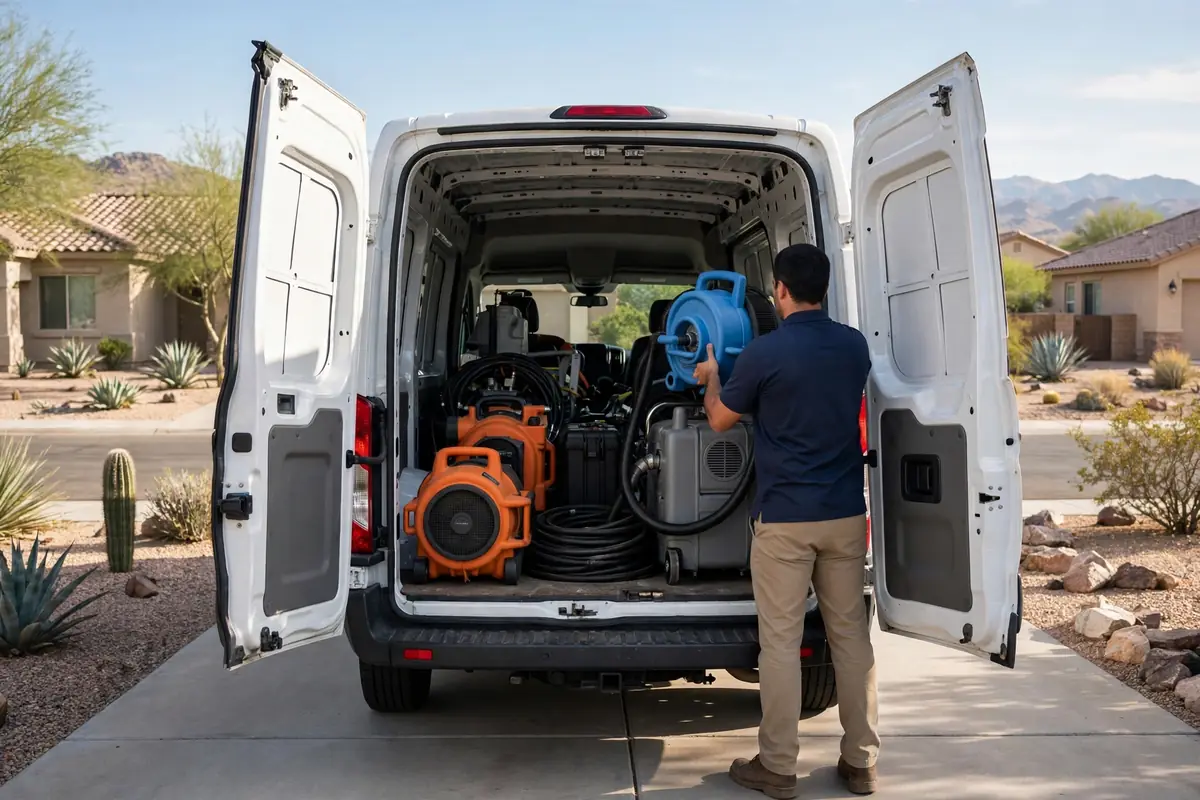
Mold work after water damage centers on three jobs: keeping spores inside the work area, removing what cannot be cleaned, and drying what remains. The tools below serve those three jobs.
Containment materials. Plastic sheeting and tape seal off the work area so spores and dust released during removal do not drift into clean rooms.
HEPA air filtration. Air filtration units with HEPA filters run during the work to capture fine particles released when affected materials are disturbed.
HEPA vacuums. Vacuums fitted with HEPA filters pick up fine dust and debris from surfaces and from inside opened cavities without blowing it back into the room.
Antimicrobial treatment. Cleaning and treating products, used according to label directions, are applied to remaining hard surfaces after affected materials are removed.
Moisture meters. Pin and pinless meters read moisture inside drywall, framing, and subfloors so the crew can confirm the structure is dry before rebuild.
Protective gear. Gloves, eye protection, and respirators keep the crew from breathing in or touching dust and debris released during removal.
Safe for Family and Pets
During mold remediation, keep family members and pets out of the contained work area until the crew says the area is ready to re-enter. Containment sheeting stays in place while removal and cleaning are underway, and air filtration runs during the work to capture particles released when materials are disturbed. Cleaning and treating products are used according to label directions, and treated surfaces are left to dry before rooms are put back into use. If anyone in the home has asthma, allergies, a weakened immune system, or another condition that makes exposure riskier, tell the crew when you call so the work area can be sealed off first.
Frequently Asked Questions
Published industry guidance says mold growth can begin in wet materials within 24 to 48 hours. In warm Arizona conditions, the fast end of that window is a real risk. Visible colonies typically appear between 48 and 72 hours, and established growth follows after day 4.
No, not for mold after water damage. Bleach does not reach growth inside porous materials, it does not remove the moisture that caused the growth, and disturbing a colony without containment releases spores into the air. Small surface mold on a hard, non-porous surface, with no water damage behind it, is a different situation. Mold after water damage requires professional containment, removal, cleaning, and verified drying.
Not in most post-water-damage jobs. The moisture map, the visible growth, and the known water event are usually enough to set the remediation scope. Testing is relevant when the source is unclear, when occupants have health concerns, or when an independent clearance test is required. Testing supplements inspection and moisture mapping, and it does not replace them.
Not if the moisture source is fixed and the structure is verified dry. Mold returns when moisture returns. The protection against recurrence is source repair plus verified drying, not a coating or a spray.
No, on this site. Mold remediation here is one step inside water damage restoration, and it exists because the water came first. We do not present mold services as independent of water damage, and this page does not offer standalone mold inspection, testing, or removal.
It depends on the scope. A small contained area may allow you to stay, with the work area sealed off. A large job with containment, HEPA filtration, and heavy equipment may make parts of the home unusable for days. Your crew will tell you what to expect before work starts. Keep children, pets, and vulnerable household members away from the containment area.
It depends on your policy, the cause, and the timing. Mold remediation that follows a covered sudden and accidental water loss is commonly part of the claim. Mold that resulted from a gradual leak that was ignored, or from deferred maintenance, is commonly excluded. This is general information, not advice about your policy. Check your policy wording and ask your agent or adjuster.
Call for a moisture assessment. There is always a moisture source, even if it is a slow leak inside a wall that you have not found yet. Moisture mapping with meters and thermal imaging finds the source path, and the plumber, HVAC technician, or roofer fixes the source once it is located.
Call Now for Mold Remediation After Water Damage in Chandler
If your home has had water damage and you see or smell mold, do not wait, and do not disturb it. Call RestoreNov now at (480) 701-8249 for a moisture assessment and a written scope across Chandler and the East Valley. Containment, removal, cleaning, verified drying, and repair, all handled as one job, with the moisture source fixed first so the mold does not come back. If you have standing water right now, start with emergency water extraction, then let drying and remediation finish the job.
Request a Call Back
Tell us what happened and where the water is. For emergencies, calling is fastest - a live person answers 24 hours a day.
Prefer to talk now?
Call (480) 701-8249 any time, day or night.
We serve Chandler and the East Valley: Downtown Chandler, Ocotillo, Fulton Ranch, Sun Groves, Tumbleweed Park, South Chandler, Gilbert, Mesa, Tempe, Queen Creek, Sun Lakes, Ahwatukee, and Higley.
Our address:
1651-1683 E Germann Rd, Chandler, AZ 85286
Send a Message
For immediate help, call (480) 701-8249. A live person answers 24 hours a day.
Online messaging is not connected yet. For immediate help, call (480) 701-8249.