
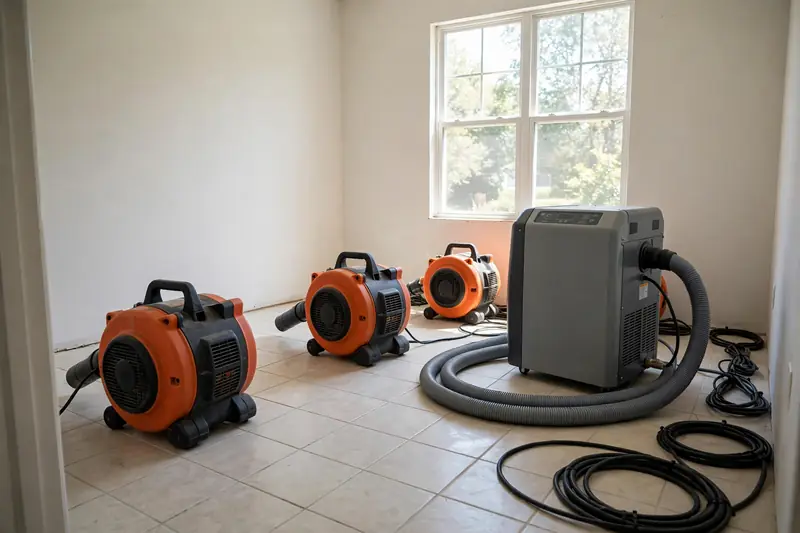
Structural Drying and Dehumidification in Chandler, AZ
After the standing water is gone, the real work begins. A room can look completely dry and still hold enough hidden moisture inside drywall, framing, subfloors, and concrete to grow mold, rot wood, and ruin finishes over the following weeks.
After the standing water is gone, the real work begins. A room can look completely dry and still hold enough hidden moisture inside drywall, framing, subfloors, and concrete to grow mold, rot wood, and ruin finishes over the following weeks. Structural drying and dehumidification is the professional process that removes that hidden moisture and verifies, with instruments, that the structure is actually dry. RestoreNov provides moisture-verified structural drying across Chandler and the East Valley. Call (480) 701-8249 for a free on-site moisture assessment and a written drying scope.
Direct answer: Structural drying is the process of removing moisture from building materials after water extraction, using commercial air movers, low-grain refrigerant (LGR) dehumidifiers, moisture meters, and thermal imaging, with daily readings until materials reach their dry standard. For most Chandler homes, structural drying takes 3 to 5 days. Drying is complete when moisture meters confirm materials are dry, not when surfaces feel dry to the touch.
What Happens When You Call
Here is the short version of what happens when you call (480) 701-8249.
- Step 1 - Call and assessment. Tell us where the water came from, when it happened, and which rooms are affected. We ask about flooring types and wall construction, so the drying plan fits the materials in your home.
- Step 2 - Dry and verify. Air movers and dehumidifiers are placed in a layout matched to the wet area. The crew returns to take moisture readings, track progress in a drying log, and adjust equipment until materials reach their dry standard.
- Step 3 - Repair and verify. Once readings confirm the structure is dry, cleaning and repair of damaged materials follow, and the final readings are recorded so you have a written record of the job.
What Structural Drying Is, and Why Extraction Alone Is Not Enough
Extraction removes liquid water. Drying removes the moisture that remains after extraction. Those are two different jobs, and confusing them is the most common and most expensive mistake homeowners make after water damage. After extraction, drywall still holds water inside its gypsum core and paper facing. Framing lumber still holds water inside its fibers. Concrete still holds water inside its pores. Insulation inside wall cavities still holds water. Carpet pad still holds water. None of that moisture is visible, and none of it comes out with a mop, a towel, or a household fan.
Left alone, that hidden moisture does three things. First, it feeds mold growth. Published industry guidance says mold growth can begin in wet materials within 24 to 48 hours, and in warm Arizona conditions the fast end of that window is a real risk. Second, it damages materials from the inside. Drywall softens and loses structural integrity. Wood framing swells, then shrinks unevenly as it dries, which can crack finishes and open joints. Hardwood cups and buckles. Third, it migrates. Moisture inside a wet wall cavity travels along framing and into adjacent dry rooms, so a leak in one room can create a mold problem in the next room if the first room is not dried correctly.
Structural drying exists to stop all three. It uses controlled airflow to move moisture out of materials and into the air, and dehumidification to pull that moisture out of the air and out of the building. It uses instruments to measure progress, and it continues until the instruments say the job is done. That last point is the whole difference between professional drying and hoping the house dries on its own.

What This Service Covers
Structural drying covers the removal of hidden moisture from building materials after standing water is gone, plus the readings that prove the structure is dry.
- Moisture mapping of floors, walls, ceilings, and wall cavities
- Drying of drywall, framing, subfloor, and concrete slab
- Drying of carpet and pad where the materials can be salvaged
- Wall-cavity drying through controlled openings
- Daily moisture readings and a written drying log
- Dehumidification sized to the wet area and the materials involved
- Drying-progress checks that watch for mold risk while materials are still wet
- Final verification readings before equipment is removed
The Science of Drying, in Plain Language
Drying is evaporation plus dehumidification, repeated until materials are dry. Air movers blow a steady stream of air across wet surfaces. Moving air carries evaporated moisture away from the surface, which lets more moisture evaporate behind it. Without airflow, the thin layer of air right next to a wet surface becomes saturated, and evaporation stalls. With airflow, evaporation continues. That is why air movers are aimed along surfaces, not randomly into the middle of a room.
Evaporated moisture goes into the indoor air. If it stays there, indoor humidity rises, evaporation slows, and moisture starts condensing on cooler surfaces. Dehumidifiers solve this by pulling moisture out of the air, collecting it, and draining it away. The two machines work as a system: air movers push moisture out of materials into the air, and dehumidifiers pull moisture out of the air. Either machine alone does half the job. Together, they dry a structure in days instead of weeks.
Temperature matters too. Warmer air holds more moisture, so evaporation runs faster in warm conditions. Chandler homes in summer are warm enough that drying runs efficiently, but heat alone does not dry a structure. An attic at 130 degrees will dry the surface of ceiling drywall while the insulation above it stays wet, because there is no airflow or dehumidification inside the cavity. Heat without measurement is guessing. Professional drying pairs heat, airflow, and dehumidification with moisture readings, so the crew knows what is happening inside materials, not just on their surfaces.
The industry standard that frames this work is the IICRC S500 Standard for Professional Water Damage Restoration. It sets the framework for water categories, drying classes, equipment placement, and monitoring. This page references S500 as a process standard only. No certification is claimed on this page.
The Equipment: What Each Machine Does
Low-Grain Refrigerant (LGR) Dehumidifiers
The LGR dehumidifier is the workhorse of structural drying. It pulls moist air across a very cold evaporator coil. Moisture in the air condenses on the coil, drips into a collection tray, and is pumped out through a drain hose. The dried air is returned to the room, where it can absorb more moisture from wet materials. Low-grain refrigerant units keep working at low humidity levels, down to very low grains per pound of air, which is what allows them to dry materials deeply rather than stopping at the point where the room merely feels comfortable.
A typical commercial LGR unit removes 150 or more pints of water per day under field conditions, compared with 30 to 70 pints per day for a store-bought consumer dehumidifier, and the consumer unit slows sharply below about 50 percent relative humidity. That capacity gap is why a household dehumidifier cannot dry a water-damaged structure. It is built to keep a basement comfortable, not to pull bound moisture out of framing and concrete.
LGR units also drain continuously through a pump and hose, so they run for days without stopping. A consumer unit fills a small tank and shuts off. On a drying job, an unattended shutoff means hours of lost drying time and a stalled job.
Air Movers
Air movers are high-velocity fans built for restoration work. They sit low to the floor and push a focused sheet of air across wet surfaces: along walls, across floors, under lifted carpet, and into wall cavities through controlled openings. A typical drying job uses one air mover per 50 to 70 square feet of wet floor area, plus additional units aimed at wet walls and cavities.
Air mover placement is not guesswork. The crew places them to create airflow across every wet surface, with no dead spots. Dead spots are areas where air does not move, and moisture hides in them. Technicians reposition air movers on daily visits as materials dry, so airflow follows the remaining moisture instead of continuing to blow on areas that are already dry.
Moisture Meters
Moisture meters are how the crew knows what is wet, how wet it is, and when it is dry. Two types are used. Pin meters push two small pins into a material and measure electrical resistance, which changes with moisture content. They give precise readings in wood, drywall, and subfloor. Pinless meters use electromagnetic waves to read moisture below a surface without puncturing it, which is useful for finished surfaces, hardwood floors, and tile.
Every drying job starts with baseline readings from unaffected materials in the same home, which establish the dry standard for that specific house. Dry is not a universal number. It is the moisture content of the same material, in the same home, in a room that was never wet. Drying is complete when wet materials return to that baseline, not when they hit an arbitrary number from a chart.
Thermal Imaging Cameras
A thermal imaging camera does not see moisture. It sees temperature differences, and wet materials are usually cooler than dry materials because evaporation cools the surface. The camera reveals patterns: a cool stripe running up a wall shows where water wicked inside the cavity. A cool patch on a ceiling shows where insulation above is wet. A cool band along a floor shows where water traveled under flooring.
Thermal imaging is a mapping tool. It tells the crew where to take pin meter readings, where to open a wall, and where to aim air movers. It is always confirmed with a moisture meter, because a cool spot can also be an air leak, a missing insulation batt, or a cold water line. The camera finds suspects. The meter confirms them.
Air Scrubbers and HEPA Filtration
Air scrubbers pull room air through a HEPA filter, which captures fine particles including mold spores, dust, and debris stirred up during drying and demolition. On clean water jobs, air scrubbers keep the air clean while equipment runs. On jobs where mold growth is suspected, or where demolition is opening wall cavities, air scrubbers run under negative air pressure to keep particles inside the work area instead of spreading them through the home. HEPA filtration is part of the drying setup, not an add-on, on any job where contamination is a concern.
Injectidry and Cavity Drying Systems
Some wall cavities and floor assemblies cannot be dried by surface airflow alone. Injectidry systems push dry air through small hoses into wall cavities, under cabinets, and beneath hardwood floors, drying the inside of the assembly without tearing it open. The crew drills small, repairable holes at the base of a wall, inserts hoses, and forces dry air through the cavity. This technique saves drywall that would otherwise be cut out, and it is one of the main reasons professional drying preserves more of a home than do-it-yourself drying.
Daily Monitoring: Why the Crew Comes Back
A drying job is not set and forget. The crew returns daily, usually once a day, to take moisture readings, reposition equipment, and record progress. Each visit follows the same pattern. The technician records moisture readings at the same points measured on day one, so readings are comparable across days. The technician checks that dehumidifiers are draining, that air movers are running and aimed correctly, and that no new wet areas have appeared. The technician moves air movers toward the remaining moisture and away from areas that have reached the dry standard. The technician updates the drying log, which is the written record of the job and part of the documentation package for your insurance carrier.
Daily monitoring serves two purposes. First, it catches problems early. A dehumidifier that stopped draining, an air mover that was switched off, or a secondary leak that started during drying all show up in the readings before they cause new damage. Second, it proves the job is done. The drying log shows a curve: readings falling day by day until they reach the dry standard. That curve is what an insurance adjuster wants to see, and it is what you should ask to see before you accept that the job is complete. If a company places equipment and does not return until pickup day, you have no drying log and no proof the structure is dry.
The Dry Standard: What "Dry" Actually Means
"Feels dry" is not dry. A drywall surface can feel dry while the gypsum core behind the paper facing still holds enough moisture to feed mold. A hardwood floor can feel dry on top while the subfloor beneath it is still wet. A concrete slab can feel dry while its pores still hold moisture that will wick upward into new flooring.
Dry means the moisture content of an affected material has returned to the baseline reading of the same material in an unaffected area of the same home. The crew measures that baseline on day one, from a room that was never wet, and uses it as the target for the whole job. Drying is complete when readings at every measured point match the baseline, not when the room feels dry and not when a fixed number of days has passed.
This is also why a household humidity reading is not a drying measurement. A cheap humidity gauge measures the air. It tells you nothing about the moisture inside your walls. A room can read a comfortable 45 percent relative humidity while the wall cavity behind the baseboard is still saturated. Only a moisture meter, reading the material itself, can confirm dry.
Drying Timelines by Material
Drying time depends on the material, how saturated it is, the water category, and how fast extraction happened. These are typical ranges for residential jobs in Chandler, assuming extraction happened promptly and drying equipment was placed the same day.
Drywall. Surface-dry in 24 to 48 hours. Fully dry through the gypsum core and paper facing in 2 to 4 days. Drywall that was saturated for more than about 48 hours, or that has lost structural integrity, is usually removed rather than dried, because it will not return to full strength.
Framing lumber. Framing behind drywall dries in 3 to 5 days with cavity airflow. Framing that was submerged or saturated for days takes longer, and may need the drywall opened to expose it to airflow.
Concrete and slab. Concrete releases moisture slowly. A bare slab surface dries in 2 to 4 days, but moisture deep in the slab can take a week or more to reach the dry standard. New flooring should not be installed over a slab until the slab itself reads dry, or moisture trapped under the new flooring will cause adhesive failure, warping, and mold.
Hardwood flooring. Hardwood dries in 3 to 7 days with controlled airflow and dehumidification, and it continues to settle for days after readings reach the dry standard. Boards that cupped during the wet period often flatten partially as they dry. Final judgment on whether hardwood is salvageable comes after drying, not during it.
Carpet and pad. Carpet surface dries in 1 to 2 days. Pad dries in 2 to 3 days if it is salvageable at all. Pad soaked with contaminated water is removed rather than dried.
Insulation. Fiberglass batt insulation inside a wet wall cavity dries slowly and unevenly, and it loses insulating value when it compresses while wet. Wet insulation is often removed rather than dried, because removal is faster, more certain, and allows the cavity and framing to dry directly.
Cabinetry and built-ins. Particle board and MDF swell when wet and do not recover. Solid wood cabinets dry in 3 to 7 days with cavity airflow. Toe kicks and cabinet bases are opened so air reaches the interior.
These timelines assume clean water and prompt extraction. Gray water and black water add removal and sanitization work that extends the job. A delayed call extends every timeline, because materials that could have been dried in place pass the point of recovery and must be removed instead.
Why "Feels Dry" Is Not Dry
This point deserves its own section, because it is the mistake that causes the most long-term damage. After a leak, a homeowner mops, runs a household fan for a day, and touches the wall. The wall feels dry. The floor feels dry. The homeowner concludes the job is done. Weeks later, a musty smell appears. Baseboards start to separate. A dark patch shows on the drywall. Mold is growing inside the wall cavity, where the surface felt dry all along.
The reason is that drying happens from the outside in, and feeling a surface only tests the outside. Evaporation dries the outer fraction of an inch of a material first. The interior of the material, and the cavity behind it, stay wet much longer. A household fan accelerates surface evaporation, which makes the surface feel dry faster, while doing almost nothing for the interior. A moisture meter is the only tool that tests the interior, and it is the reason professional drying is verified rather than assumed.
There is a second trap. In Chandler, indoor air is dry for much of the year. Dry air makes wet surfaces feel dry quickly, because surface moisture evaporates fast into low-humidity air. That surface evaporation can mask deep moisture for days. The wall feels dry because the surface is dry. The cavity behind it is still wet. Only readings confirm it.
Drying and Mold Prevention
Fast, verified drying is the primary mold prevention tool. Mold needs three things: moisture, an organic food source, and time. Drywall paper, wood framing, carpet backing, and dust all provide food. Time is the variable drying controls. Published industry guidance says mold growth can begin in wet materials within 24 to 48 hours, so every hour of wet time matters, and every hour of effective drying removes risk.
Drying prevents mold in two ways. First, it removes the moisture mold needs before colonies establish. Materials that are dried within the window and verified dry do not support mold growth. Second, it removes the moisture that lets existing colonies spread. Where mold growth has already started, drying alone is not remediation. Containment, HEPA filtration, and removal of affected materials are added to the plan, and the affected area is kept isolated until it is clean and dry. The full mold sequence is on the mold remediation after water damage page, which covers mold as a consequence of water damage, not as a standalone service.
What Slows Drying Down
Several factors extend drying time, and knowing them helps you set expectations and avoid mistakes during the job.
Delayed extraction. Water that sat for a day before extraction has soaked deeper into every material. Deep moisture takes longer to evaporate than surface moisture, and materials that could have been dried in place may need removal instead.
Closed rooms and closed doors. Drying equipment needs air circulation. A closed bedroom door, a closed closet, or a room sealed off from the dehumidifier will not dry. Keep interior doors open and keep the drying area connected to the dehumidifier.
Switched-off equipment. Air movers are loud, and dehumidifiers add heat and noise. Turning them off overnight, even once, can add a full day to the drying timeline, because materials reabsorb moisture from the humid air while the equipment is off. Leave equipment running continuously until the crew confirms the job is done.
Hidden assemblies. Double walls, built-in cabinets, tiled shower surrounds, and multi-layer flooring all hide moisture. The crew maps these during inspection, but a hidden assembly discovered mid-job can extend the timeline while cavity drying is added.
Secondary leaks. A plumbing repair that was not fully completed, an AC drain that clogs again, or a roof leak that returns during a storm can re-wet materials mid-job. Tell the crew immediately if you see new water, and confirm the source repair is complete before drying begins.
High indoor humidity. Monsoon season raises indoor humidity, which slows evaporation. The crew compensates with additional dehumidification capacity, but a monsoon-season job may run a day longer than the same job in a dry month.
Extraction Plus Drying: The Full Sequence
Structural drying is step two in a fixed sequence. Step one is emergency water extraction, which removes standing water and absorbed water from floors and carpet. Step two is the drying covered on this page. Step three is cleaning and sanitizing. Step four is mold prevention checks and, where needed, remediation. Step five is repair and rebuild: drywall, baseboards, flooring, paint, and trim restored to pre-loss condition. Step six is final moisture verification and a walkthrough with you.
Skipping any step leaves moisture behind. Extraction without drying leaves hidden moisture. Drying without moisture mapping leaves hidden wet spots. Repair before verification seals moisture inside walls, where it causes mold and rot behind new drywall. The sequence is the job, and the written scope you receive before work begins covers all of it.
Drying for Specific Chandler Loss Types
Different causes of water damage produce different drying challenges, and the drying plan changes with the cause.
Burst pipe and slab leak drying. A burst pipe saturates a wide area quickly, and drying focuses on the full moisture map, including rooms the water reached under flooring. A slab leak saturates concrete and wall bases slowly over days or weeks, and drying focuses on the slab, wall bases, and flooring over the leak path. The full picture is on the burst pipe and slab leak page.
Flood drying. Floodwater is Category 3, so drying follows removal of contaminated porous materials and sanitization. Flood cuts in drywall open wall cavities for drying, and the drying timeline starts after removal, not before. See the flood damage restoration page.
Sewage drying. Sewage jobs follow the same pattern: removal of contaminated materials, sanitization, then drying. Drying equipment is placed after sanitization, and the area stays isolated until readings confirm dry. See the sewage cleanup page.
Ceiling and wall cavity drying. AC condensate overflows and roof leaks saturate ceiling cavities and wall tops, where gravity and insulation complicate drying. Cavity drying systems and controlled openings are used heavily here. See the ceiling and wall water damage repair page.
Areas We Serve in Chandler and the East Valley
We provide structural drying & dehumidification across Chandler and the surrounding East Valley. Our address is 1651-1683 E Germann Rd, Chandler, AZ 85286, and our crews come to you.
Serving Chandler and the East Valley: Downtown Chandler, Ocotillo, Fulton Ranch, Sun Groves, Tumbleweed Park, Gilbert, Mesa, Tempe, Queen Creek, Sun Lakes, Ahwatukee, Higley.
We also serve Chandler neighborhoods including Andersen Springs, Pecos Ranch, Clemente Ranch, Fox Crossing, Cooper Commons, and Dobson Place.
Tools & Technology We Use
Drying works because each piece of equipment does one job well. The crew combines them into a layout matched to your home and the materials that got wet.
- Air movers high-velocity fans that push dry air across wet surfaces and into corners, speeding evaporation from floors, walls, and baseboards.
- LGR dehumidifiers low-grain refrigerant units that pull moisture out of the air, so water evaporated from materials leaves the building instead of settling back into them.
- Moisture meters pin and pinless meters measure moisture inside drywall, flooring, framing, and concrete, so progress is tracked with numbers rather than touch.
- Thermal imaging an infrared camera shows surface temperature patterns that point to damp areas behind walls and under floors, so hidden moisture is found and mapped.
- Monitoring logs daily written readings of moisture levels, temperature, and humidity, showing how drying is progressing and when equipment can be moved or removed.
- Wall-cavity drying small hoses and panels that direct airflow into wall cavities and under cabinets, drying framing and insulation without tearing out whole walls where the structure allows.
Frequently Asked Questions
For most residential jobs, 3 to 5 days of equipment run time with daily moisture checks. Small, clean water jobs in one room can finish in 2 to 3 days. Large, contaminated, or multi-room jobs take longer. Your written scope includes a timeline for your specific job, and daily readings show whether the job is on track.
Household fans move air but cannot reach moisture inside wall cavities, and consumer dehumidifiers lack the capacity and low-humidity performance to dry structural materials. For anything beyond a small spill caught within minutes, professional drying with commercial equipment and moisture verification is the safer choice. A room that feels dry without readings is not verified dry.
Yes. Air movers and dehumidifiers must run continuously until the crew confirms the job is done. Turning equipment off, even overnight, lets materials reabsorb moisture and can add a full day to the timeline.
In most cases, yes, for jobs limited to one or two rooms. The equipment is loud, and the drying area will be warm and dry. Large jobs, sewage events, and jobs with containment may make parts of the home unusable for a few days. Your crew will tell you what to expect before work starts.
When moisture readings at every measured point match the dry standard baseline taken from unaffected materials in your home, and the crew shows you the drying log. Ask to see the readings before you accept that the job is complete.
Properly controlled drying does not damage materials. Uncontrolled heat, such as placing a space heater against a wall, can crack finishes and warp wood. Professional drying uses measured airflow and dehumidification, not uncontrolled heat, and daily readings prevent over-drying.
The crew adds containment, HEPA filtration, and removal of affected materials to the plan, and the affected area stays isolated until it is clean and dry. See the mold remediation after water damage page for the full sequence.
Most standard homeowners policies cover sudden and accidental water damage and the mitigation that follows it, including drying. They generally do not cover gradual leaks that were ignored, or flood damage from outside rising water, which usually requires separate flood insurance. We document the loss with photos, moisture readings, drying logs, and a written scope so your adjuster has what is needed.
Call Now for Structural Drying in Chandler
If your home has had water damage, extraction alone is not enough. Call RestoreNov at (480) 701-8249 for moisture-verified structural drying across Chandler and the East Valley. Commercial air movers, LGR dehumidifiers, daily moisture readings, and a written drying log that proves the job is done. If you are dealing with standing water right now, start with emergency water extraction, then let drying finish the job.
Request a Call Back
Tell us what happened and where the water is. For emergencies, calling is fastest - a live person answers 24 hours a day.
Prefer to talk now?
Call (480) 701-8249 any time, day or night.
We serve Chandler and the East Valley: Downtown Chandler, Ocotillo, Fulton Ranch, Sun Groves, Tumbleweed Park, South Chandler, Gilbert, Mesa, Tempe, Queen Creek, Sun Lakes, Ahwatukee, and Higley.
Our address:
1651-1683 E Germann Rd, Chandler, AZ 85286
Send a Message
For immediate help, call (480) 701-8249. A live person answers 24 hours a day.
Online messaging is not connected yet. For immediate help, call (480) 701-8249.