
The short answer: Most residential structural drying takes 3 to 5 days. A small, recent leak can dry in 24 to 72 hours. A multi room loss typically takes 3 to 7 days. Major flooding, water inside walls and under flooring, or contaminated water can take a week or longer. There is no single number, because drying time depends on the water category, the materials that got wet, how long the water sat, the indoor conditions, and how quickly professional drying started. Drying is finished when moisture meter readings match the dry standard for each material, not when the surface feels dry. If you have water damage, call RestoreNov at (480) 701-8249 for an assessment, because the timeline for your home is set by measurements, not by a calendar.
What "Structural Drying" Actually Means
Structural drying is not mopping up a spill. It is the process of removing moisture from the building materials of your property: walls, subfloors, framing, insulation, ceilings, and the air inside the structure. It is different from surface cleanup. A wet vacuum removes standing water. A towel dries a floor surface. Structural drying removes the water that soaked into the structure itself.
That distinction is the whole reason drying takes days instead of hours. Water does not just sit on top of building materials. It soaks into them. Drywall wicks moisture upward from the base. Wood absorbs water into its fibers. Concrete absorbs water into its pores. Insulation traps water against framing. Each of those materials releases moisture at a different rate, and drying is not complete until all of them have released enough moisture to reach their dry standard.
Structural drying is also different from air drying. Air drying means opening windows and waiting. It is far too slow and too uneven for a water damaged structure. Moisture trapped inside walls, subfloors, and ceiling cavities cannot escape through natural ventilation alone. Mold begins growing within 24 to 48 hours. Professional drying uses controlled airflow, dehumidification, temperature management, and daily moisture monitoring to remove hidden moisture that air drying cannot reach. Our article on the mold 24 to 48 hour window after water damage explains why the drying deadline is so tight.
The Drying Process, Step by Step
Understanding the process explains the timeline. Each step takes time, and skipping a step does not save time. It creates a bigger problem later.
Step 1: Inspection and moisture mapping. The technician inspects the loss, identifies the water source and category, and maps moisture with pin and pinless meters and a thermal imaging camera. This step finds how far water traveled, including into wall cavities and under flooring where you cannot see it. Moisture mapping sets the drying plan, the equipment count, and the drying goals. Without it, the technician is guessing.
Step 2: Extraction. Standing water is removed with professional extractors. Carpet is extracted. Hard floors are squeegeed and extracted. Every gallon removed by extraction is a gallon that does not have to be evaporated, which is why fast extraction shortens the total drying time more than any other single step. Our emergency water extraction service handles this phase.
Step 3: Removal of unsalvageable materials. Materials that cannot be dried effectively in place are removed: saturated insulation, softened or sagging drywall, soaked carpet padding, and any porous materials contaminated by gray or black water. Removing them serves two purposes. It removes the most mold vulnerable materials, and it opens the structure so drying equipment can reach the framing and cavities behind them.
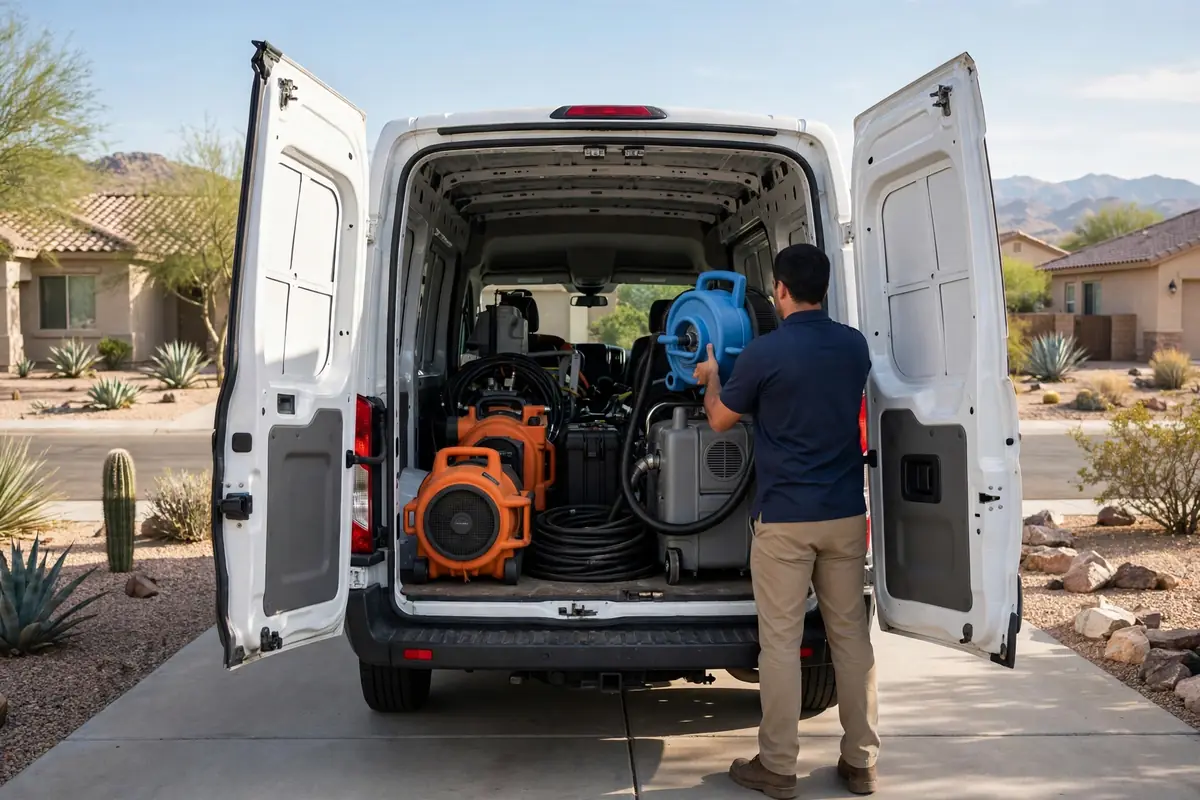
Step 4: Drying equipment setup. Air movers and dehumidifiers are placed based on the moisture map. Air movers create high velocity airflow across wet surfaces to speed evaporation. Dehumidifiers remove the evaporated moisture from the air so it does not recondense on other surfaces. The two work as a system. Airflow without dehumidification just moves moisture around the house. Dehumidification without airflow leaves stagnant damp pockets inside cavities. In some cases, technicians use directed airflow, wall cavity drying systems, or floor drying mats to push dry air into enclosed spaces.
Step 5: Daily monitoring. The technician returns daily, takes moisture readings at the same points, records them, and adjusts equipment placement as the drying progresses. Monitoring is what makes drying a scientific process instead of a guess. Readings show which materials are drying on schedule and which are lagging, and the equipment is adjusted accordingly.
Step 6: Verification and equipment removal. Drying is complete when readings at every monitored point match the dry standard for that material. The dry standard is established by taking readings from unaffected materials of the same type in the same home, which gives a baseline for what "dry" means in that specific structure. Equipment is removed only after verification. A drying log documents the readings, which matters for insurance claims and for your own records.
Step 7: Repairs and reconstruction. Once the structure is verified dry, repairs begin: new drywall, taping and mudding, texture matching, paint, flooring, and baseboards. Reconstruction is a separate phase from drying, and it should never start before drying goals are met. Closing a wall over damp framing traps moisture and guarantees a return visit. Our water damage repair and reconstruction service covers this phase.
The 8 Factors That Set Your Drying Time
No two drying jobs take the same time, because eight variables combine differently in every loss.
1. How much water, and how far it spread
A small leak contained to one room dries faster than a whole house flood. But the amount of water is not just the volume you saw. It is the volume that soaked into materials. A burst pipe that ran for ten minutes and was shut off quickly delivers less water to the structure than a slow leak that ran for a week. Water that spread under flooring, into wall cavities, and across multiple rooms takes longer because there is more wet material and more of it is enclosed.
2. How long the water sat before drying started
Time is the most controllable factor, and it is the one homeowners influence most. Water that is extracted within hours has not yet soaked deeply into materials. Water that sat for two days has penetrated drywall, insulation, subfloor, and framing. Water that sat for a week has saturated everything it touched. The longer the delay, the deeper the penetration, and the longer the drying. This is why the first call should happen the same day, not after the weekend.
3. The water category
Clean water (Category 1) from a supply line can often be dried in place, because the materials are not contaminated. Gray water (Category 2) from a dishwasher or washing machine requires removal of porous materials that absorbed it, which adds demolition time before drying can start. Black water (Category 3) from sewage or floodwater requires removal of all porous materials it touched, plus cleaning and disinfection, which adds more time still. Higher categories do not just take longer to dry. They change the job from drying to removal plus drying. See our article on clean, gray, and black water for the full category system.
4. The materials that got wet
Different materials dry at very different rates. This is the factor that most often surprises homeowners, because two rooms that look equally wet can have very different drying times.
- Drywall dries moderately fast when it is intact, but it wicks moisture upward and can hold water in its core. Drywall that is soft, sagging, or contaminated is removed rather than dried.
- Wood framing and hardwood flooring dry slowly. Wood absorbs water into its fibers and releases it slowly. Hardwood floors can take a week or more to stabilize, and they may cup, crown, or buckle during drying. Rushing hardwood drying can cause permanent damage.
- Concrete and tile dry slowly because concrete is dense and porous. A concrete slab that absorbed water can release moisture for days. Tile itself does not absorb water, but the grout, thinset, and subfloor below it do.
- Insulation is the slowest and most difficult material to dry in place. Fiberglass insulation holds water against framing and loses its insulating value when wet. In most cases, wet insulation is removed rather than dried, because drying it in place is unreliable and leaves the framing damp.
- Carpet and padding dry relatively fast with extraction and airflow, but padding that stayed wet for an extended period often cannot be restored. Carpet over a wet subfloor cannot be declared dry until the subfloor is dry too.
- Plaster and dense masonry dry very slowly and are specialty drying situations. They hold deep moisture and release it over a long period.
5. Indoor temperature and humidity
Drying is a physics process governed by psychrometry, the science of air and moisture. Warm air holds more moisture than cold air, so drying is faster in warm conditions. Low indoor humidity allows faster evaporation, because dry air can absorb more moisture from wet materials. High indoor humidity slows evaporation, because the air is already saturated.
In Chandler, indoor conditions are usually favorable for drying, because air conditioning keeps temperatures moderate and indoor humidity relatively low. But a home with the AC off, with windows open during a humid monsoon day, or with a large volume of water evaporating into the air can have indoor humidity high enough to slow drying significantly. That is why dehumidifiers are essential: they control the indoor humidity so evaporation can continue at a useful rate.
6. Airflow and equipment placement
Proper equipment placement dramatically affects drying speed. Air movers must be positioned to push dry air across every wet surface, including inside wall cavities and under flooring where possible. A room with two air movers placed correctly dries faster than a room with four air movers placed randomly. Equipment must also be sized to the space. An undersized dehumidifier cannot keep up with the moisture load, and drying stalls. A technician who monitors daily readings and adjusts placement as materials dry gets faster results than one who sets equipment and leaves it.
7. Whether materials were removed or dried in place
Removing wet insulation, saturated drywall, and soaked padding opens the structure and exposes framing and cavities to airflow. That speeds drying of the remaining structure. Drying in place, where materials are left intact and air is forced into cavities, preserves more of the original structure but takes longer, because the air must penetrate through layers. The choice depends on the material, the contamination, and the extent of saturation. A technician makes the call based on moisture readings, not on a preference for one method.
8. Access and building construction
Drying is faster when technicians can access the wet materials. Open rooms dry faster than enclosed cavities. A slab foundation home dries differently from a home with a raised floor. A flat roof with a wet ceiling assembly dries differently from a pitched roof with an accessible attic. Homes with built in cabinetry, built in shelving, or tile over a wet subfloor have access constraints that slow drying, because the wet material is covered by something that cannot be removed quickly.
Typical Timelines by Scenario
These are general estimates, not guarantees. Your home's timeline is set by on site measurements.
Small, recent clean water leak, one room. A supply line leak caught quickly, one room, drywall and flooring affected but no wall cavity saturation. Approximately 24 to 72 hours of professional drying. Extraction, airflow, and dehumidification, with verification on the final day.
One room with wall cavity and insulation involvement. A leak that reached wall cavities, with wet insulation and baseboards. Approximately 2 to 4 days. Insulation removal and cavity drying add time, because the wall must be opened, the insulation removed, the cavity dried, and the readings verified before close up.
Multiple rooms, clean water. A burst pipe or water heater failure that affected several rooms, with water under flooring and in multiple wall bases. Approximately 3 to 7 days. More wet material, more equipment, more monitoring points, and a longer evaporation load.
Water beneath flooring or inside walls. Water that penetrated under tile, hardwood, or laminate, or that saturated wall assemblies. Several days to a week or longer. Subfloor drying is slow, and hardwood requires careful, gradual drying to avoid permanent cupping or cracking.
Major flooding or storm damage. Monsoon floodwater that entered multiple rooms, saturated wall assemblies, and contaminated materials. One week or more. Floodwater is Category 3, which means porous materials must be removed, the structure cleaned and disinfected, and drying verified before repairs. The removal and cleaning phases add days before drying even starts.
Water damage with mold growth. If mold has already established, the job becomes drying plus remediation. Containment, removal of affected materials, HEPA filtration, and cleaning add time. The timeline depends on the extent of the growth. See our article on the mold 24 to 48 hour window for the growth timeline.
Specialty materials. Plaster walls, dense masonry, concrete slabs with deep saturation, and hardwood floors that require gradual drying can extend timelines beyond the ranges above. These are specialty drying situations, and the technician will explain the expected timeline during the assessment.
Why "Feels Dry" Is Not Dry
This is the most important concept in the entire article. A wall that feels dry to the touch can still contain 20 to 30 percent moisture inside. A floor that feels dry can have a wet subfloor below it. A ceiling that looks dry can have wet insulation above it.
Human hands are not moisture meters. They detect surface temperature and surface dampness, not internal moisture content. Professional drying uses pin meters that measure moisture inside wood and drywall, pinless meters that scan a larger area without puncturing the surface, and thermal imaging cameras that reveal temperature differences caused by hidden moisture. Those tools, plus a dry standard established from unaffected materials in the same home, are the only reliable way to declare a structure dry.
Ending drying based on feel is the most common cause of a mold problem that appears weeks after a water loss. The surface dried, the structure did not, and mold grew in the damp interior. The drying log, with readings at every monitored point, is the proof that drying was completed to standard. If a contractor offers to close a wall without showing you readings, ask for them.
Can You Speed Up Drying?
Homeowners often ask if they can shorten the timeline. The honest answer is that some things help and some things hurt.
What helps: Calling early. The single biggest time saver is starting extraction and drying within hours, before water penetrates deeply. Keeping the AC running at a normal temperature helps, because warm, dehumidified air dries faster than cold, humid air. Keeping the drying equipment running continuously helps, because turning it off lets moisture redistribute and rewet surfaces. Clearing the work area so technicians can place equipment correctly helps.
What hurts: Turning off the equipment to save noise or electricity. Every hour the equipment is off, drying stalls and moisture redistributes into drier areas. Opening windows during humid weather, which raises indoor humidity and slows evaporation. Painting, closing walls, or installing flooring before readings confirm dryness, which traps moisture and forces a second drying job. Running household fans instead of professional equipment, which moves surface air but does not dehumidify or reach inside cavities.
What does not help as much as people think: Heat. Adding heat can speed evaporation, but uncontrolled heat can warp wood, crack drywall, and damage finishes. Professional drying controls temperature as part of the psychrometric balance. More heat is not automatically better.
The fastest drying job is the one that starts early, runs continuously, and is verified with meters. There is no shortcut that beats those three things.
What to Expect While Drying Equipment Runs
Drying equipment is loud. Air movers sound like powerful fans, because that is what they are. Dehumidifiers hum and produce heat. The equipment typically runs 24 hours a day for the duration of the job. That is normal, and it is necessary. Turning it off at night adds a day or more to the timeline.
The equipment also produces warm, dry air. Rooms may feel warmer than usual. That is part of the drying process. The dehumidifier is removing gallons of water from the air, and that water is collected in a reservoir or drained to a sink.
Technicians will visit daily to take readings and adjust equipment. Those visits are part of the job, not a sign that something is wrong. If readings stall or a material is not drying on schedule, the technician adjusts placement, adds equipment, or recommends removing a material that is not drying. That responsiveness is what separates professional drying from leaving fans running and hoping.
Most homes remain livable during drying, unless the loss involved sewage, widespread mold, or removal of large sections of flooring and walls. Your restoration team will tell you if temporary relocation makes sense for your situation.
Frequently Asked Questions
Most residential drying takes 3 to 5 days. Small, recent leaks can dry in 24 to 72 hours. Multi room losses take 3 to 7 days. Major flooding, water inside walls and under flooring, or contaminated water can take a week or longer. The timeline is set by on site moisture measurements, not by a fixed schedule.
In most cases, yes. Drying equipment is loud and runs around the clock, but the home usually remains livable. If the loss involved sewage, widespread mold, or removal of large sections of flooring and walls, your restoration team will tell you if temporary relocation makes sense.
Because the floor surface is not the structure. Water soaks into drywall, framing, subfloor, and insulation, and those materials release moisture slowly. A surface that feels dry can still be wet inside. Drying is complete when meter readings match the dry standard for each material, not when the surface feels dry.
You should not. Drying equipment runs continuously for a reason. Turning it off lets moisture redistribute and rewet surfaces, which adds a day or more to the timeline. The noise is inconvenient, but it is temporary, and it is the sound of your home drying correctly.
Drying as part of a covered water damage claim is generally covered, because it is part of the mitigation and repair. The coverage depends on your policy and the cause of the loss. Document the drying with photos, moisture logs, and invoices. See our guide to water damage insurance claims in Arizona for the details.
When moisture meter readings at every monitored point match the dry standard for that material. Your restoration team should show you the drying log with readings over time. If a contractor offers to close a wall without readings, ask for them. Readings are the proof.
It depends on how long they stayed wet, the type of wood, and how carefully they are dried. Hardwood that is dried gradually and correctly often stabilizes, though some cupping or crowning may remain and require sanding and refinishing. Hardwood that stays wet for an extended period, or that is dried too aggressively, may be permanently damaged. A restoration assessment determines whether the floors can be saved.
Air drying is too slow and too uneven for a water damaged structure. Moisture trapped inside walls, subfloors, and ceiling cavities cannot escape through natural ventilation. Mold can begin growing within 24 to 48 hours. The result is often a mold problem that appears weeks later, in the places you could not see, and a repair that is larger and more expensive than the original drying job would have been.
---
Need Help With Water Damage in Chandler?
If you are dealing with this problem in your Chandler home, call RestoreNov at (480) 701-8249 for an assessment. See our Structural Drying and Emergency Water Extraction pages for how the work is handled.